
The Rise of the “System Intelligence Layer”: A New Architectural Primitive for Enterprises
Why Traditional Enterprise Architectures Are Missing a Critical Layer
Enterprise architecture has evolved significantly over the past two decades. Organizations have invested heavily in infrastructure abstraction, service orientation, cloud platforms, and integration layers. Yet despite these advances, most enterprises still struggle to answer basic questions about how their systems actually behave.
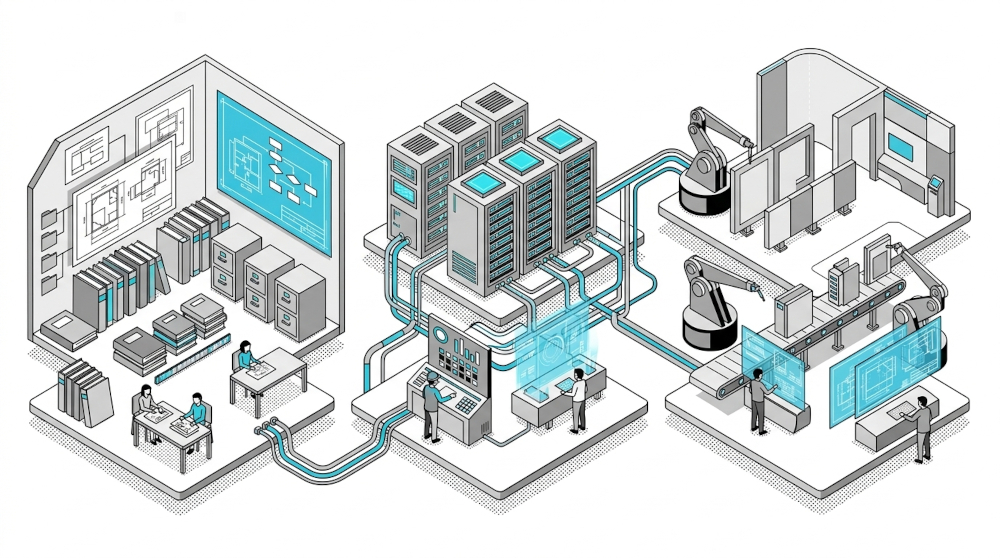
This gap exists because traditional architectures focus on what systems are rather than what systems do. Infrastructure diagrams show where workloads run. Application maps show how components are deployed. Integration diagrams show connections. None of these, on their own, capture the lived reality of execution: how business rules flow, how data is transformed, or how exceptions propagate under real conditions.
As a result, understanding system behavior remains a manual, fragile exercise. Architects rely on a mix of outdated documentation, individual expertise, and runtime troubleshooting. This approach does not scale—especially in environments where systems span decades of technology, multiple vendors, and constant regulatory change.
The absence of a dedicated layer for system understanding creates systemic risk. Decisions about modernization, integration, or compliance are made with incomplete information. Teams overcompensate with process and conservatism, slowing innovation and increasing cost.
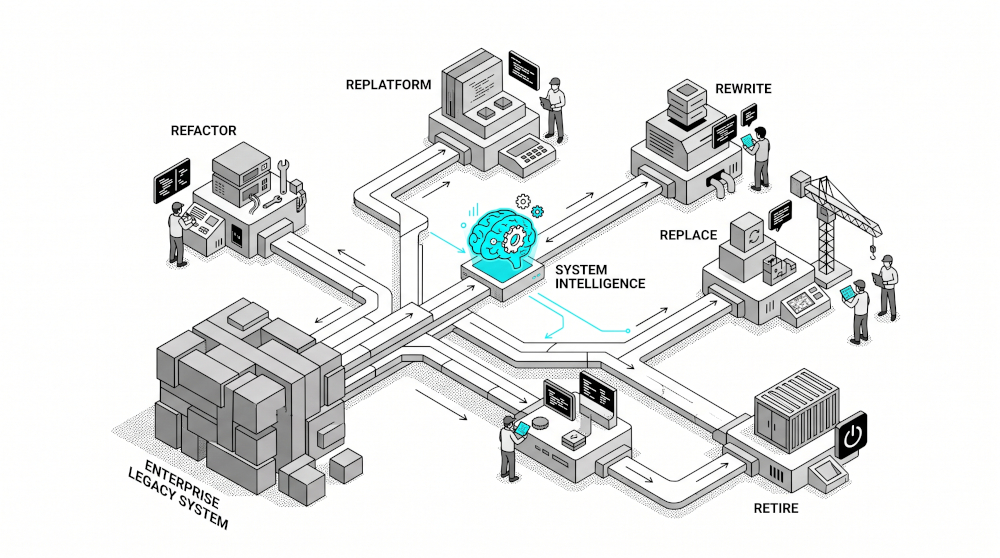
What’s missing is not another platform or framework, but an architectural primitive: a layer designed specifically to capture, maintain, and expose system intelligence. Until that layer exists, enterprises will continue to modernize technology faster than they can understand it.
From Infrastructure and Applications to Intelligence
Enterprise architecture has always evolved in response to scale and complexity. As systems grew beyond single applications and data centers, new layers emerged to manage that complexity—each addressing a specific class of problem.
Infrastructure layers abstracted hardware and enabled portability. Application layers standardized how business logic was built and deployed. Integration layers connected systems and data across organizational boundaries. Observability tools followed, providing signals about performance and availability.
Yet none of these layers were designed to preserve understanding. They optimize execution, not comprehension. They tell teams where systems run and whether they are healthy, but not why they behave the way they do.
This is the inflection point enterprises are now reaching. Modern environments are not just distributed—they are continuously changing. Cloud-native services, API ecosystems, regulatory mandates, and AI-driven automation increase the pace of change. Without a corresponding evolution in how understanding is captured, architectural complexity outpaces human cognition.
An intelligence layer is the natural next step. Just as infrastructure layers abstracted hardware, an intelligence layer abstracts behavioral knowledge. It provides a consistent way to see how systems function across legacy and modern stacks, independent of underlying technology choices.
This shift mirrors earlier architectural transitions. Enterprises once resisted infrastructure abstraction, preferring direct control. Over time, abstraction proved essential. The same pattern is emerging with system intelligence. What was once implicit and manual must now be explicit and continuously maintained.
The move toward intelligence is not about replacing existing layers. It is about complementing them—adding a foundation that allows architects, engineers, and risk teams to reason about systems with confidence.
That raises an important question: what exactly belongs in a system intelligence layer, and what does not?
What a System Intelligence Layer Is (and What It Is Not)
A system intelligence layer is often confused with existing tools that promise visibility or insight. To understand its role, it is just as important to define what it is not as it is to define what it is.
It is not documentation. Traditional documentation describes intended design at a moment in time. A system intelligence layer captures observed and validated behavior and evolves as systems change. It is living, not archival.
It is not observability or monitoring. Metrics, logs, and traces show what is happening right now. They are essential for operations, but they do not explain why systems behave the way they do across scenarios, rules, and dependencies.
It is not a modeling exercise. Static models often reflect assumptions or idealized architectures. System intelligence is grounded in actual execution paths, data transformations, and control flows.
So what is it?
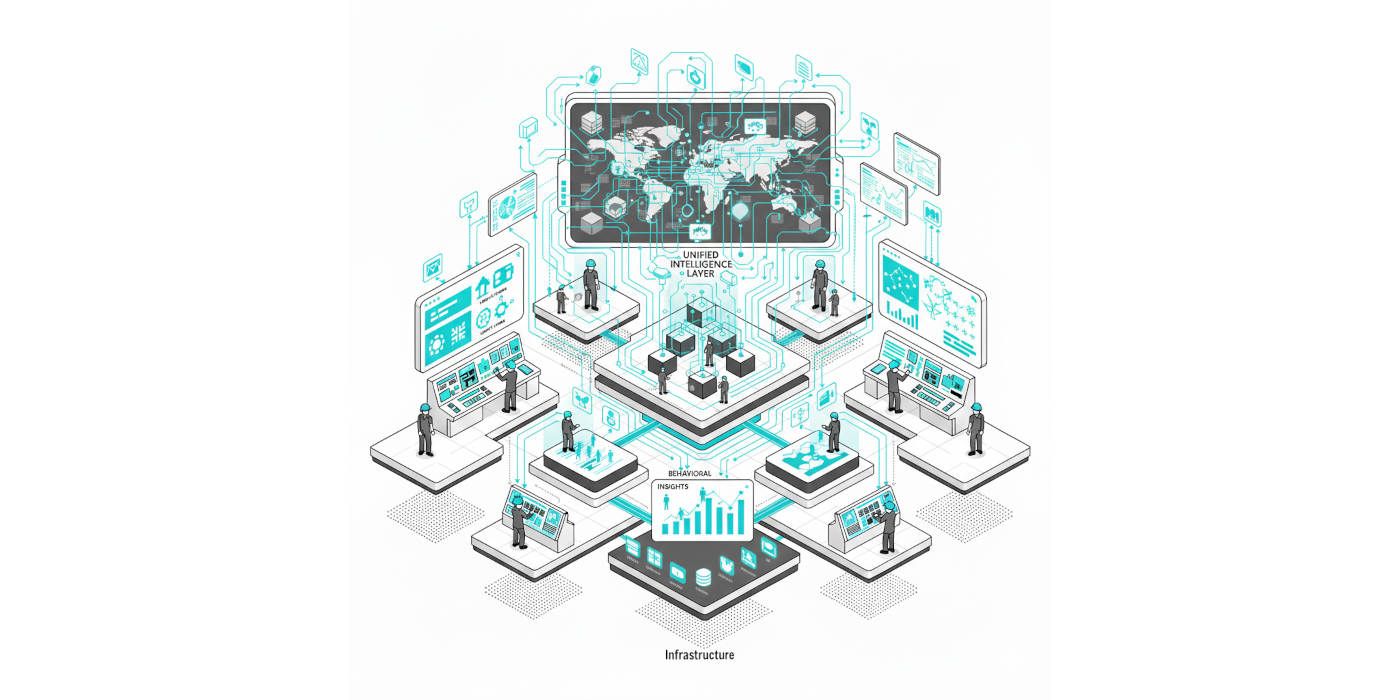
A system intelligence layer is a persistent, machine-readable representation of system behavior. It encodes how logic executes, how data moves, how components depend on one another, and how exceptions are handled—across both legacy and modern environments.
Because it is structured and queryable, this intelligence can be reused. Architects can assess change impact before making decisions. Compliance teams can trace data lineage without manual reconstruction. Developers can understand inherited systems without reverse engineering.
Most importantly, the intelligence layer is continuously updated. As code changes, integrations evolve, or regulations introduce new requirements, the intelligence reflects the current state of the system. This prevents the decay that plagues traditional artifacts.
By clearly separating intelligence from infrastructure and tooling, enterprises gain a new architectural primitive—one focused not on execution, but on understanding.
How the Intelligence Layer Sits Across Legacy and Modern Systems
One of the defining strengths of a system intelligence layer is that it is technology-agnostic. It does not replace legacy platforms or modern services, and it does not require uniform architectures to be effective. Instead, it sits across the enterprise landscape, providing a consistent lens through which behavior can be understood.
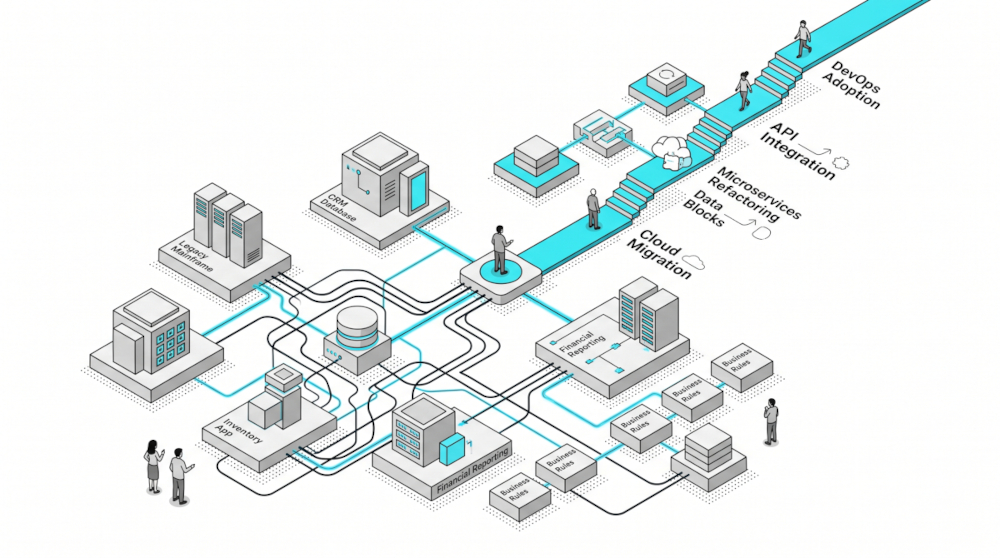
In legacy environments—mainframes, monoliths, packaged applications—the intelligence layer captures embedded business rules, batch flows, data transformations, and exception paths that are often poorly documented or entirely implicit. These systems may be stable, but their behavior is opaque. Intelligence makes them explainable without rewriting or disrupting them.
In modern environments—microservices, APIs, cloud-native platforms—the challenge is different. Behavior is distributed across many small components, each changing independently. While individual services may be well understood, their collective behavior is not. The intelligence layer connects these fragments, revealing end-to-end flows and cross-service dependencies that are otherwise difficult to reason about.
Crucially, the intelligence layer does not require architectural purity. Enterprises can modernize incrementally, coexist with multiple generations of technology, and still maintain a unified understanding of system behavior. Legacy cores, modern front ends, and third-party integrations are all represented through the same behavioral lens.
This cross-cutting position is what makes the intelligence layer so powerful. It becomes the single place where architects can see how old and new systems interact, where risk concentrates, and where modernization will have the greatest impact. Decisions are no longer made in isolation, based on partial views of the landscape.
By sitting above technology choices rather than inside them, the intelligence layer enables modernization without forcing premature standardization. It supports reality as it exists—while providing the clarity needed to evolve it safely.
Why Regulated Enterprises Need This Layer First
Regulated enterprises operate under a fundamentally different set of constraints. Change is unavoidable, but understanding must always precede action. In this environment, the absence of system intelligence is not just an efficiency problem—it is a risk exposure.
Regulators do not audit intentions or architectures; they audit behavior. They ask how data moves, where controls are enforced, how exceptions are handled, and what happens when systems fail. Answering these questions requires more than diagrams or policy statements. It requires verifiable understanding of how systems actually operate.
Without a system intelligence layer, regulated organizations rely on manual reconstruction. Compliance teams interview engineers, review code, and piece together narratives under time pressure. The process is slow, expensive, and error-prone. Worse, it introduces subjectivity into what should be objective explanations of system behavior.
As regulatory demands increase—around data privacy, resilience, financial controls, and operational transparency—the cost of this approach escalates. Each audit becomes a bespoke effort. Each system change introduces uncertainty. Risk accumulates quietly until it surfaces as findings, delays, or remediation programs.
A system intelligence layer changes this dynamic. Behavioral knowledge is continuously available and current. Data lineage can be traced without reverse engineering. Control logic can be demonstrated, not inferred. Compliance becomes an operational capability rather than a recurring fire drill.
This is why regulated enterprises often feel modernization pain first—and why they also stand to benefit most from architectural intelligence. When understanding is institutionalized, regulation stops being a drag on innovation and becomes a design constraint that can be managed proactively.
With intelligence in place, modernization is no longer something that must be paused for compliance. It becomes something that can proceed with confidence.
System Intelligence as an Enabler of Continuous Modernization
Episodic modernization is a symptom of incomplete understanding. Enterprises pause change because each initiative requires rediscovery, risk reassessment, and revalidation. A system intelligence layer removes this friction by making understanding persistent.
With intelligence in place, modernization becomes incremental. Teams can assess the impact of proposed changes before implementing them. Dependencies are visible. Behavioral risk is known. This allows organizations to modernize continuously—retiring legacy components, introducing new services, or adjusting controls without large, disruptive programs.
Continuous modernization also improves prioritization. When architects can see which parts of the system are most complex, fragile, or risk-prone, investment decisions become clearer. Effort is directed where it has the greatest impact, rather than where it is easiest to execute.
From an operational standpoint, the intelligence layer reduces the cost of change. Testing becomes more targeted because expected behaviors are explicit. Incidents are easier to diagnose because execution paths are understood. Over time, the system becomes easier to evolve, not harder.
This model aligns modernization with how enterprises actually operate. Business requirements do not arrive in five-year cycles. Regulations do not wait for transformation windows. Continuous intelligence allows technology to evolve at the pace of the business while maintaining control.
For organizations struggling with modernization fatigue, this shift is transformative. Change stops being a series of high-risk events and becomes a steady, manageable process.
This inevitably changes the role of enterprise architects and platform leaders—shifting them from documentation stewards to intelligence owners.
What Changes for Architects and Platform Leaders
The introduction of a system intelligence layer fundamentally changes the role of enterprise architects and platform leaders. Their value is no longer measured by the completeness of documentation or the elegance of target-state diagrams, but by the quality and durability of system understanding they enable.
Architects move from designing static representations to curating living intelligence. Instead of periodically updating diagrams, they ensure that behavioral knowledge remains accurate as systems evolve. This shifts architecture from a planning function to an operational one, embedded in day-to-day decision-making.
Platform leaders gain a new control surface. With intelligence in place, they can see how changes propagate across services, where dependencies concentrate, and which components pose the greatest risk. This visibility supports better governance without slowing teams down.
Decision-making becomes more evidence-based. Architects no longer rely on anecdotal knowledge or tribal memory to assess impact. They work from shared, validated intelligence that aligns technical, operational, and compliance perspectives.
This shift also improves cross-functional collaboration. When architects, engineers, and risk teams share a common understanding of system behavior, conversations move faster and with less friction. Disagreements are resolved through evidence rather than interpretation.
Ultimately, the intelligence layer elevates architecture from a supporting function to a strategic capability. It enables leaders to guide modernization with confidence, balancing innovation with control in environments where both are mandatory.
One final principle emerges from this shift: the next baseline for enterprise architecture will not be systems that merely run—but systems that can explain themselves.
The Next Architectural Baseline: Designing Systems That Explain Themselves
Enterprise architecture has always sought to reduce complexity through abstraction. The next step in that evolution is not more abstraction, but more explainability. Systems must not only execute reliably—they must be able to explain their behavior to the people who govern, change, and audit them.
Designing systems that explain themselves requires treating intelligence as a first-class architectural concern. Behavioral knowledge cannot be an afterthought or a side effect of delivery. It must be captured, maintained, and made accessible as systems evolve.
This new baseline does not replace existing architectural practices; it strengthens them. Infrastructure, application, and integration layers continue to do what they do best. The system intelligence layer sits alongside them, ensuring that understanding keeps pace with execution.
For regulated enterprises, this shift is inevitable. As systems become more complex and regulatory expectations increase, manual explanation will no longer scale. Intelligence must be institutionalized.
For architects and platform leaders, the implication is clear. The future belongs to organizations that can modernize continuously without losing control—because their systems can explain themselves.
The rise of the system intelligence layer marks a transition from architecture as design to architecture as understanding. Enterprises that adopt this mindset will not only modernize faster, but do so with confidence that persists long after individual projects end.
Most enterprise architectures explain where systems run and how they connect—but not how they actually behave. CodeAura helps enterprises and modernization partners introduce a system intelligence layer that makes behavior visible, auditable, and reusable across legacy and modern environments.