
Why “Lift-and-Shift” Is Still the Default Modernization Choice
Lift-and-shift remains the most common modernization approach not because it is technically superior, but because it appears financially safer in the short term. It promises faster timelines, lower upfront cost, and minimal disruption to business operations. For executives under pressure to modernize quickly, it looks like a controlled, reversible decision.
From a governance perspective, lift-and-shift is also easier to approve. It avoids deep changes to business logic, limits the scope of testing, and fits neatly into capital planning cycles. The narrative is simple: move the system, reduce infrastructure cost, and defer harder decisions.
This simplicity is deceptive. Lift-and-shift reduces visible transformation effort, but it does not reduce the underlying complexity of the system. It merely relocates it. What looks like progress is often a postponement of financial and operational reckoning.
Yet organizations continue to choose it because the alternative—deeper modernization—requires confidence in understanding system behavior, cost drivers, and risk exposure. When that confidence is missing, the least disruptive option wins by default.
The Hidden Financial Assumptions Behind Lift-and-Shift Decisions
Every lift-and-shift decision is based on implicit financial assumptions, even when it is framed as a technical move.
The first assumption is cost neutrality or reduction. Enterprises assume that infrastructure savings will offset migration costs. In practice, these savings are often consumed by higher operational overhead, licensing changes, and increased integration complexity.
The second assumption is risk containment. By preserving existing behavior, lift-and-shift is expected to reduce delivery risk. This overlooks the fact that behavior still changes when execution environments, scaling models, and operational tooling change—introducing new forms of risk that are rarely priced in.
The third assumption is deferral without penalty. Organizations assume they can modernize “later” without consequence. What is often ignored is the compounding cost of delay: higher integration effort, slower change velocity, and increased compliance overhead in the interim.
These assumptions are rarely tested with real system data. They are accepted because they align with short-term financial planning and minimize immediate disruption. Over time, however, they turn lift-and-shift into a financial decision with long-tail consequences that are far more expensive than anticipated.
How Lift-and-Shift Shifts Cost, Not Complexity
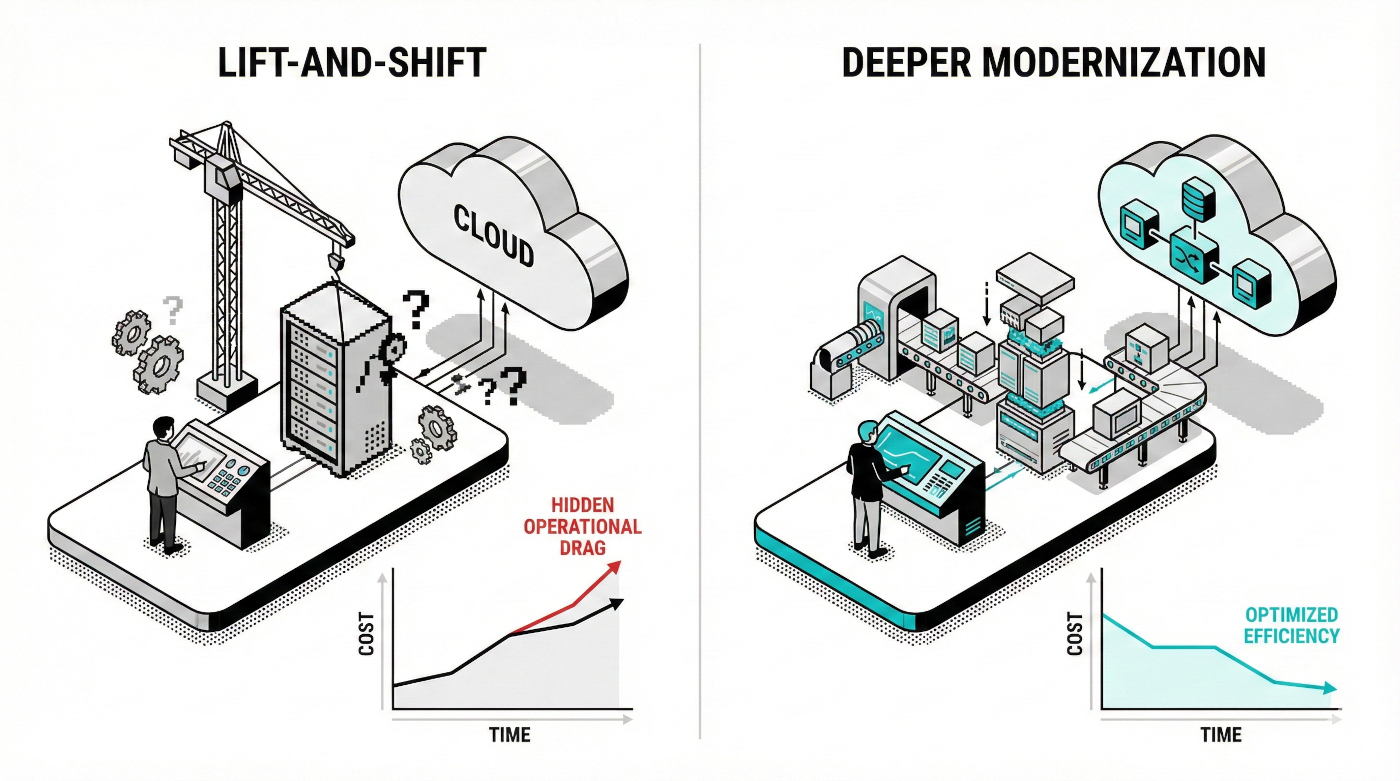
Lift-and-shift does not eliminate complexity; it redistributes it. What disappears from infrastructure line items often reappears in operations, integration, and risk management.
After migration, systems typically require more orchestration. Legacy architectures running in modern environments introduce inefficiencies: overprovisioned resources to handle peak loads, higher monitoring overhead, and increased support effort to manage behaviors that were never designed for elastic platforms. These costs are operational, ongoing, and difficult to attribute directly to the original decision.
Integration costs also rise. Lift-and-shift preserves tightly coupled logic that becomes harder to integrate with modern services and APIs. Each new integration requires custom handling, defensive testing, and manual validation. Over time, integration becomes one of the largest hidden cost centers in “modernized” environments.
From a financial perspective, this is a cost shift from CAPEX-like transformation spending to recurring OPEX. The balance sheet looks cleaner in the short term, but the income statement absorbs growing operational drag. Because these costs are diffuse, they rarely trigger a clear modernization rethink—until they become material.
Lift-and-shift feels cheaper because complexity is not removed; it is amortized quietly over time.
The Long-Term Financial Drag of Deferred Modernization
Deferring deeper modernization creates a compounding financial drag that is easy to underestimate and hard to reverse.
Each year that core logic remains unchanged, the cost of change increases. New regulations require more manual controls. New integrations require more custom work. Each incremental improvement is harder than the last because it must work around legacy constraints preserved during lift-and-shift.
This drag affects more than IT budgets. Business initiatives slow because systems are harder to adapt. Risk increases because understanding decays. Compliance costs rise because behavior must be revalidated repeatedly in environments never designed for transparency.
From a CFO’s perspective, the most dangerous aspect of deferred modernization is that it produces no single failure event. Instead, it creates a steady erosion of efficiency and optionality. Costs accumulate quietly until they constrain strategic choices.
Lift-and-shift is often justified as a temporary measure. In practice, temporary decisions have a way of becoming permanent—especially when the true cost of deferral is not visible at the time the decision is made.
When Lift-and-Shift Actually Makes Financial Sense
Despite its drawbacks, lift-and-shift is not inherently a bad decision. In certain scenarios, it can be financially rational—provided its limitations are acknowledged upfront.
Lift-and-shift makes sense when the primary objective is time-bound risk reduction, such as exiting an expiring data center contract or responding to an urgent regulatory or operational mandate. In these cases, speed and certainty outweigh long-term optimization.
It can also be appropriate for systems with limited remaining lifespan. If a platform is scheduled for retirement or replacement within a clearly defined window, investing in deep modernization may not produce sufficient return.
Another valid scenario is cash flow constraint. When capital availability is limited, lift-and-shift can preserve optionality by deferring larger investments. The key is ensuring that the deferral is intentional and governed—not accidental.
In all of these cases, the decision succeeds only if enterprises explicitly plan for what comes next. Lift-and-shift should be treated as a financial bridge, not a destination.
Why Deeper Modernization Requires Better Financial Visibility
The challenge with deeper modernization is not just technical complexity—it is financial uncertainty. CFOs are reluctant to approve investments when costs, risks, and timelines are poorly understood.
Deeper modernization changes business logic, integration patterns, and operational models. Without clear visibility into system behavior and dependencies, estimating impact is speculative. This uncertainty pushes leaders toward safer-looking options, even when they are more expensive in the long run.
Financial visibility depends on understanding where complexity truly lives, which components drive cost and risk, and how changes propagate across the system. Without this insight, modernization decisions are made on intuition rather than evidence.
This is why many enterprises stall between lift-and-shift and deeper transformation. They know the shallow path is suboptimal, but they lack the confidence to pursue something better.
Improving financial visibility is the prerequisite for rational modernization decisions—and that visibility starts with system intelligence.
How System Intelligence Enables Better Capital Allocation Decisions
System intelligence changes modernization from a speculative investment into an analyzable one. By making system behavior, dependencies, and change impact visible, it provides the missing inputs CFOs need to evaluate modernization options with confidence.
With intelligence in place, enterprises can see which components are truly high-cost or high-risk, and which are stable candidates for deferral. Modernization investment can be targeted where it produces the greatest financial return, rather than spread evenly or driven by architectural ideology.
This clarity improves capital efficiency. Instead of funding broad, multi-year programs based on rough estimates, leaders can sequence investments incrementally. Each decision is informed by evidence about operational drag, compliance exposure, and integration cost—not assumptions.
System intelligence also supports better trade-off analysis. CFOs can compare the long-term cost of lift-and-shift against the upfront investment of deeper modernization using real system data. Capital allocation becomes a strategic exercise, not a forced compromise.
Modernization Strategy as Portfolio Management, Not Project Delivery
The most mature enterprises no longer view modernization as a single project to complete. They manage it as a portfolio of assets, each with its own risk profile, cost structure, and return horizon.
In this model, lift-and-shift, refactoring, replacement, and retirement coexist. Decisions are revisited as conditions change. Modernization becomes an ongoing discipline aligned with financial planning cycles, not a one-time disruption.
System intelligence is what makes this approach viable. It provides a consistent basis for evaluating assets over time, tracking how risk and cost evolve, and adjusting investment accordingly. Without it, portfolio management collapses back into episodic projects driven by urgency rather than strategy.
For CFOs and executive sponsors, this reframing is critical. Modernization stops being an IT initiative and becomes a form of capital stewardship—one that balances near-term constraints with long-term value creation.
Short-term savings can create long-term drag.