
Why Most Consulting Firms Lose Money on Legacy Modernization (Even When Projects Succeed)
The Profitability Myth in Legacy Modernization
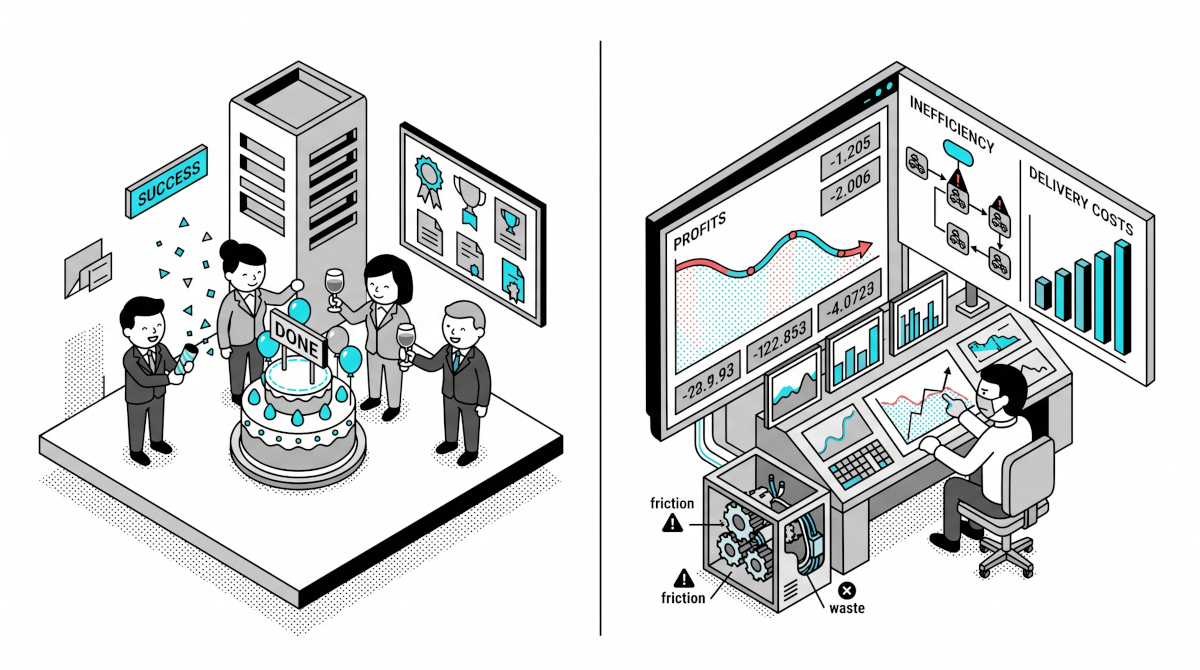
Most consulting firms believe they are making money on legacy modernization projects.
After all, the signals look strong—multi-million dollar contracts, fully staffed teams, and delivery milestones consistently met. From the outside, these engagements appear to be some of the most reliable revenue engines in a consulting portfolio.
But revenue is not margin.
And in legacy modernization, that distinction is where profitability quietly breaks down.
Across banking, healthcare, and manufacturing environments, firms are successfully delivering complex transformation programs—modernizing COBOL systems, migrating monoliths, and enabling cloud readiness. On paper, these are wins. Projects are completed. Clients are satisfied. Case studies are written.
Yet beneath that surface, a different story is unfolding.
Margins are shrinking. Senior talent is overutilized in low-leverage work. Timelines stretch beyond initial estimates. And the hidden cost of understanding legacy systems continues to compound across every phase of delivery.
This is the uncomfortable reality: many consulting firms are losing money on legacy modernization projects—even when those projects are delivered successfully.
The issue isn’t execution failure. It’s economic inefficiency.
Legacy systems introduce a unique kind of opacity—one that obscures effort, inflates uncertainty, and quietly erodes profitability in ways traditional delivery models were never designed to handle. What looks like a high-value engagement often carries invisible operational drag that never fully surfaces in standard P&L reporting.
And because these inefficiencies are normalized—accepted as “part of the process”—they rarely trigger strategic change.
Instead, firms double down. More hours. More senior oversight. More buffer built into future estimates.
But none of that fixes the core problem.
Because the real challenge in legacy modernization isn’t delivering the project.
It’s delivering it profitably.
Why Strong Revenue Numbers Mask Weak Margins
On the surface, legacy modernization projects look like some of the most financially attractive engagements in a consulting firm’s portfolio.
Deal sizes are large—often ranging from $500K to $5M+. Engagements span months, sometimes years. Billable utilization appears healthy, with teams fully allocated and revenue recognized consistently over time.
By every traditional metric, these projects signal success.
But those metrics are misleading.
Revenue, especially in long-running transformation programs, creates a false sense of financial security. It tells you how much work is being billed—not how efficiently that work is being delivered. And in legacy environments, efficiency is where profitability quietly collapses.
The core issue is this: legacy modernization inflates effort in ways that aren’t immediately visible in financial reporting.
Hours get logged. Milestones get met. But beneath that, delivery teams are absorbing hidden friction at nearly every stage of the project lifecycle.
Discovery takes longer than expected because systems lack documentation.
Development slows down as engineers struggle to interpret decades-old logic.
Testing cycles expand due to misunderstood dependencies.
None of these issues stop the project.
But all of them increase the cost of delivering it.
And because most consulting firms operate on fixed bids or tightly scoped estimates, that additional effort doesn’t translate into additional revenue. It comes directly out of margin.
This is where the illusion breaks.
A project that appears to generate a 30–40% margin at the proposal stage can quietly degrade into a 10–15% margin—or worse—by the time it’s delivered. In some cases, once senior talent overages and rework cycles are fully accounted for, profitability approaches zero.
What makes this especially dangerous is that these losses are rarely obvious.
They don’t show up as failed projects. They don’t trigger client escalations. And they don’t always surface in post-project reviews, because the delivery itself is still considered successful.
Instead, they accumulate silently across engagements—gradually eroding the firm’s overall profitability while leadership continues to view legacy modernization as a high-performing service line.
This is why many firms don’t realize there’s a problem.
Because they’re measuring the wrong thing.
Legacy modernization doesn’t fail loudly.
It succeeds quietly—while margins disappear underneath it.
The Hidden Cost Centers Draining Consulting Profitability
If margin erosion in legacy modernization were caused by a single issue, it would be easier to detect—and fix.
But that’s not how it happens.
Instead, profitability is chipped away by a set of persistent, compounding cost centers that are embedded directly into how these projects are delivered. Each one, on its own, seems manageable. Together, they create a systemic drag on margins that most firms underestimate.
These are not edge cases. They are structural realities of working with legacy systems.
And they show up in nearly every engagement.
Discovery Chaos (Unclear Scope)
Legacy systems rarely come with clean documentation. In many cases, what exists is outdated, incomplete, or entirely missing.
Teams are forced to reverse-engineer the system just to understand what they’re working with.
Dependencies are unclear. Data flows are hidden. Business rules are buried deep inside decades-old code. What should be a defined discovery phase turns into an open-ended investigation.
This creates immediate downstream impact:
- Initial estimates are based on partial understanding
- Scope expands as new dependencies are uncovered
- Change requests become reactive rather than strategic
It’s not uncommon for 40% or more of a legacy system to be effectively undocumented, forcing teams to learn the system while actively delivering against it.
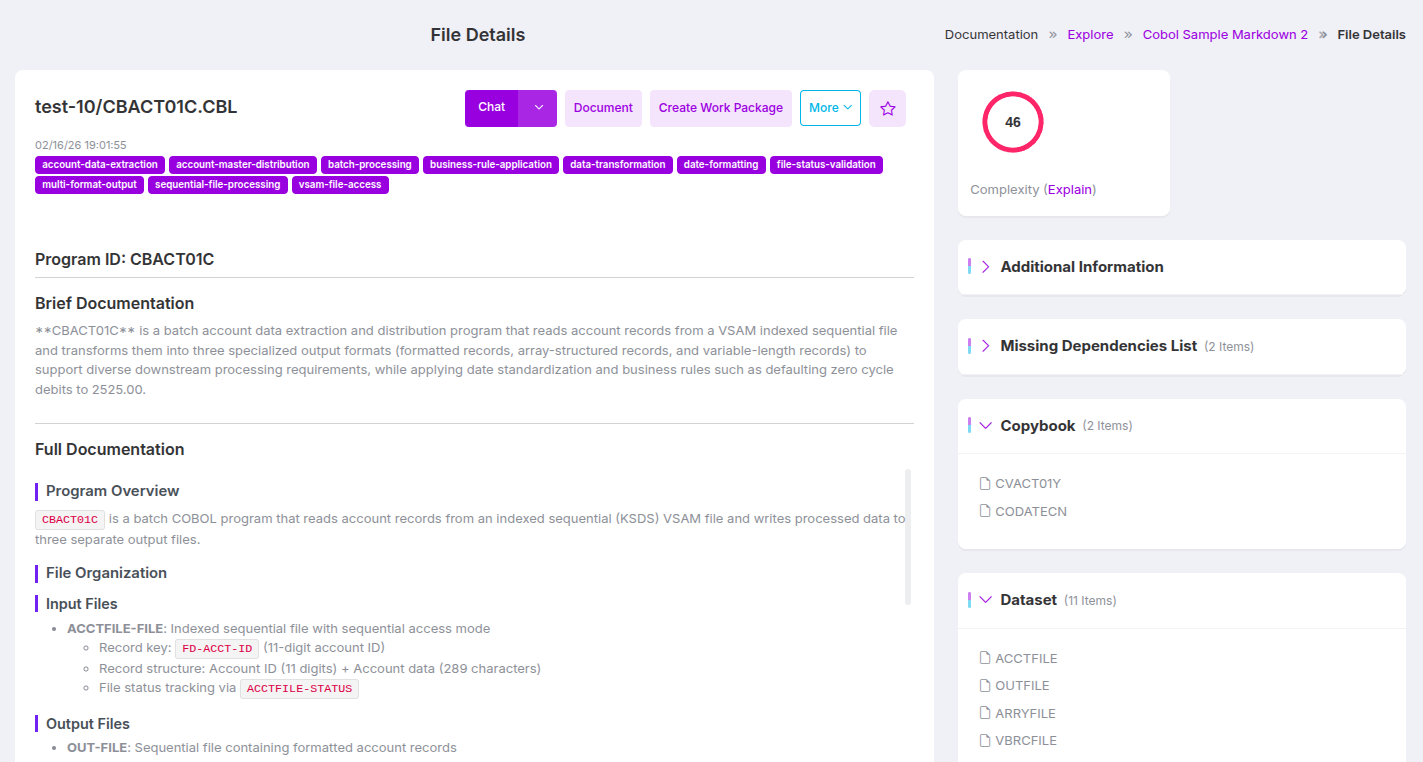
Instead of spending weeks reverse-engineering systems, teams can generate structured documentation in minutes.
Senior Talent Doing Low-Leverage Work
Legacy projects demand experience—but they often misuse it.
Highly paid senior engineers and architects spend a disproportionate amount of time on tasks that don’t scale:
- Reading and interpreting legacy code
- Debugging unfamiliar logic
- Explaining system behavior to the rest of the team
This is necessary work—but it’s also low-leverage.
Every hour spent decoding legacy logic is an hour not spent designing target architecture, accelerating migration, or delivering client value. Over time, this imbalance creates two major risks:
- Margin erosion from over-reliance on expensive resources
- Burnout and attrition among your most critical talent
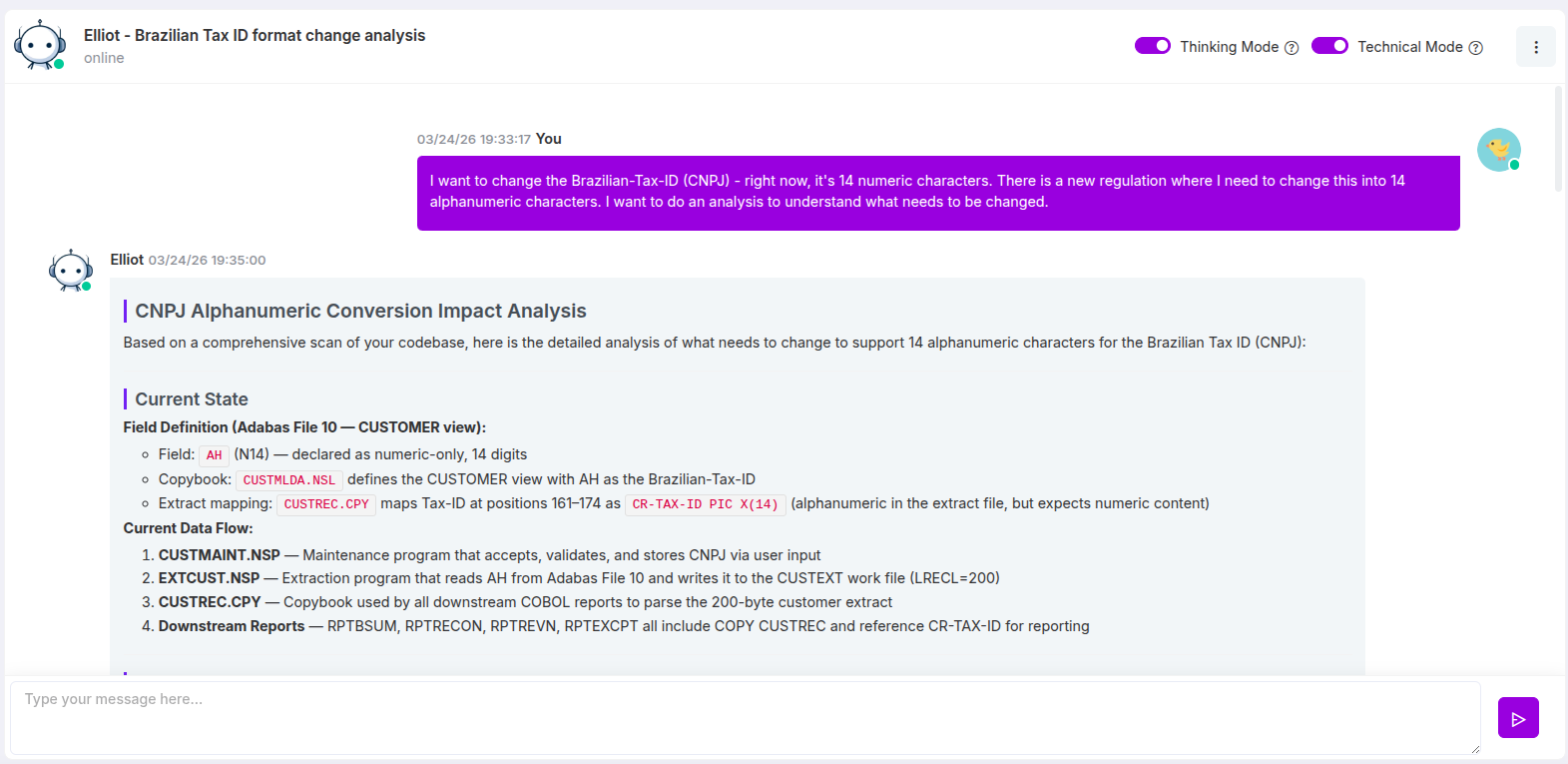
Instead of relying on senior engineers to explain legacy logic, teams can query the system directly.
Rework from Misunderstood Logic
In legacy environments, business logic is rarely documented in a way that aligns with how modern teams think.
It’s embedded in code—often fragmented across modules, written in outdated paradigms, and shaped by years of incremental changes.
The result: teams move forward with incomplete or incorrect assumptions.
This leads to:
- Features being rebuilt after validation failures
- Increased QA cycles due to unexpected behavior
- Delays caused by backtracking and correction
Rework is one of the most expensive forms of inefficiency—and in legacy modernization, it’s often unavoidable without deeper system understanding upfront.
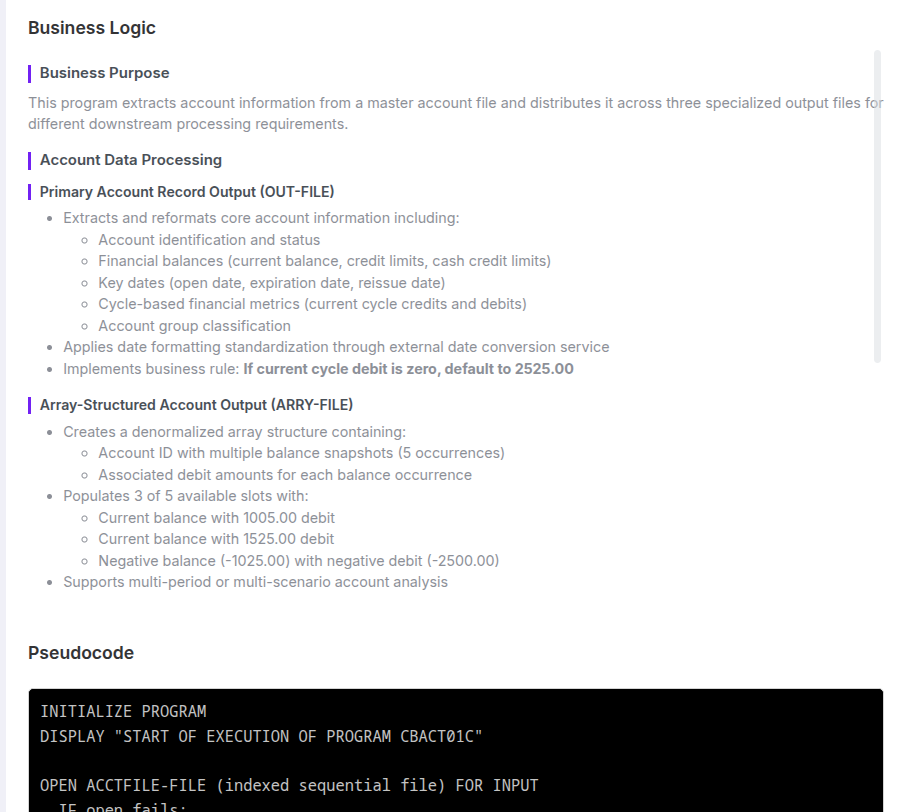
By extracting business logic upfront, teams reduce rework and avoid costly misinterpretations.
Dependency on Tribal Knowledge
In many legacy environments, the system isn’t documented—it’s remembered.
Critical knowledge lives with a small number of individuals who have worked on the system for years, sometimes decades. They understand edge cases, hidden dependencies, and undocumented workflows that no one else can easily access.
This creates a fragile operating model:
- Delivery bottlenecks around key individuals
- Increased risk when those individuals are unavailable
- Knowledge loss due to attrition or retirement
In regulated industries already facing a shrinking pool of legacy-skilled engineers, this risk is accelerating.
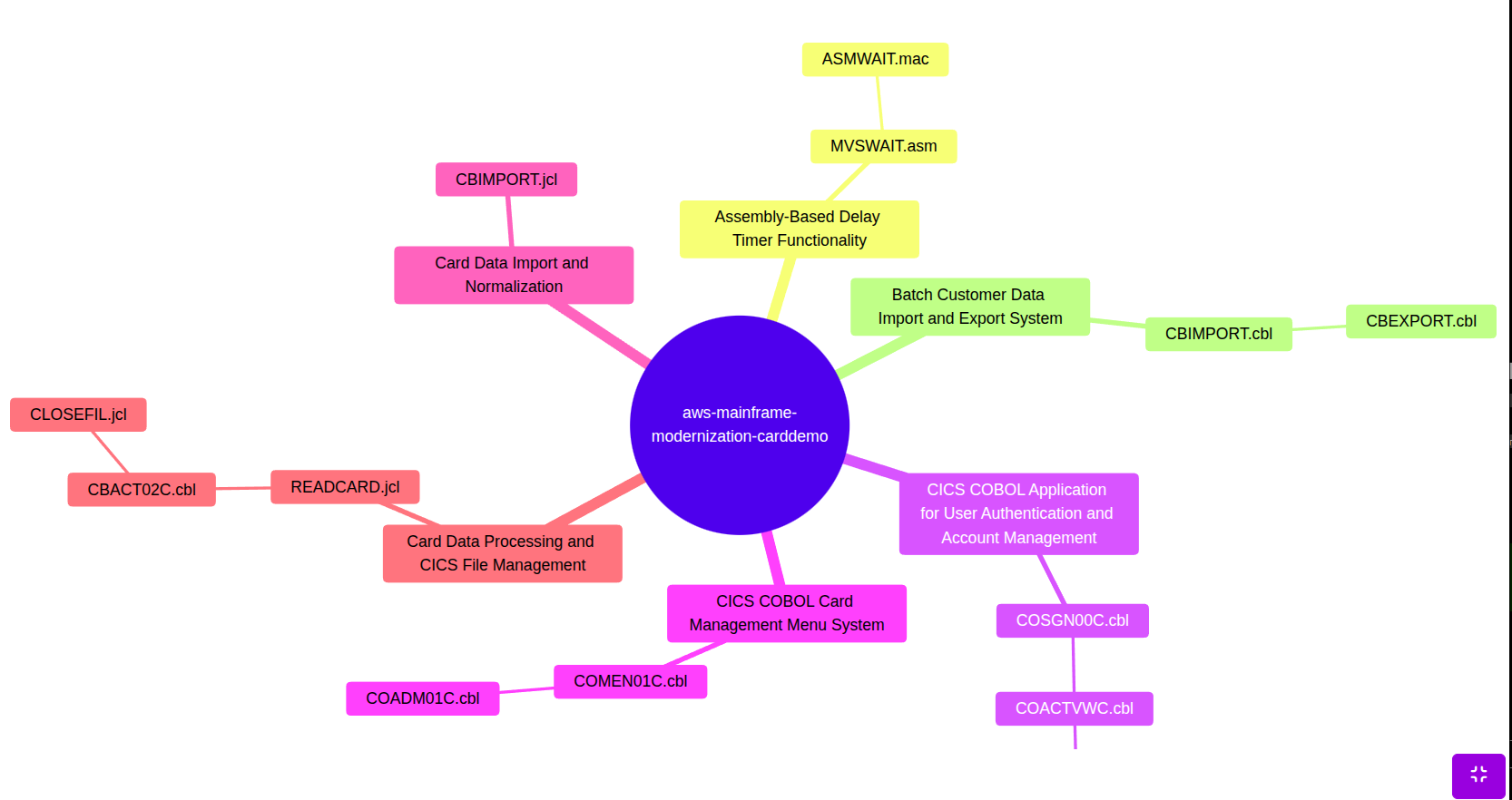
Instead of relying on individuals, firms can build a persistent, searchable system intelligence layer.
These four cost centers don’t just exist independently—they interact.
Discovery gaps increase reliance on senior talent.
Misunderstood logic drives rework.
Tribal knowledge slows everything down.
And none of it is fully visible in traditional delivery metrics.
Which is why firms continue to underestimate their impact.
The Compounding Effect (Where Margins Actually Disappear)
Individually, each inefficiency in a legacy modernization project can be explained away.
Discovery takes a little longer than expected.
A few additional senior resources are pulled in.
Testing cycles expand slightly.
None of these, in isolation, trigger alarm.
But legacy modernization is not impacted by isolated inefficiencies—it is shaped by how these inefficiencies compound over time.
This is where margins don’t just shrink. They collapse.
What begins as a well-scoped, high-margin engagement gradually absorbs incremental cost at every stage of delivery:
- Discovery overruns add 15–25% more effort before development even begins
- Misinterpreted logic introduces 10–20% rework during build phases
- Dependency gaps extend QA and integration timelines by another 10–15%
These percentages rarely appear in a single report. They are distributed across phases, teams, and timelines.
But when combined, the impact is significant.
A project initially modeled at a 30% margin can quickly degrade:
- Additional discovery effort reduces margin to ~22%
- Rework cycles bring it down to ~15%
- Delays and extended staffing push it into the 5–10% range
And in some cases, especially where fixed pricing is involved, profitability approaches zero—or turns negative.
What makes this dynamic particularly dangerous is that it unfolds gradually and invisibly.
There is no single moment where the project “fails.”
No clear signal that margin has been compromised beyond recovery.
Instead, the erosion is normalized.
Teams adapt. Leaders accept overruns as part of the process. Future projects are scoped with more buffer—but the underlying inefficiencies remain unchanged.
Over time, this creates a structural problem:
Firms are not just losing margin on one project.
They are institutionalizing a delivery model where margin erosion is expected.
And once that expectation is built into how projects are planned and executed, it becomes incredibly difficult to reverse.
Because the issue is no longer project-level.
It’s systemic.
What High-Performing Consulting Firms Do Differently
The firms that consistently protect—and expand—their margins in legacy modernization are not approaching these projects the same way as everyone else.
They are not relying on more experienced teams, longer timelines, or more conservative estimates.
They are changing the delivery model itself.
At a fundamental level, these firms recognize that legacy modernization is not just a technical execution problem—it is an information problem. The faster a team can understand a system, the more efficiently it can transform it. And efficiency, not effort, is what ultimately drives margin.
This shift leads to a different set of operating principles.
First, they prioritize understanding before execution.
Instead of treating discovery as a preliminary phase to move through quickly, they treat it as a strategic lever. The goal is not just to scope the system, but to build a usable, structured understanding of it—one that can be reused across the entire lifecycle of the project.
This reduces ambiguity early, which directly limits downstream rework, delays, and dependency surprises.
Second, they reduce reliance on individual expertise.
Traditional models depend heavily on senior engineers to interpret systems and guide teams. High-performing firms move away from this dependency by externalizing system knowledge—making it accessible, searchable, and reusable across the team.
This allows junior and mid-level engineers to operate with greater autonomy, while senior talent focuses on high-value architectural and strategic work.
The result is not just better efficiency—it is a fundamentally different cost structure.
Third, they treat documentation as an asset, not a byproduct.
In most engagements, documentation is created after the fact—if at all. Leading firms invert this approach. They generate and maintain documentation continuously, using it as a foundation for decision-making, onboarding, and validation.
This transforms documentation from a static deliverable into an active component of delivery.
Fourth, they introduce automation into the earliest stages of the lifecycle.
Rather than applying automation only during migration or testing, they apply it during discovery and analysis—where the highest uncertainty exists. By reducing the manual effort required to interpret legacy systems, they eliminate one of the largest sources of hidden cost.
The cumulative effect of these changes is significant.
Projects move faster—not because teams are working harder, but because they are working with clarity.
Rework decreases because decisions are made with better system visibility.
Senior talent is used more strategically, improving both margin and retention.
Most importantly, profitability becomes predictable.
These firms are no longer absorbing the inefficiencies of legacy systems—they are systematically removing them from the delivery process.
And that is what separates high-performing consulting organizations from the rest.
Where CodeAura Fits
The firms that are protecting—and expanding—their margins are not doing so by increasing effort.
They are doing it by changing how knowledge is created, accessed, and applied throughout the modernization lifecycle.
This is where CodeAura becomes a strategic layer in delivery.
Instead of treating legacy systems as opaque, high-risk environments that require manual interpretation, CodeAura introduces a structured, AI-driven understanding of those systems from the outset. It transforms how teams approach discovery, development, and migration—by making system intelligence immediately accessible and continuously usable.
At the front of every legacy project is the discovery problem.
Unclear scope, undocumented systems, and hidden dependencies create uncertainty that cascades throughout delivery. CodeAura addresses this directly through AI-generated documentation—producing system-level and function-level insights that would traditionally take weeks to assemble.
The impact is immediate:
- Faster, more accurate scoping
- Reduced ambiguity in early-stage planning
- Less reliance on assumptions that lead to downstream rework
As projects move into execution, the next constraint emerges—how teams access and use system knowledge.
Instead of routing every question through senior engineers, CodeAura provides a centralized knowledge layer that teams can interact with directly. Engineers can query the system, understand logic, and trace dependencies without interrupting critical resources.
This shifts how talent is utilized:
- Senior engineers focus on architecture and decision-making
- Delivery teams move faster with less friction
- Knowledge becomes scalable, not bottlenecked
Rework, one of the most expensive forms of margin loss, is addressed through early visibility into business logic.
By extracting and structuring logic from legacy code, CodeAura enables teams to validate assumptions before development begins. This reduces misinterpretation, shortens QA cycles, and limits the need for costly rework late in the project.
Finally, CodeAura eliminates one of the most persistent risks in legacy modernization: dependency on tribal knowledge.
By creating a persistent, searchable system intelligence layer, firms no longer rely on a small number of individuals to interpret critical systems. Knowledge is retained, shared, and reused across projects—reducing delivery risk and improving long-term operational resilience.
The result is not just better execution.
It is a measurable shift in business outcomes:
- Reduced discovery time
- Improved resource efficiency
- Lower rework rates
- More predictable delivery margins
CodeAura does not replace consulting expertise.
It amplifies it—by removing the inefficiencies that have historically made legacy modernization unpredictable and margin-intensive.
And in doing so, it enables firms to operate with a level of precision that traditional delivery models cannot achieve.
Reframe the Narrative
Legacy modernization has long been treated as a technical challenge.
Outdated systems. Aging languages. Complex migrations.
But for consulting firms, that framing is incomplete.
Because the real challenge is not whether these projects can be delivered.
It is whether they can be delivered profitably.
For years, the industry has optimized around execution—better project management, more experienced teams, tighter timelines. And while those improvements matter, they do not address the underlying issue: a delivery model built for systems that are fully understood, applied to systems that are not.
That mismatch is where margins disappear.
The firms that will lead the next decade of modernization are not the ones that simply deliver successful transformations. They are the ones that redesign how those transformations happen—embedding intelligence, automation, and system-level visibility into every stage of delivery.
They shift from effort-based models to insight-driven ones.
From reactive problem-solving to proactive system understanding.
From relying on individuals to building scalable knowledge systems.
This is not a marginal improvement.
It is a structural advantage.
Because as regulatory pressure increases, legacy systems become more complex, and experienced talent becomes harder to find, the cost of inefficiency will only grow. Firms that continue to operate with opaque systems and manual discovery processes will see margins compress further—regardless of how strong their delivery capabilities are.
The opportunity, then, is not just to modernize systems.
It is to modernize the economics of how that work is done.
The question is no longer:
Can you deliver legacy modernization projects successfully?
It is:
Can you do it in a way that protects—and expands—your margins?
If you are running legacy modernization engagements today, that is the question that matters most.