
Refactoring vs Replatforming vs Rewriting: Choosing the Right Modernization Strategy
The Cost of Choosing the Wrong Modernization Strategy
Most legacy modernization initiatives do not fail because of poor engineering execution. They fail much earlier—at the point of strategy selection.
Choosing between refactoring, replatforming, and rewriting is not a technical preference. It is a decision that directly shapes cost structures, delivery timelines, operational risk, and ultimately, business outcomes. Yet in many enterprises, this decision is made with incomplete information, internal bias, or urgency-driven assumptions.
The consequences are significant. A rewrite chosen too early can spiral into multi-year delays and budget overruns. A replatforming effort that ignores deeply embedded inefficiencies can carry forward the very problems it was meant to solve. Even refactoring, often seen as the safest option, can become an endless cycle of incremental changes without delivering meaningful transformation.
In regulated industries such as banking, healthcare, and manufacturing, the stakes are even higher. Modernization decisions are not isolated IT initiatives—they are tightly coupled with compliance mandates, audit readiness, and operational continuity. A misstep does not just impact delivery timelines; it can introduce regulatory exposure and business disruption.
What makes this more challenging is that many organizations default to what they know. Teams experienced in cloud migrations may lean toward replatforming. Engineering-led organizations may favor rewriting for architectural purity. Risk-averse environments may default to refactoring. In each case, the strategy is chosen based on familiarity rather than fit.
This is where modernization efforts begin to drift. Strategy becomes a reflection of internal comfort zones instead of an informed response to system realities.
The result is predictable: rework, escalating costs, missed deadlines, and in some cases, complete project failure.
The critical insight is simple but often overlooked—modernization success is not determined by how well a strategy is executed, but by whether the right strategy was chosen in the first place.
Why Legacy Modernization Decisions Are Inherently Complex
If choosing the right modernization strategy were straightforward, failure rates would not be as high as they are. The reality is that most organizations are making decisions in environments filled with uncertainty, incomplete visibility, and competing constraints.
Legacy systems are rarely well understood. In many enterprises, core platforms have evolved over decades, shaped by multiple teams, shifting business requirements, and layers of undocumented changes. What exists today is not just code—it is an accumulation of institutional knowledge, workarounds, and critical business logic that is often invisible on the surface.
This lack of clarity creates a fundamental challenge: you cannot confidently choose how to modernize a system you do not fully understand.
Compounding this issue is the hidden nature of business logic. In regulated industries especially, systems often encode rules tied to compliance, reporting, and operational workflows. These rules are not always documented in specifications—they live inside the code. A seemingly simple change or migration decision can unintentionally disrupt critical processes if these dependencies are not identified upfront.
At the same time, organizations are balancing multiple pressures. Budgets are constrained. Timelines are aggressive. Regulatory requirements continue to evolve. Leadership expects modernization to deliver both cost savings and innovation, often within the same initiative. These competing priorities make it difficult to objectively evaluate which strategy—refactoring, replatforming, or rewriting—is the best fit.
There is also a structural challenge. Different stakeholders view modernization through different lenses. CTOs may prioritize architectural flexibility. CFOs focus on cost predictability. CROs emphasize risk and compliance exposure. Each perspective is valid, but without a shared understanding of the system, alignment becomes difficult and decisions become fragmented.
In this environment, strategy selection often becomes reactive rather than informed. Teams rely on partial data, assumptions, or prior experience instead of a comprehensive view of the system landscape.
This is why modernization decisions feel inherently complex—not because the strategies themselves are difficult to understand, but because the context in which they are applied is deeply uncertain.
Until that uncertainty is addressed, every strategy carries hidden risk.
Refactoring, Replatforming, and Rewriting—What They Really Mean
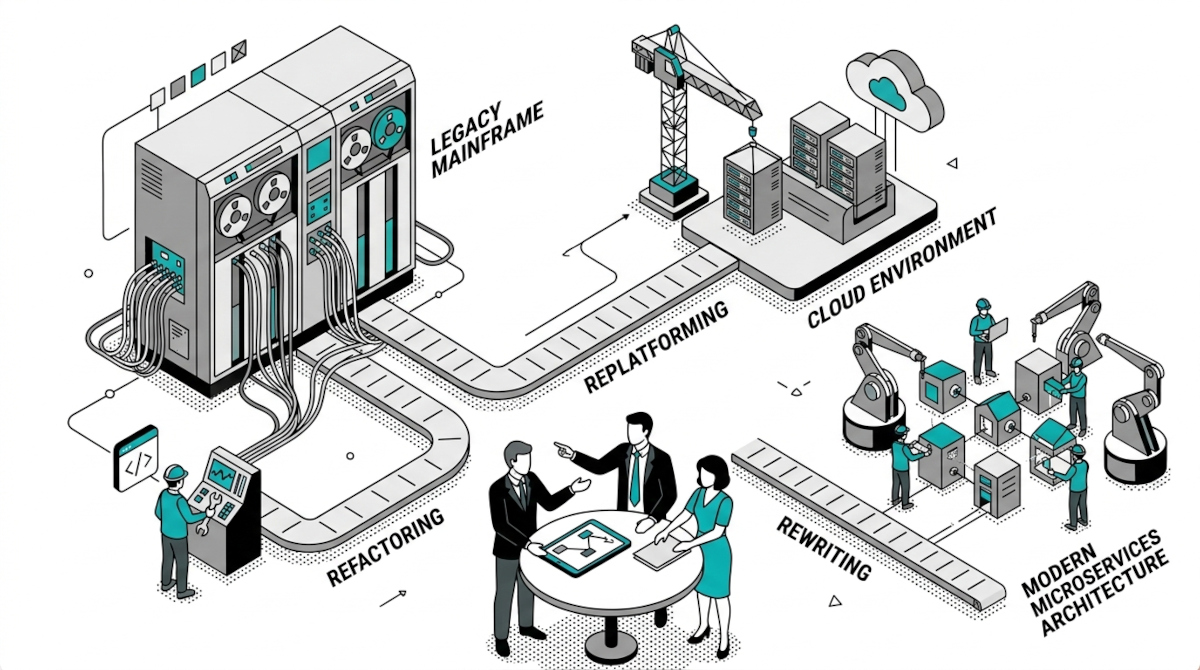
At a high level, refactoring, replatforming, and rewriting are often presented as straightforward options. In practice, each represents a fundamentally different approach to risk, investment, and transformation depth. Understanding what they actually involve is critical before making any strategic decision.
Refactoring
Refactoring focuses on improving the internal structure of an existing system without altering its core functionality. The goal is to make the codebase cleaner, more maintainable, and easier to extend—while preserving the business logic that already works.
This approach is typically best suited for systems where the underlying logic is still valuable and aligned with current business needs. In these cases, the risk of changing behavior outweighs the benefits of starting over.
The primary advantage of refactoring is its relatively low risk profile. Because the system’s functionality remains intact, organizations can make incremental improvements without disrupting operations. It is also generally faster and less costly than a full rebuild.
However, refactoring has its limitations. It does not eliminate all technical debt—it restructures it. Over time, incremental improvements can slow down, especially if deeper architectural issues remain unresolved. Without clear visibility into dependencies, even refactoring efforts can introduce unintended complexity.
Replatforming
Replatforming involves moving an existing system to a modern infrastructure environment—most commonly the cloud—while making minimal changes to the application itself. The focus here is on improving scalability, performance, and operational efficiency rather than transforming core logic.
This strategy is often chosen when infrastructure constraints are the primary bottleneck. Organizations looking to reduce mainframe costs, improve deployment flexibility, or enable better integration with modern services frequently consider replatforming as a middle-ground approach.
One of its key advantages is speed. Compared to rewriting, replatforming can deliver faster time-to-value, particularly when infrastructure modernization is the immediate priority. It also unlocks benefits such as improved resilience and scalability.
The trade-off is that existing inefficiencies are often carried forward. If the underlying architecture or business logic is outdated, replatforming alone will not address those issues. In many cases, it becomes a stepping stone rather than a complete solution.
From a cost perspective, replatforming typically sits in the mid-range—more investment than refactoring, but significantly less than a full rewrite.
Rewriting
Rewriting is the most transformative—and most demanding—approach. It involves rebuilding the system from the ground up using modern architectures, frameworks, and design principles.
This strategy is most appropriate when existing systems are no longer viable—either due to extreme technical debt, lack of scalability, or misalignment with current business requirements. It offers the opportunity to design a clean, future-ready architecture without legacy constraints.
The benefits are substantial. A successful rewrite can deliver maximum flexibility, improved performance, and long-term maintainability. It enables organizations to fully align their systems with modern development practices and evolving business needs.
However, rewriting carries the highest level of risk. It requires a deep and accurate understanding of existing business logic—something many organizations lack. Without this understanding, critical functionality can be lost or misinterpreted during the rebuild.
It is also the most resource-intensive option. Rewrites demand significant time, budget, and coordination across teams. Delays and scope expansion are common, especially when hidden dependencies surface mid-project.
Each of these strategies is valid. None is inherently superior. The effectiveness of any approach depends entirely on context—system maturity, business priorities, risk tolerance, and most importantly, how well the existing system is understood.
A Practical Comparison: Speed, Cost, Risk, and Outcomes
Understanding the definitions of refactoring, replatforming, and rewriting is only the first step. The real challenge for decision-makers is evaluating how these strategies compare in practical, business-relevant terms.
At the executive level, modernization decisions are rarely about code—they are about trade-offs. How quickly can value be delivered? What level of investment is required? How much risk can the organization absorb? And what kind of outcome is expected?
A side-by-side comparison helps clarify these dimensions.
| Strategy | Speed | Cost | Risk | When to Use |
|---|---|---|---|---|
| Refactoring | Medium | Low–Medium | Low | Preserve stable, valuable logic |
| Replatforming | Fast–Medium | Medium | Medium | Improve infrastructure and scalability |
| Rewriting | Slow | High | High | Enable full transformation |
Refactoring sits at the lower end of the risk spectrum. It allows organizations to improve systems incrementally while maintaining operational continuity. This makes it particularly attractive in regulated environments where stability is critical. However, the trade-off is that transformation is gradual, and deeper architectural limitations may persist.
Replatforming accelerates time-to-value by addressing infrastructure constraints without requiring a full rebuild. It is often the fastest way to unlock cloud benefits such as scalability and resilience. That said, it introduces moderate risk—particularly if hidden dependencies or performance bottlenecks are carried into the new environment.
Rewriting, while offering the most transformative potential, fundamentally changes the risk profile. It demands significant upfront investment and long timelines, with outcomes that are highly dependent on execution quality and system understanding. For organizations seeking a complete reset, it can be the right choice—but it is rarely the safest or fastest path.
What becomes clear in this comparison is that there is no universally “best” strategy. Each option optimizes for different priorities. Speed often comes at the expense of depth. Lower risk may limit transformation. Greater flexibility typically requires higher investment.
This is where many organizations struggle. Without a clear understanding of their system and constraints, these trade-offs are evaluated in isolation, leading to decisions that look reasonable on paper but fail in execution.
The goal is not to find the perfect strategy—it is to find the strategy that aligns with the reality of the system and the priorities of the business.
The Hidden Variable: Understanding Your Existing System
All three modernization strategies—refactoring, replatforming, and rewriting—can succeed. All three can also fail. The difference rarely lies in the strategy itself. It lies in one overlooked variable: how well the existing system is understood.
In most enterprises, legacy systems are only partially visible. Documentation is outdated or missing. Key developers have moved on. Business logic is embedded deep within the codebase, often intertwined with decades of incremental changes. What appears to be a stable system on the surface is, in reality, a complex web of dependencies and implicit rules.
This creates a dangerous illusion. Teams believe they understand the system well enough to make strategic decisions, when in fact, critical components remain hidden.
Industry estimates suggest that more than 40% of enterprise systems contain undocumented components. This lack of visibility is not just a technical inconvenience—it is a direct source of risk. Every unknown dependency increases the likelihood of failure during modernization, regardless of the chosen approach.
For example, a refactoring effort may unintentionally disrupt tightly coupled modules. A replatforming initiative might expose performance bottlenecks that were previously masked by legacy infrastructure. A rewrite could miss essential business rules that were never formally documented but are critical to operations and compliance.
In regulated industries, this risk is amplified. Systems often encode compliance logic tied to frameworks such as HIPAA, PCI-DSS, or Basel IV. Losing or misinterpreting these rules is not just a technical failure—it can lead to audit issues, financial penalties, and operational disruption.
The core issue is not complexity—it is uncertainty.
Without a clear understanding of system architecture, data flows, and embedded business logic, modernization becomes a series of assumptions. And assumptions are where risk accumulates.
This is why system understanding must precede strategy. It is the foundation that determines whether a chosen path is viable, sustainable, and aligned with business objectives.
Until organizations make this invisible layer visible, every modernization decision—no matter how well-intentioned—remains exposed to avoidable risk.
Why Most Modernization Strategies Fail Before They Begin
By the time a modernization initiative is officially underway, the conditions for failure are often already in place.
This is not a result of poor execution. In many cases, engineering teams are capable, budgets are approved, and leadership is aligned on the need for change. The failure begins earlier—during the assumptions and decisions that shape the strategy itself.
One of the most common mistakes is committing to a rewrite without fully understanding the scope. On paper, rewriting promises a clean break from legacy constraints. In reality, it introduces a discovery process that happens too late—during execution rather than before it. As hidden dependencies and undocumented logic emerge, timelines expand, costs increase, and confidence erodes.
Replatforming efforts often encounter a different version of the same problem. Organizations move systems to modern infrastructure expecting immediate performance and scalability gains, only to find that underlying inefficiencies persist. Legacy bottlenecks, tightly coupled components, and inefficient data flows do not disappear in a new environment—they become more visible and, in some cases, more problematic.
Refactoring, while lower risk, is not immune to failure. Without a clear understanding of system dependencies, incremental changes can create unintended side effects. What begins as a controlled improvement effort can turn into a prolonged cycle of fixes, regressions, and diminishing returns.
Across all three strategies, the pattern is consistent: decisions are made based on partial visibility.
Another contributing factor is misalignment between stakeholders. Leadership may push for speed, while engineering teams prioritize stability. Compliance teams may introduce constraints that were not fully accounted for in the initial plan. Without a shared, system-level understanding, these perspectives remain disconnected, and strategy execution becomes fragmented.
The result is predictable:
- Scope expands beyond initial estimates
- Timelines slip as unknowns surface
- Costs increase due to rework and course correction
- Confidence declines across stakeholders
In many cases, organizations respond by adjusting the strategy midstream—shifting from rewrite to refactor, or layering refactoring onto a replatforming effort. While this can stabilize the initiative, it also introduces additional complexity and delays, reinforcing the cycle of inefficiency.
The critical takeaway is that most modernization failures are not caused by choosing the wrong strategy alone. They are caused by choosing a strategy too early—before the system is sufficiently understood.
Until that pattern changes, even well-funded and well-executed initiatives will continue to struggle.
A Smarter Approach: Let Insight Drive Strategy Selection
Modernization strategies are often treated as starting points. In reality, they should be outcomes.
The most effective organizations do not begin by asking whether to refactor, replatform, or rewrite. They begin by asking a more fundamental question: what do we actually have, and how does it behave?
This shift in approach changes everything. Instead of committing early to a predefined path, teams build a foundation of insight that allows the right strategy to emerge based on evidence rather than assumption.
A practical framework for this approach is straightforward, but often overlooked:
First, document the system. This goes beyond surface-level documentation. It requires a structured understanding of codebases, components, data flows, and integrations. The goal is to transform undocumented or fragmented knowledge into a centralized, accessible view.
Second, analyze dependencies and business logic. This is where hidden complexity becomes visible. Which components are tightly coupled? Where does critical business logic reside? What processes are tied to compliance requirements? These insights reveal not just how the system is built, but how it functions in a real-world context.
Third, evaluate constraints and objectives. With a clear understanding of the system, organizations can assess trade-offs more accurately. Time constraints, budget limitations, risk tolerance, and regulatory requirements can now be mapped against actual system characteristics—not assumptions.
Only after these steps should a strategy be selected.
This sequence—document, understand, then modernize—ensures that strategy is grounded in reality. It reduces the likelihood of mid-project surprises, aligns stakeholders around a shared understanding, and creates a more predictable path to execution.
It also enables flexibility. In many cases, the right answer is not a single strategy, but a combination. Certain components may be refactored to preserve stable logic, while others are replatformed for scalability or rewritten to support new capabilities. Without system-level insight, this hybrid approach is nearly impossible to execute effectively.
This is the key distinction between reactive modernization and intentional transformation. One is driven by urgency and incomplete information. The other is driven by clarity and informed decision-making.
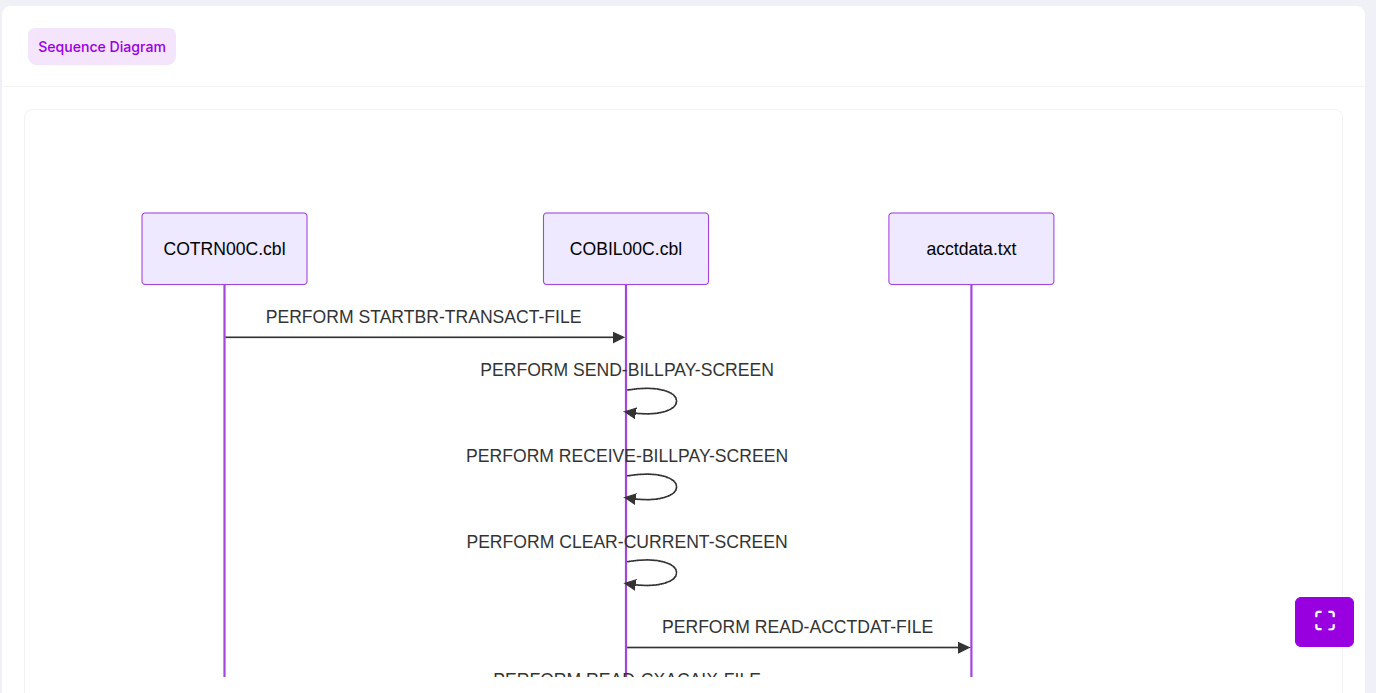
When organizations allow insight to guide strategy—rather than the other way around—they significantly increase their chances of delivering modernization initiatives on time, within budget, and aligned with business goals.
How CodeAura Enables Confident Modernization Decisions
Modernization strategies do not fail because organizations lack options. They fail because those options are chosen without sufficient clarity. This is the gap CodeAura is designed to address.
Rather than promoting a single approach, CodeAura operates as a strategy-agnostic foundation—enabling organizations to make informed decisions across refactoring, replatforming, and rewriting.
Enabling Refactoring
Refactoring requires precision. Teams need to know where complexity exists, which components are safe to modify, and where hidden dependencies could introduce risk.
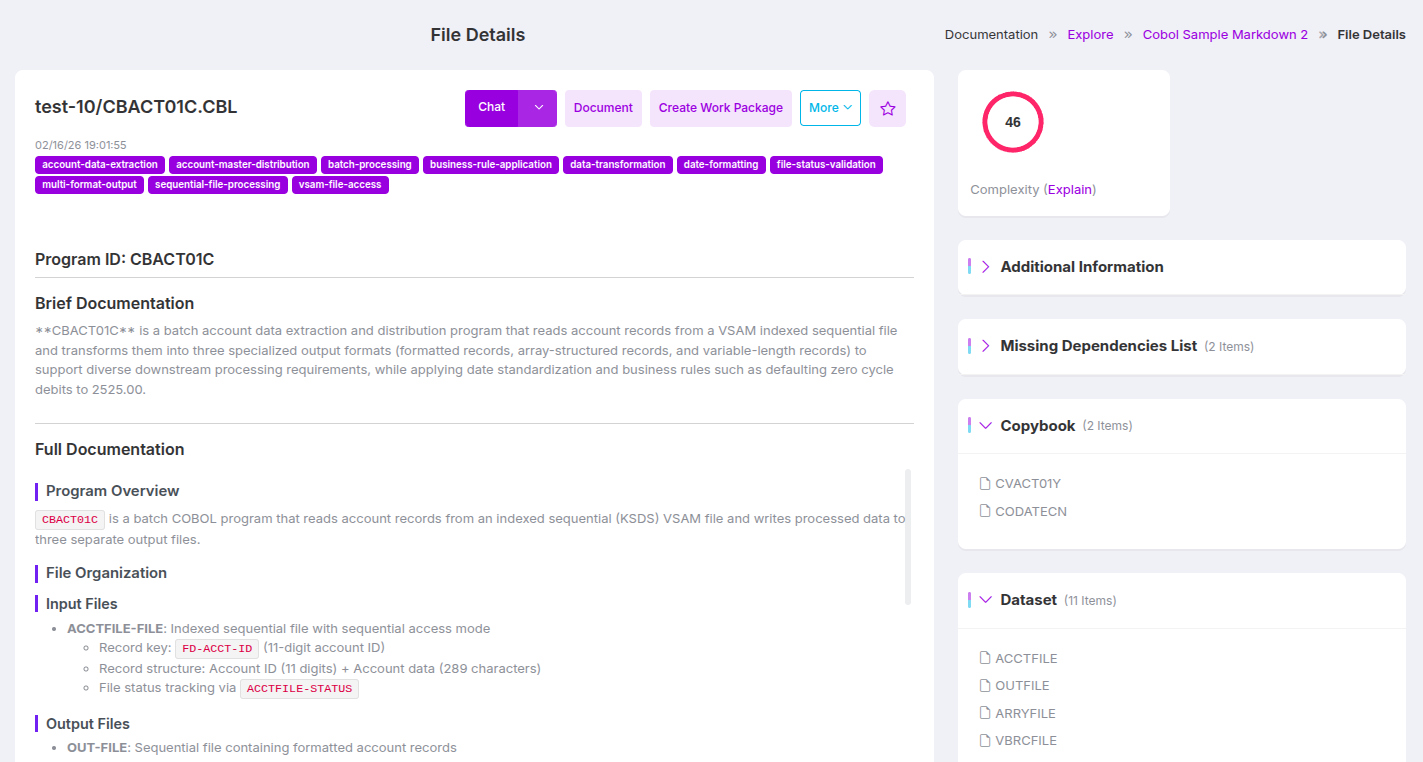
CodeAura provides deep, AI-driven code analysis that transforms opaque codebases into structured, navigable systems. It generates detailed documentation, highlights complexity hotspots, and surfaces relationships between components.
This allows engineering teams to move from assumption-based refactoring to targeted, risk-aware improvements.
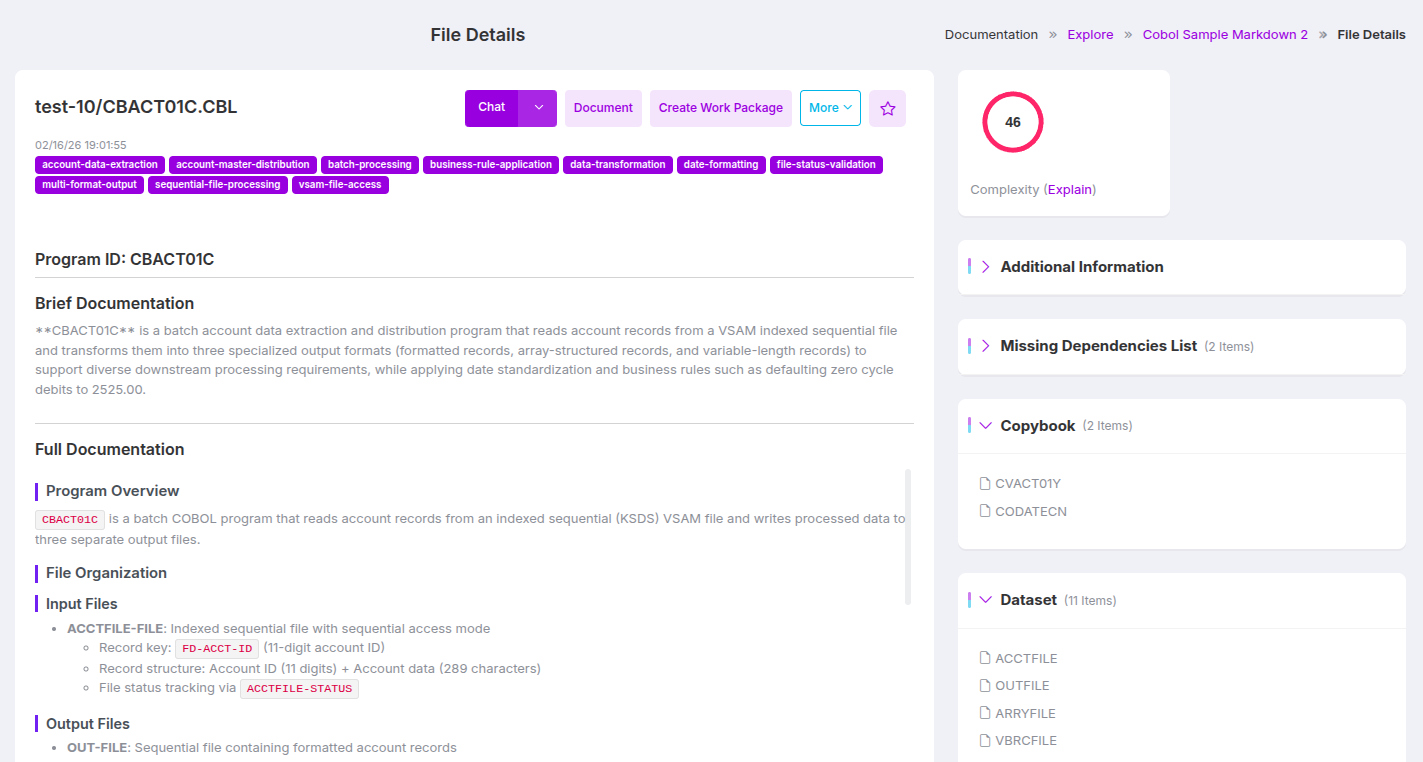
The result is not just cleaner code, but a controlled and predictable refactoring process grounded in visibility.
Supporting Replatforming
Replatforming initiatives often struggle with unseen dependencies and unclear system boundaries. Moving to modern infrastructure without fully understanding these relationships can lead to performance issues, integration failures, and unexpected rework.
CodeAura addresses this by mapping system-level interactions and dependencies across services, modules, and data flows. It provides a clear picture of how components communicate and what is impacted during migration.
With this level of insight, organizations can identify what can be migrated safely, what requires modification, and where potential failure points exist—reducing uncertainty during platform transitions.
De-Risking Rewrites
Rewriting a system demands the highest level of confidence in existing business logic. Without it, organizations risk rebuilding systems that are functionally incomplete or misaligned with operational needs.
CodeAura extracts and translates embedded business logic into structured, human-readable formats. It enables teams to understand not just what the code does, but why it exists.
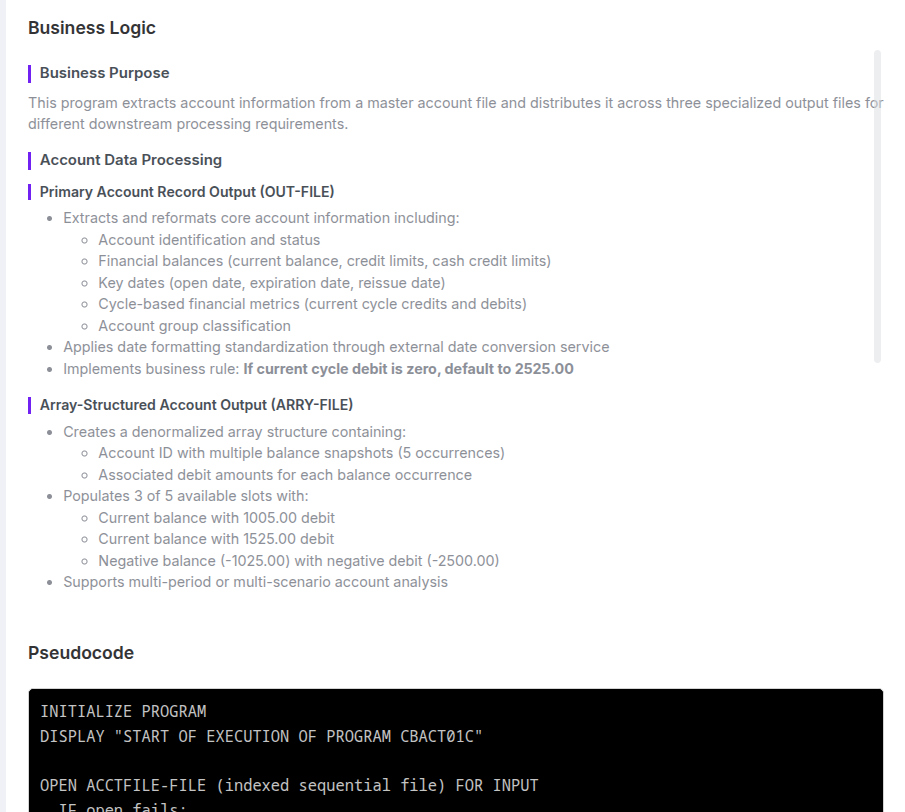
This capability ensures that critical rules, workflows, and compliance-related logic are preserved during transformation—turning rewriting from a high-risk leap into a controlled, insight-driven process.
Across all three strategies, the value remains consistent: clarity before action.
CodeAura does not replace modernization strategies—it strengthens them. By making legacy systems understandable, it allows organizations to choose the right path with confidence, align stakeholders around shared insights, and execute transformation initiatives with significantly reduced risk.
Practical Decision Framework
Choosing between refactoring, replatforming, and rewriting should not rely on intuition or organizational bias. It should be the result of a structured evaluation grounded in system reality, business priorities, and risk tolerance.
A practical decision framework helps translate complexity into actionable clarity. It ensures that strategy selection is consistent, defensible, and aligned with both technical and executive objectives.
At its core, the decision comes down to four key dimensions:
1. System Understanding
Before any strategy is considered, the most important question is:
- How well do we understand the current system?
If visibility is low—undocumented code, unclear dependencies, hidden business logic—then high-risk strategies like rewriting become significantly more dangerous. In such cases, initial efforts should focus on improving system understanding before committing to transformation.
2. Risk Tolerance
Different strategies carry different risk profiles:
- Low risk tolerance favors refactoring
- Moderate risk tolerance supports replatforming
- High risk tolerance may justify rewriting
Organizations operating in regulated environments or with mission-critical systems must weigh the operational and compliance impact of failure. Risk is not just technical—it is business-wide.
3. Time Constraints
Urgency plays a critical role in shaping strategy:
- Tight timelines often push toward replatforming for faster infrastructure gains
- Moderate timelines allow for controlled refactoring
- Longer horizons are typically required for successful rewrites
However, speed without understanding introduces hidden delays later. A fast start does not guarantee a fast finish.
4. Business and Compliance Requirements
Modernization decisions must align with external pressures:
- Are there regulatory mandates driving change (e.g., audit readiness, data handling requirements)?
- Is scalability required to support growth or new products?
- Are there cost reduction targets tied to infrastructure or maintenance?
These factors often determine whether incremental improvement is sufficient or full transformation is necessary.
Bringing these dimensions together, a simplified decision checklist emerges:
- Do we have clear visibility into system architecture and business logic?
- What level of risk can the organization absorb?
- How quickly do we need to deliver measurable outcomes?
- What regulatory or compliance constraints must be preserved?
- Are we optimizing for short-term stability or long-term transformation?
The key is not to force a single answer, but to reveal the most appropriate path given the context.
In many cases, the outcome is not a binary decision. Organizations may adopt a hybrid approach—refactoring critical components, replatforming for scalability, and selectively rewriting areas that require deeper transformation. This layered strategy is often the most practical, but only when guided by a clear understanding of the system.
Without this framework, decisions remain subjective. With it, modernization becomes a structured, insight-driven process.
Strategic Reframe
Refactoring, replatforming, and rewriting are often positioned as competing strategies. In reality, they are simply different tools—each with its own strengths, limitations, and ideal use cases.
The success of a modernization initiative does not come from choosing the most advanced or ambitious option. It comes from choosing the strategy that aligns with the reality of the system and the priorities of the business.
This is where many organizations need to reframe their thinking.
Modernization is not a question of what should we do? It is a question of what does our system allow us to do, given what we know about it?
When decisions are made without that clarity, even the most well-intentioned strategies can lead to delays, cost overruns, and missed objectives. But when strategy is grounded in understanding—when systems are visible, dependencies are mapped, and business logic is clear—the path forward becomes significantly more predictable.
In this context, refactoring becomes a precise optimization tool. Replatforming becomes a controlled infrastructure evolution. Rewriting becomes a deliberate, well-informed transformation rather than a leap into uncertainty.
The shift is subtle, but critical: strategy is no longer the starting point. It is the outcome of insight.
For organizations navigating legacy modernization, this distinction defines the difference between reactive change and strategic transformation.
Before choosing how to modernize, the better question is whether you truly understand what you’re modernizing.