
The Modernization Playbook: How Leading Enterprises Reduce Risk While Moving Faster
The Speed vs. Risk Dilemma in Legacy Modernization
Every legacy modernization initiative begins with a deceptively simple question: how fast can we move without breaking what already works?
For enterprise leaders, this is not just a technical concern—it is a business-critical balancing act. Core systems in industries like banking, healthcare, and manufacturing are deeply embedded in daily operations. They process transactions, enforce compliance, and carry decades of institutional knowledge. Changing them introduces risk. Not changing them introduces stagnation.
This creates a persistent tension.
Move too fast, and organizations risk disrupting mission-critical workflows, introducing defects, or failing regulatory requirements. Move too cautiously, and modernization efforts stretch into multi-year programs that drain budgets, delay innovation, and erode competitive advantage.
In practice, most enterprises fall into one of two traps:
- Acceleration without control, where speed leads to instability
- Caution without progress, where risk avoidance leads to paralysis
Neither outcome is acceptable in today’s environment, where regulatory pressure is increasing and digital expectations continue to rise.
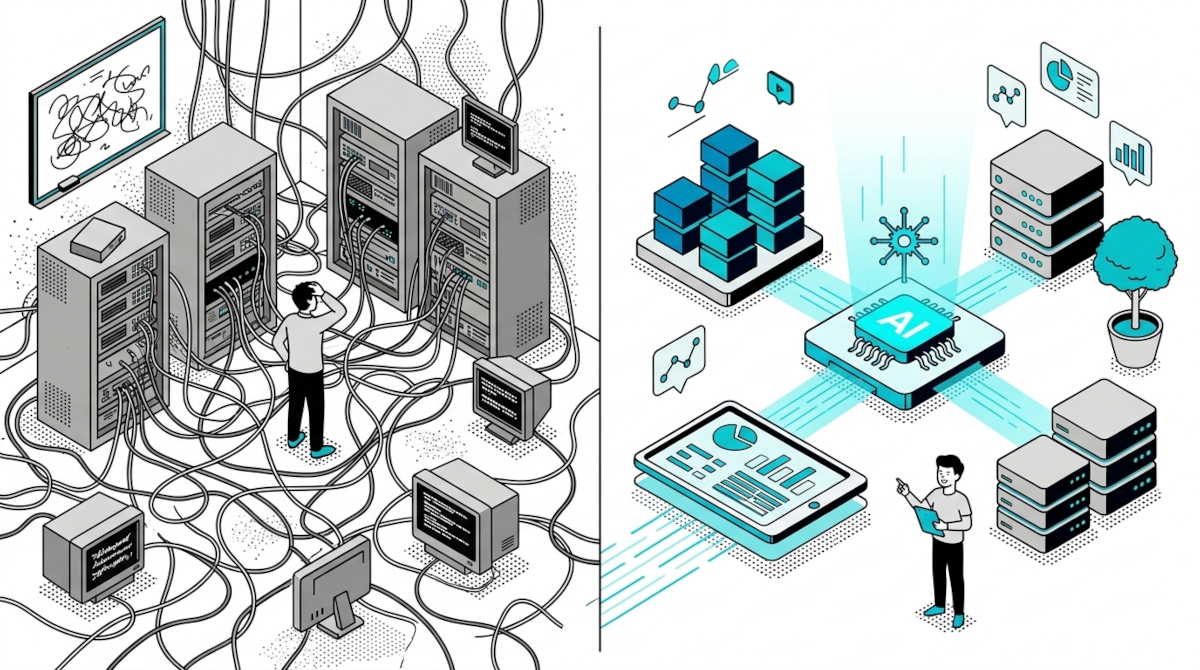
The reality is that speed and risk are not inherently opposing forces—but they are treated that way when modernization lacks structure. Without a clear understanding of legacy systems, dependencies, and business logic, organizations are forced to choose between moving quickly and moving safely.
This is why so many modernization efforts stall before delivering meaningful value.
The issue is not ambition. It is not investment. It is not even technology.
It is the absence of a repeatable, structured approach that allows enterprises to move forward with confidence.
The organizations that succeed are not the ones that take the biggest risks—or the ones that avoid them entirely. They are the ones that systematically reduce uncertainty before accelerating execution.
That distinction defines the difference between failed transformation and measurable progress.
Why Most Modernization Efforts Fail Despite Investment
Enterprise modernization is rarely constrained by intent or funding. Organizations invest millions into transformation programs, assemble cross-functional teams, and engage global consulting firms—yet failure rates remain consistently high.
The reason is not a lack of effort. It is a lack of structure.
Most modernization initiatives begin with an incomplete understanding of the systems they aim to transform. Legacy environments—particularly those built on COBOL, mainframes, or tightly coupled monoliths—contain years of undocumented logic, hidden dependencies, and business rules that are critical but poorly understood. Without visibility into these systems, every decision becomes an assumption.
This leads to compounding risk.
Teams underestimate complexity because they cannot see it. What appears to be a simple module rewrite often triggers cascading dependencies across upstream and downstream systems. As a result, timelines slip, costs escalate, and confidence erodes.
At the same time, many organizations adopt “big-bang” transformation strategies, attempting to replace entire systems in a single motion. While appealing in theory, this approach concentrates risk into a single execution window. Any miscalculation—whether technical or operational—can derail the entire initiative.
Another common failure point is misalignment between technical execution and business objectives. Modernization efforts are often driven by IT roadmaps rather than business outcomes. This creates a disconnect where technical progress does not translate into measurable value, making it difficult to justify continued investment.
Compounding this issue is the reliance on fragmented tooling ecosystems. Documentation tools, code analyzers, migration utilities, and project management platforms often operate in isolation. This fragmentation results in inconsistent outputs, duplicated effort, and a lack of end-to-end visibility.
The pattern is consistent across industries:
- Limited system understanding leads to flawed planning
- Flawed planning leads to execution risk
- Execution risk leads to delays, overruns, or failure
Modernization does not fail because enterprises are unprepared to invest. It fails because they attempt to transform complex systems without first establishing clarity and control.
Until that foundation is addressed, even the most well-funded initiatives will continue to struggle to deliver predictable outcomes.
The Limits of Traditional Modernization Approaches
When faced with legacy complexity, most enterprises default to established modernization strategies. These approaches are familiar, widely adopted, and often recommended by vendors and consultants. However, despite their popularity, they consistently fall short in delivering predictable, low-risk outcomes.
The issue is not that these approaches are inherently flawed—it is that they are applied without sufficient system understanding or structural discipline.
Big-Bang Modernization
The big-bang approach aims to replace an entire legacy system in a single, large-scale transformation. On paper, this offers a clean break from outdated technology. In practice, it introduces one of the highest-risk execution models in enterprise IT.
By concentrating all changes into a single release window, organizations create a scenario where failure has widespread consequences. Testing becomes too complex, rollback strategies are limited, and even minor oversights can disrupt critical operations.
More importantly, big-bang transformations assume a level of system understanding that most organizations simply do not have. Without deep visibility into dependencies and business logic, the likelihood of missing critical functionality is high.
The result is often delayed launches, budget overruns, or, in worst cases, complete project failure.
Lift-and-Shift
In contrast, lift-and-shift strategies prioritize speed by moving legacy systems to modern infrastructure—typically the cloud—without fundamentally changing the application architecture.
While this approach reduces immediate migration risk, it does little to address the underlying issues that made modernization necessary in the first place.
Inefficient code, tightly coupled components, and undocumented logic are preserved rather than resolved. Organizations may achieve short-term gains in scalability or infrastructure cost, but they continue to carry the burden of technical debt.
Over time, this creates a different kind of risk: modern infrastructure supporting outdated, inflexible systems.
Fragmented Tooling Ecosystems
To compensate for complexity, enterprises often assemble a collection of specialized tools—documentation platforms, code analyzers, migration utilities, and project management systems.
Individually, these tools can be powerful. Collectively, they introduce fragmentation.
Each tool operates within its own context, producing outputs that are not always aligned or interoperable. Teams are forced to manually bridge gaps between systems, leading to duplicated effort, inconsistent insights, and reduced confidence in decision-making.
This fragmentation also limits visibility. Leaders lack a unified view of progress, risk, and system interdependencies, making it difficult to steer modernization efforts effectively.
Across all three approaches, a common pattern emerges: execution is prioritized before understanding.
This inversion is the root cause of inefficiency and risk. Without a structured foundation—one that establishes clarity, context, and alignment—modernization becomes reactive rather than controlled.
Leading enterprises recognize this limitation. Instead of relying solely on traditional methods, they adopt a fundamentally different approach—one that begins with understanding and scales through structure.
What Leading Enterprises Do Differently
Organizations that consistently succeed in modernization efforts do not rely on luck, scale, or excessive investment. They operate with a fundamentally different mindset—one that prioritizes clarity, control, and incremental progress over speed alone.
Rather than treating modernization as a one-time event, they approach it as a structured, intelligence-driven process.
They Start with Understanding, Not Migration
Leading enterprises resist the urge to immediately transform systems. Instead, they begin by building a comprehensive understanding of their existing environment.
This includes uncovering hidden dependencies, mapping business logic, and identifying undocumented processes that have evolved over time. By doing so, they eliminate assumptions early and replace them with verifiable insights.
This shift has a direct impact: decisions are no longer based on incomplete information, and transformation efforts are grounded in reality rather than estimation.
They Break Modernization into Phases
Rather than committing to high-risk, all-or-nothing transformations, successful organizations adopt a phased approach.
They divide modernization into manageable segments, each with clearly defined objectives, success criteria, and risk boundaries. This allows teams to validate progress incrementally, adjust strategies based on real outcomes, and avoid large-scale failures.
Each phase reduces uncertainty, making subsequent phases faster and more predictable.
They Align Technical Execution with Business Outcomes
Modernization efforts are not treated as purely technical upgrades. Instead, they are tightly aligned with business priorities such as cost reduction, compliance readiness, and revenue enablement.
This ensures that every modernization decision is tied to measurable impact. High-value systems are prioritized, unnecessary work is avoided, and stakeholders across the organization remain aligned.
As a result, modernization becomes a driver of business performance—not just an IT initiative.
They Use Automation to Scale with Consistency
Manual analysis and transformation cannot keep pace with the scale and complexity of enterprise systems. Leading organizations address this by embedding automation into every stage of the modernization lifecycle.
Automation enables:
- Faster system discovery and documentation
- Consistent analysis across large codebases
- Repeatable transformation processes
More importantly, it reduces reliance on individual expertise, mitigating the risk of knowledge silos and talent gaps—an increasingly critical concern in legacy environments.
The common thread across these practices is clear: successful modernization is not about moving faster—it is about removing uncertainty before accelerating.
By establishing understanding, structuring execution, aligning with business outcomes, and leveraging automation, leading enterprises transform modernization from a high-risk initiative into a controlled, repeatable capability.
This foundation sets the stage for a more formalized approach—a playbook that can be applied consistently across systems and teams.
The Modernization Playbook: A Structured Path to Transformation
Modernization succeeds when it is treated not as a single initiative, but as a repeatable, structured process. Leading enterprises operationalize this through a clear framework that reduces uncertainty at every stage while enabling controlled acceleration.
At its core, this playbook is built around three sequential phases: Document, Understand, and Modernize. Each phase builds on the previous one, ensuring that transformation decisions are grounded in insight rather than assumption.
This approach aligns directly with the D.U.M framework—designed to bring clarity, context, and confidence to complex legacy environments.
Phase 1: Document
The first step is to establish a reliable foundation of system knowledge.
In most enterprises, legacy systems suffer from incomplete or outdated documentation. Critical business logic exists only in code, and in many cases, only in the minds of a shrinking pool of experienced engineers. This creates immediate risk.
The Document phase addresses this by systematically extracting and structuring knowledge from the system itself.
Key activities include:
- Analyzing source code across languages such as COBOL, JCL, and Java
- Generating comprehensive documentation at both file and system levels
- Identifying dependencies, data flows, and integration points
- Highlighting potential risk areas and undocumented logic
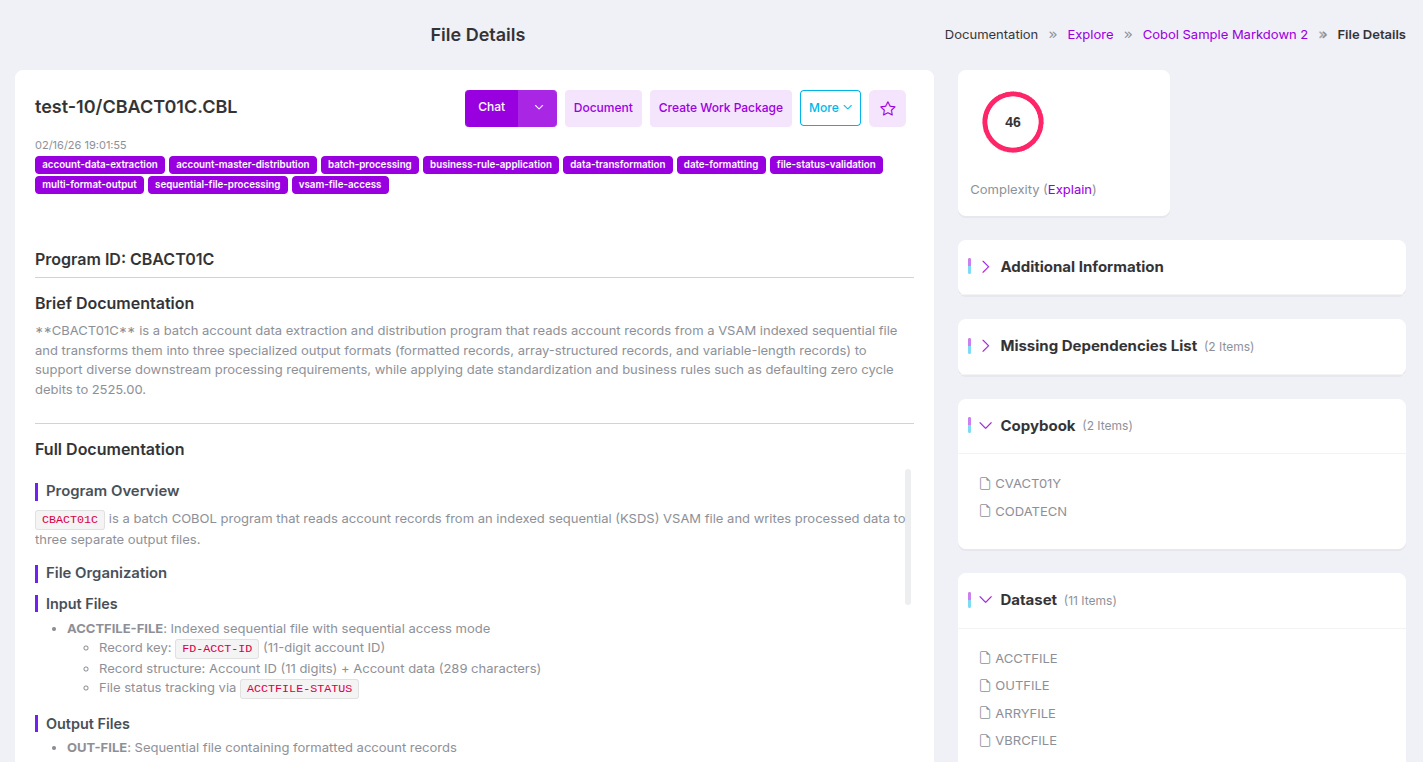
The objective is not just visibility—it is confidence. With accurate, accessible documentation, teams can begin modernization efforts with a clear understanding of what exists and what must be preserved.
Phase 2: Understand
Once documentation is established, the next step is to build contextual intelligence.
Understanding goes beyond static documentation. It involves interpreting how systems behave, how components interact, and how business logic drives outcomes.
Key activities include:
- Mapping system-wide dependencies across applications and services
- Analyzing business rules embedded within legacy code
- Identifying redundancies, inefficiencies, and optimization opportunities
- Creating visual representations such as dependency graphs and system maps
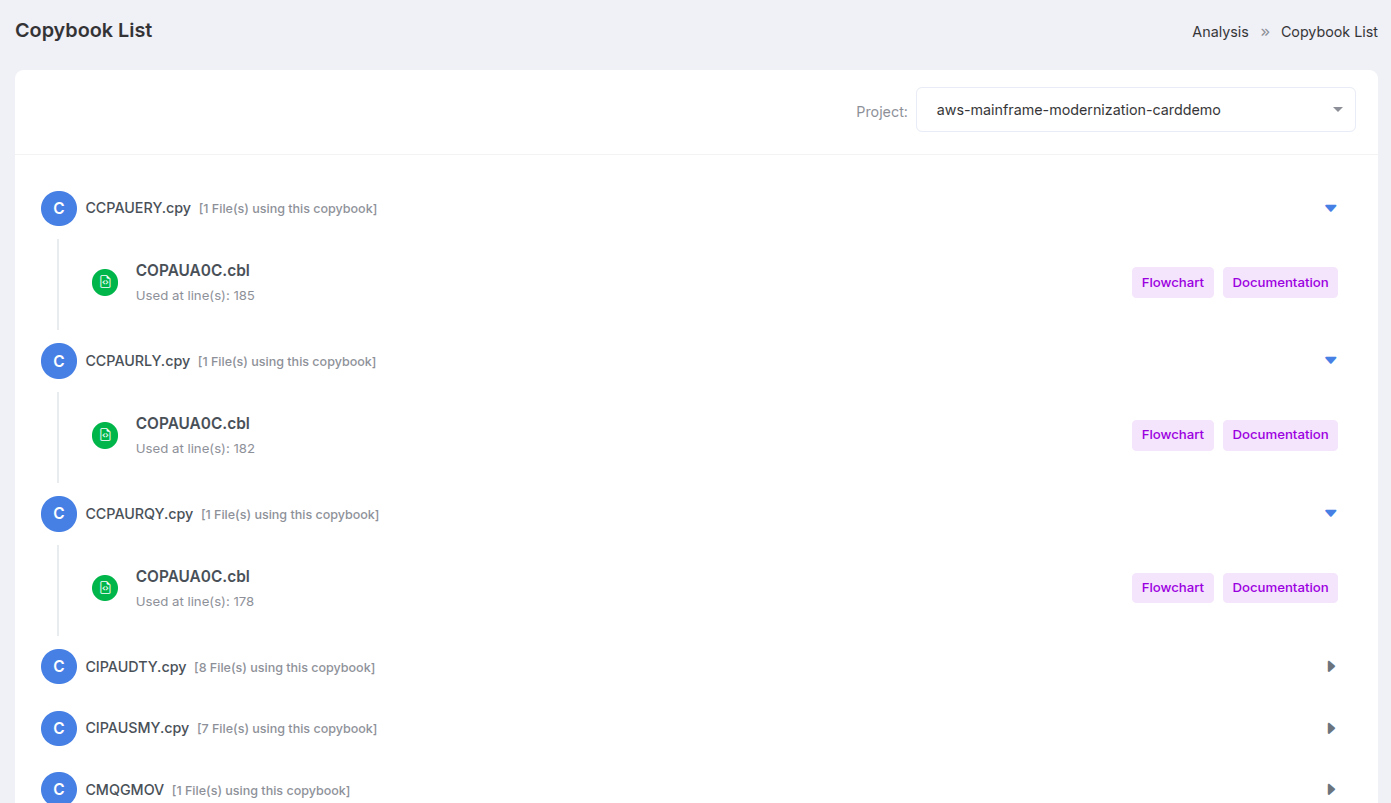
This phase transforms raw information into actionable insight. Teams gain the ability to answer critical questions:
- What systems are tightly coupled?
- Where are the highest-risk dependencies?
- Which components can be safely modified or replaced?
By resolving these unknowns early, organizations significantly reduce the risk of downstream failures.
Phase 3: Modernize
With a strong foundation of knowledge and understanding, enterprises can move into execution with confidence.
The Modernize phase focuses on controlled transformation, guided by insights generated in earlier stages.
Key activities include:
- Refactoring or rewriting legacy components into modern architectures
- Replatforming systems where appropriate
- Generating new code using AI-assisted tools
- Validating outputs against existing business logic and requirements
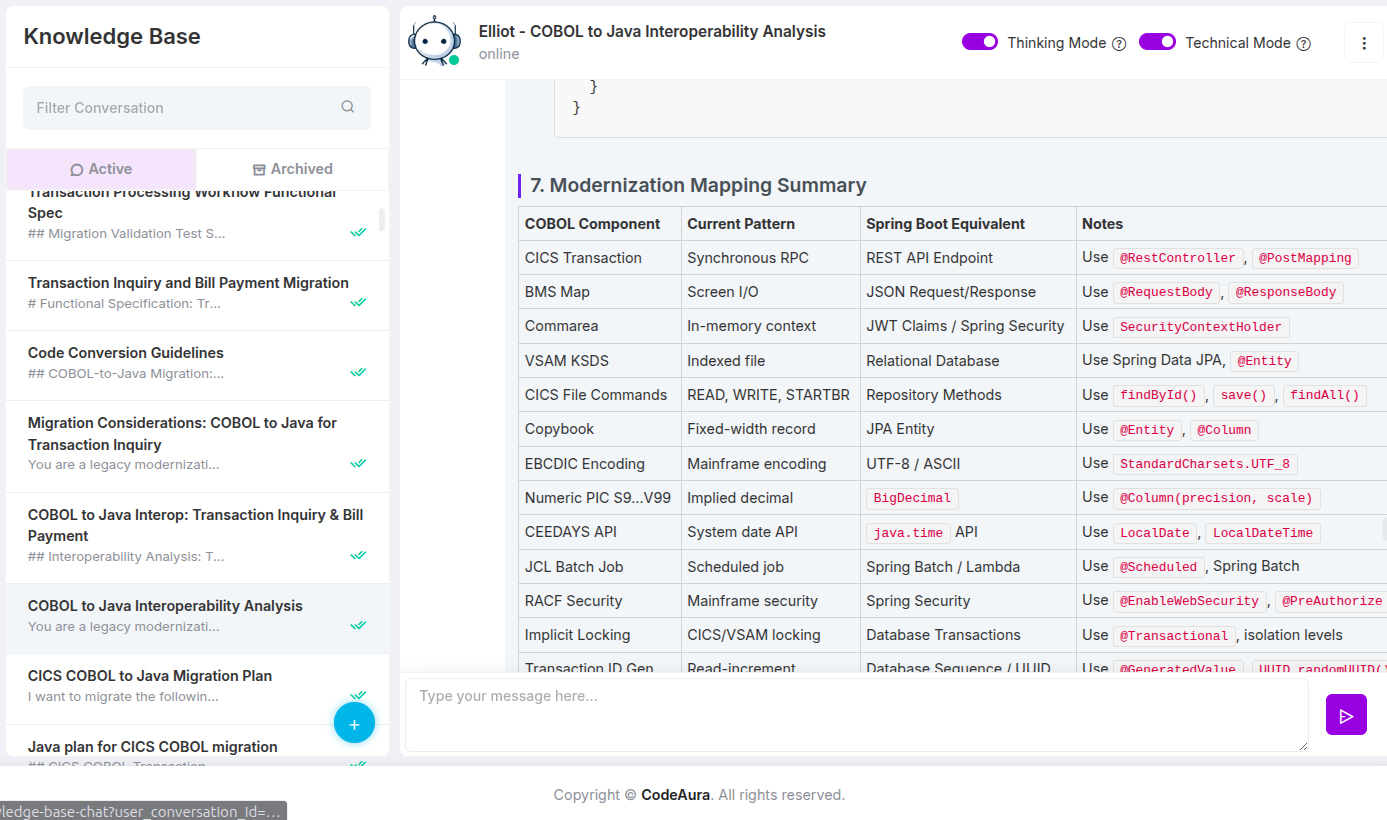
Because decisions are backed by structured understanding, execution becomes faster and more predictable. Teams are no longer reacting to unexpected issues—they are operating with foresight.
The strength of this playbook lies in its sequencing.
By documenting first, organizations eliminate ambiguity. By understanding second, they reduce risk. By modernizing last, they accelerate execution without compromising stability.
This is how leading enterprises resolve the traditional trade-off between speed and safety—not by choosing one over the other, but by engineering a process that enables both.
How Structured Modernization Reduces Risk and Accelerates Delivery
The perceived trade-off between speed and risk in modernization exists because most organizations attempt to execute transformation without first eliminating uncertainty. A structured approach reverses this dynamic.
By sequencing modernization into clearly defined phases—Document, Understand, Modernize—enterprises fundamentally change how risk is managed and how speed is achieved.
Risk Reduction Through Clarity and Control
Risk in legacy modernization is driven primarily by unknowns: undocumented logic, hidden dependencies, and unclear system behavior. A structured playbook addresses these risks at their source.
By the time execution begins, organizations have already:
- Established a clear inventory of systems and components
- Mapped critical dependencies and integration points
- Identified high-risk areas and fragile logic
- Validated assumptions with real system data
This level of visibility transforms risk from something unpredictable into something measurable and manageable.
Instead of discovering issues during deployment—when the cost of failure is highest—teams surface them early, when they are easier and less expensive to resolve.
Speed Through Reduced Rework and Friction
Speed in modernization is not achieved by moving faster at every step. It is achieved by eliminating the need to slow down later.
Unstructured approaches often create cycles of rework:
- Rewriting components that later need correction
- Reanalyzing systems due to missing context
- Delaying releases بسبب unforeseen dependencies
A structured approach minimizes these disruptions.
With accurate documentation and contextual understanding in place, teams can:
- Make decisions faster with higher confidence
- Execute changes without repeated validation cycles
- Reduce handoff friction between teams
The result is a smoother, more continuous execution flow—where progress is sustained rather than interrupted.
Financial Impact: Predictability and ROI Realization
For executive stakeholders, the most important outcome is not just technical success—it is financial predictability.
Structured modernization delivers this by:
- Reducing cost overruns caused by unexpected complexity
- Shortening project timelines through efficient execution
- Enabling earlier realization of business value
In many enterprise environments, even a modest reduction in rework or delay can translate into millions in cost savings over the lifecycle of a modernization program.
More importantly, predictable delivery builds organizational confidence. Stakeholders are more willing to invest in modernization when outcomes are consistent and measurable.
Ultimately, structured modernization does not simply reduce risk or increase speed in isolation—it aligns both outcomes within a single, repeatable system.
Risk is reduced because uncertainty is addressed early.
Speed increases because execution is no longer constrained by avoidable setbacks.
This is the shift that separates reactive transformation efforts from disciplined, high-performing modernization programs.
Operationalizing the Playbook with CodeAura
A structured modernization playbook provides the blueprint—but execution at enterprise scale requires the right platform to operationalize it consistently.
This is where CodeAura becomes critical. It functions not as a point solution, but as the execution layer that enables each phase of modernization to be carried out with speed, precision, and repeatability.
Rather than relying on fragmented tools and manual processes, CodeAura unifies documentation, analysis, and transformation into a single, AI-driven workflow.
In the Document Phase
CodeAura accelerates the creation of system visibility by automatically extracting and organizing knowledge from legacy codebases.
This includes:
- Generating detailed documentation across multiple languages, including COBOL and JCL
- Structuring business logic into accessible, human-readable formats
- Creating a centralized knowledge base that can be queried by both technical and non-technical stakeholders
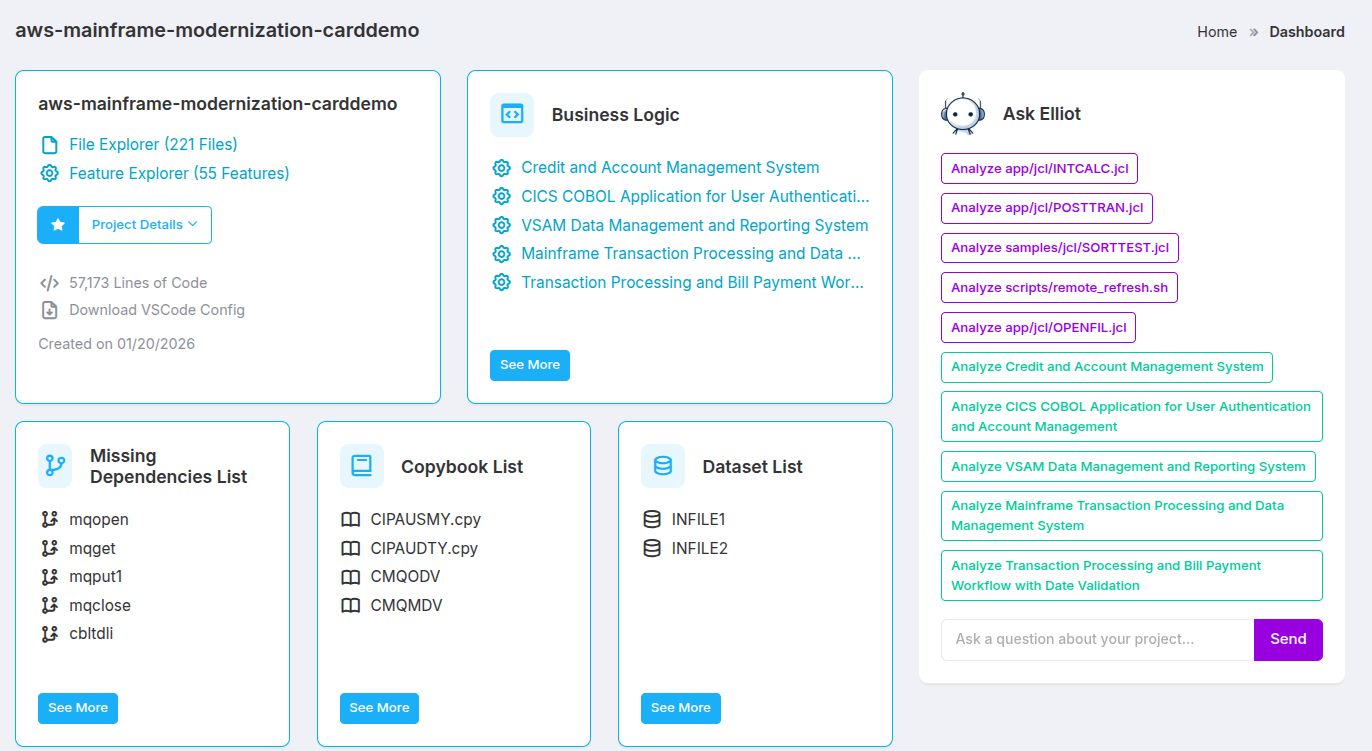
The result is immediate clarity. What previously required weeks or months of manual analysis can be achieved in a fraction of the time, with greater consistency.
In the Understand Phase
Beyond documentation, CodeAura enables deep system comprehension through contextual analysis and visualization.
Capabilities include:
- Mapping dependencies across applications, services, and data flows
- Generating interaction diagrams and system-level views
- Allowing teams to query systems conversationally to uncover logic and relationships
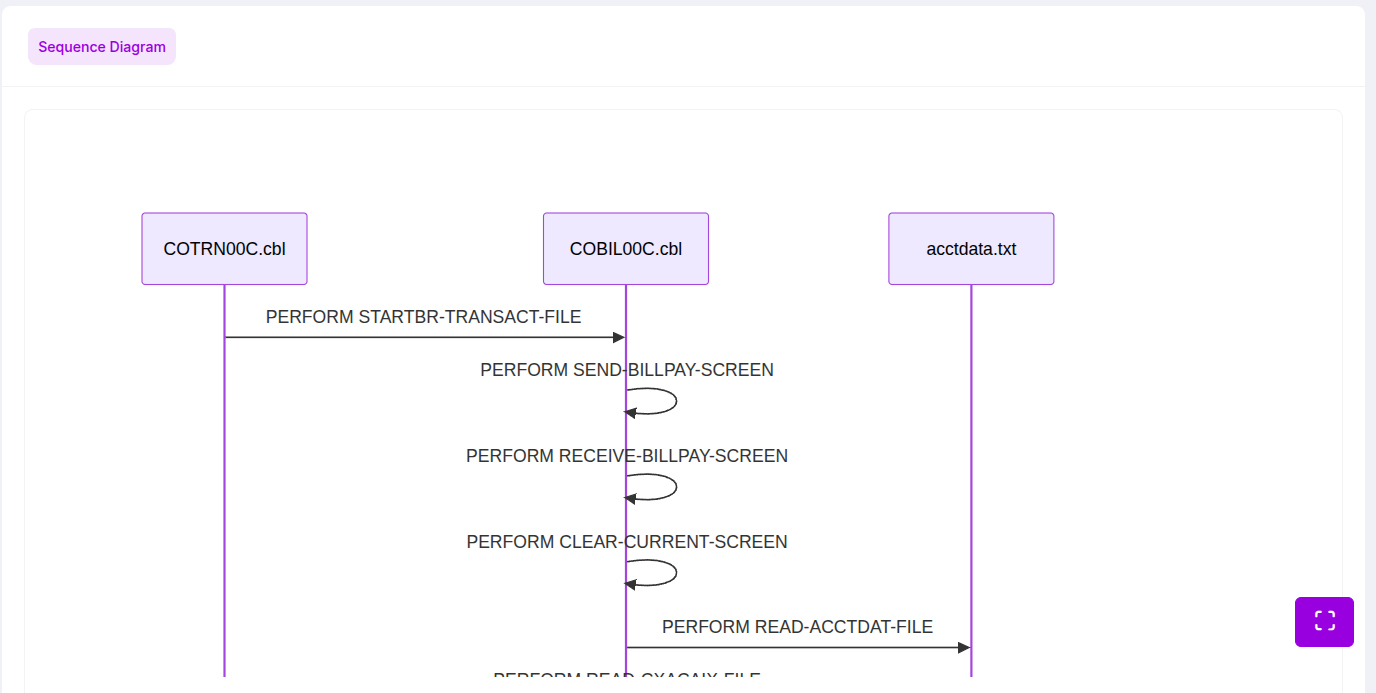
This transforms static information into actionable intelligence. Teams gain a dynamic understanding of how systems behave, making it easier to identify risk, prioritize changes, and plan modernization strategies.
In the Modernize Phase
Execution is where most modernization efforts encounter friction. CodeAura reduces this friction by enabling AI-assisted transformation.
This includes:
- Supporting code migration from legacy languages to modern stacks such as Java and JavaScript
- Assisting with refactoring while preserving business logic
- Providing validation mechanisms to ensure transformed systems behave as expected
Because earlier phases have already established clarity and context, these transformations can be executed with significantly lower risk and higher speed.
The key advantage of CodeAura is not just automation—it is continuity across the modernization lifecycle.
Each phase feeds into the next:
- Documentation informs understanding
- Understanding guides modernization
- Modernization reinforces documentation
This closed-loop system ensures that knowledge is continuously preserved and enhanced, rather than lost during transformation.
For enterprise leaders, this translates into a critical capability: the ability to scale modernization efforts without scaling risk.
Reframing Modernization: From Trade-Off to Strategic Advantage
For years, enterprise modernization has been framed as a compromise—move fast and accept risk, or move carefully and sacrifice speed.
This framing is no longer viable.
In an environment defined by regulatory pressure, rising technical debt, and increasing demand for digital capabilities, organizations cannot afford to choose between stability and progress. They must achieve both.
The shift begins by recognizing a fundamental truth: modernization challenges are not primarily technological—they are structural.
Failures do not occur because enterprises lack tools or talent. They occur because transformation is approached without a clear, repeatable system for reducing uncertainty and guiding execution.
When modernization is structured—when it begins with documentation, advances through understanding, and executes with insight—the equation changes.
- Risk is no longer an unpredictable byproduct; it is actively managed and reduced
- Speed is no longer forced; it emerges naturally from clarity and alignment
- Outcomes are no longer variable; they become consistent and measurable
This is the distinction between modernization as an initiative and modernization as a capability.
Organizations that adopt a structured playbook are not simply completing projects more successfully. They are building the internal ability to continuously evolve their systems with confidence.
This capability has long-term strategic implications:
- Faster response to regulatory changes such as Basel IV, HIPAA, and PCI-DSS
- Improved resilience in mission-critical systems
- Greater agility in launching new products and services
- Sustained reduction in technical debt and operational overhead
In this context, modernization is no longer a cost center or a periodic disruption. It becomes a core driver of competitiveness and operational excellence.
The role of platforms like CodeAura is to make this transformation repeatable—to embed structure, intelligence, and automation into every stage of the journey.
Because ultimately, the difference between a failed modernization effort and a successful one is not the scale of investment or the choice of technology.
It is the approach.
And the organizations that recognize this are the ones that move forward—not just faster, but with far greater confidence and control.
Build a modernization strategy that delivers speed without compromising stability.