
The first failures may show up in business workflows
When Brazil introduces the alphanumeric CNPJ for new registrations in July 2026, the first visible problems may not appear in the code. They may appear in everyday business workflows: a supplier cannot be onboarded, an invoice cannot be processed, a customer record is rejected, or a finance report no longer reconciles.
The format change is specific, but its impact is broad. The new CNPJ will keep the existing 14-position structure, with the first 12 positions able to include letters and numbers and the final two positions remaining numeric verification digits. Existing numeric CNPJs will remain valid.
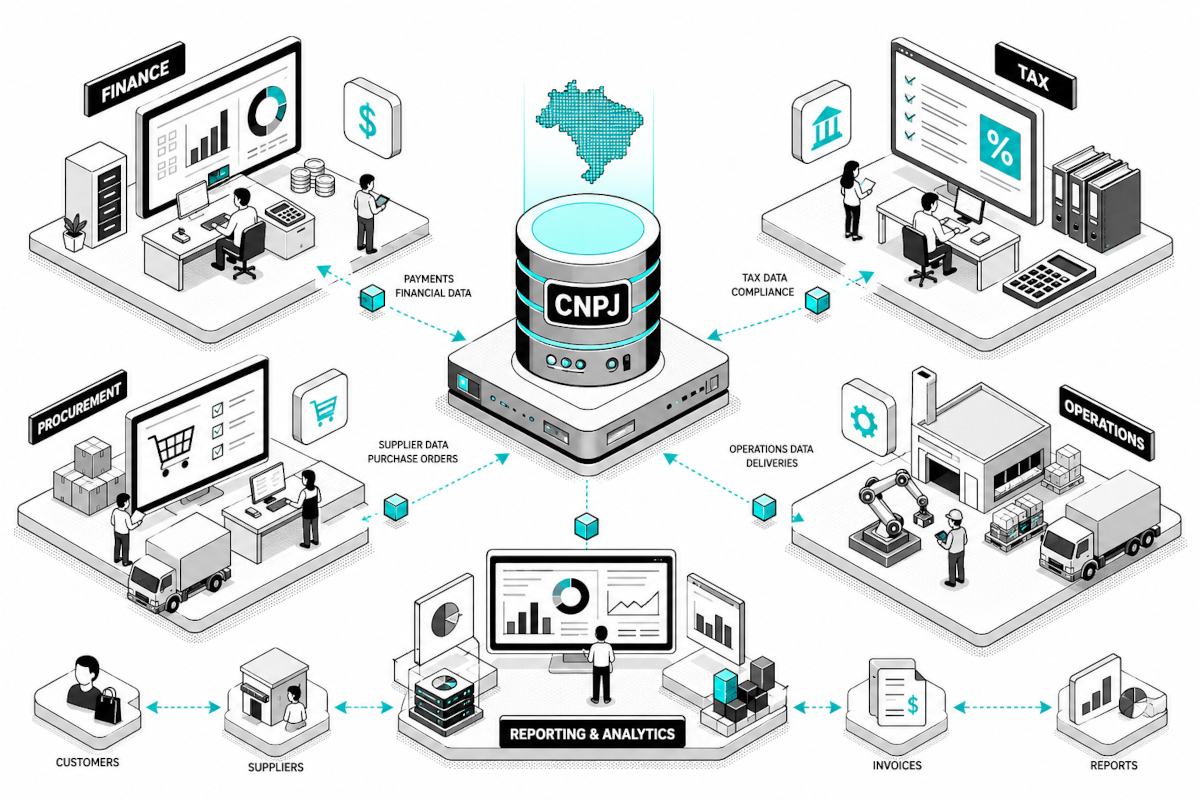
For business teams, the practical question is not only whether IT can update a validation rule. It is whether CNPJ data can still move correctly through customer onboarding, supplier registration, invoicing, billing, tax reporting, payments, reconciliations, audit trails, and operational dashboards. The Article 8 brief frames this directly: the alphanumeric CNPJ is not only an IT change; it affects business workflows that depend on customer, supplier, branch, fiscal, and billing data.
That means finance, tax, procurement, customer operations, and compliance teams should be involved before system changes are considered complete. Technical readiness means the system can accept the new value. Operational readiness means the business can use that value accurately, consistently, and without creating downstream exceptions.
Why finance, tax, procurement, and operations teams should care
CNPJ is more than a registration number. In many Brazilian business processes, it functions as a core identifier that connects legal entities, branches, customers, suppliers, invoices, contracts, payments, tax obligations, and audit records. When that identifier changes format, the impact can move across the organization quickly.
The risk is not that existing numeric CNPJs become invalid. They remain valid. The operational challenge is that new CNPJs may include letters in positions where teams, forms, spreadsheets, systems, and integrations have historically expected only numbers. That assumption may exist in obvious places, such as customer registration screens, but also in less visible places, such as spreadsheet templates, ERP exports, fiscal integrations, approval workflows, reconciliation rules, and reporting filters.
Finance teams may see the impact in billing, accounts receivable, accounts payable, payment matching, credit notes, and month-end reconciliation. Tax and fiscal teams may see it in invoice validation, tax reporting, fiscal document processing, and audit evidence. Procurement teams may see it in supplier onboarding, vendor master data, purchase orders, and third-party compliance checks. Operations teams may see it in branch setup, customer support, exception handling, and data-quality workflows.
That is why CNPJ readiness should not be treated as a narrow IT task. IT can update applications, databases, APIs, and validation logic, but business teams need to confirm that the actual workflows still operate correctly from beginning to end. The Article 8 brief makes this central point: the alphanumeric CNPJ affects business processes that depend on customer, supplier, branch, fiscal, and billing data.
Customer data and onboarding readiness
Customer-facing workflows are one of the first areas business teams should review. A valid CNPJ may enter the organization through a registration form, customer portal, sales process, branch setup request, contract workflow, support ticket, or CRM update. If any part of that chain assumes CNPJ is numeric-only, a legitimate new customer record may be rejected, altered, duplicated, or routed into an exception queue.
The issue is not limited to the field where the CNPJ is typed. Customer onboarding often depends on multiple connected steps: account creation, business verification, customer identity matching, tax data collection, contract generation, credit checks, billing setup, and customer support access. A form may accept the alphanumeric value, but the CRM may not store it correctly. A portal may allow entry, but a backend validation service may fail. A sales workflow may create the customer record, but duplicate detection may miss a match because the logic strips letters or compares only numeric values.
Search and support workflows also matter. Customer service teams may need to locate accounts by CNPJ during onboarding, billing disputes, fiscal document questions, or account maintenance. If search logic removes non-numeric characters, stores the value inconsistently, or fails to match punctuated and unpunctuated formats, support teams may struggle to find the right customer record.
For finance and operations leaders, the practical readiness question is simple: can a new customer with an alphanumeric CNPJ move from registration to billing without manual intervention? That means testing customer workflows end to end, not only confirming that one application screen accepts the new format. The Article 8 brief specifically calls out customer registration, CRM records, portals, duplicate detection, branch registration, contract creation, and support systems as areas to review.
Supplier onboarding and procurement risk
Supplier onboarding should be treated as one of the highest-priority workflows for alphanumeric CNPJ readiness. Procurement and supplier management teams depend on CNPJ data to register vendors, validate tax information, create purchase orders, manage contracts, support payment setup, and maintain vendor master records. If those workflows assume CNPJ is always numeric, a new supplier with a valid alphanumeric CNPJ may be blocked before any business transaction can begin.
The risk can appear at several points in the supplier lifecycle. A supplier portal may reject the identifier during registration. An ERP vendor record may fail validation after the supplier has already submitted documentation. A procurement approval workflow may stall because one connected system accepts the new format while another does not. A supplier export may fail when sent to a tax, payment, compliance, or third-party risk platform. In each case, the technical issue becomes an operational delay.
Manual workarounds can make the problem worse. If teams shorten the value, remove letters, enter placeholders, or store the CNPJ in a comment field to keep the process moving, they may create data-quality, audit, and compliance issues. Supplier data needs to remain consistent across procurement, finance, tax, legal, and compliance records.
The practical test is whether a supplier with an alphanumeric CNPJ can move from onboarding to purchase order creation, invoice receipt, accounts payable processing, tax validation, and payment without data being rejected or changed along the way. The Article 8 brief identifies supplier onboarding, vendor master data, procurement systems, supplier portals, tax documentation, banking details, contract systems, and third-party risk systems as key areas for review.
Invoicing, billing, accounts payable, and fiscal documents
Invoicing and billing workflows deserve special attention because they sit at the intersection of customer data, supplier data, fiscal rules, ERP processes, accounts receivable, accounts payable, and external integrations. A CNPJ value may be created in one system, validated in another, transmitted to a fiscal service provider, used in a tax engine, stored in the ERP, exported to a report, and later used for reconciliation.
That chain can break in subtle ways. An invoice may fail because the customer CNPJ does not pass an old numeric-only validation rule. An accounts payable process may reject a supplier record even though procurement accepted it. A fiscal integration may fail because an API payload contains letters where the receiving system expects only digits. A billing platform may store the value correctly, while a downstream reporting or reconciliation process does not.
The goal is not to assume that every invoicing or fiscal system will fail. The goal is to test the workflows that matter most before the new format appears in production. Finance and tax teams should validate whether alphanumeric CNPJ values can move through invoice issuance, invoice receipt, billing setup, payment processing, credit notes, tax calculations, fiscal document workflows, and month-end reconciliation without being rejected, reformatted, truncated, or separated from the correct customer or supplier record.
This is where business participation is critical. IT can test whether a field accepts letters. Finance and tax teams can confirm whether the business process still works: whether invoices can be issued, fiscal documents can be processed, payments can be matched, exceptions can be handled, and audit evidence remains consistent. The Article 8 brief identifies invoicing, billing, fiscal document processing, accounts payable, accounts receivable, tax engines, ERP fiscal modules, integrations, invoice validation, and reconciliation as major readiness areas.
Reporting, audit, and data consistency
Some alphanumeric CNPJ issues may be harder to detect because they do not stop a user at the point of entry. A customer or supplier record may be accepted by the main application, while reporting, export, analytics, audit, or reconciliation processes mishandle the value later.
This is especially important for finance, tax, and compliance teams. CNPJ data often appears in tax reports, audit reports, BI dashboards, data warehouses, CSV files, spreadsheet exports, payment files, and month-end reconciliation processes. If one system stores the identifier correctly but another casts it as a number, strips letters, applies old formatting rules, or rejects the record during an ETL process, the organization may not discover the problem until a report fails, a reconciliation does not tie out, or an audit trail contains inconsistent identifiers.
Data consistency matters as much as field acceptance. Teams should review whether CNPJ values are preserved across source systems, integrations, reports, extracts, spreadsheets, dashboards, and archives. They should also test whether systems handle both existing numeric CNPJs and new alphanumeric CNPJs consistently, including punctuated and unpunctuated formats.
The practical question for reporting and compliance teams is not only, “Can the system store the new CNPJ?” It is, “Can we trust that the same legal entity is represented consistently across operational systems, fiscal records, reports, and audit evidence?” The Article 8 brief highlights reporting, BI dashboards, data warehouses, reconciliation processes, regulatory reporting, spreadsheet exports, CSV files, and data-quality checks as areas that may need review.
From technical readiness to operational readiness
Technical readiness means the system can process the new CNPJ format. Operational readiness means the business can use it correctly across real workflows, with the right procedures, controls, training, and exception handling in place.
That distinction matters because many CNPJ-related processes involve people as well as systems. Finance, tax, procurement, billing, customer operations, and support teams may need updated process documentation, revised data-entry guidance, refreshed onboarding checklists, new test scenarios, and clear rules for handling exceptions. Teams should know that letters may appear in new CNPJs, that existing numeric CNPJs remain valid, and that manual shortcuts can create downstream data-quality or compliance problems.
Business readiness should also include vendor and partner coordination. ERP providers, fiscal service providers, payment platforms, procurement tools, CRM systems, tax engines, and reporting platforms may all handle CNPJ data in different ways. A workflow is only ready when the full chain has been tested, not just the primary system.
For leaders, the key question is whether users can complete their normal work without inventing workarounds. Can a procurement analyst onboard a supplier? Can accounts payable process an invoice? Can accounts receivable bill a customer? Can tax teams reconcile fiscal records? Can compliance teams trace the identifier through audit evidence? The Article 8 brief frames this clearly: technical readiness means the system can process the value; operational readiness means the business can use it correctly.
How CodeAura helps business and technology teams prepare
Preparing for the alphanumeric CNPJ requires more than finding a few validation rules. Enterprises need to understand where CNPJ appears, which workflows depend on it, which systems exchange it, and which reports or integrations may transform it incorrectly. That is why readiness should begin with discovery and analysis before implementation.
CodeAura is designed to help teams build that understanding layer. In the Discovery phase, CodeAura can help identify where CNPJ appears across code, databases, APIs, configuration files, integrations, reports, documentation, and workflow logic. This helps business and technology teams move from assumptions to a clearer map of affected systems and processes.
In the Analysis phase, CodeAura can help assess how the format change may affect customer onboarding, supplier management, invoicing, billing, fiscal integrations, accounts payable, accounts receivable, reporting, and downstream systems. This is especially useful when CNPJ data moves across ERP systems, fiscal platforms, legacy applications, vendor tools, and spreadsheets. The goal is to prioritize the workflows where a failure would create business disruption, compliance exposure, or manual rework.
For complex environments, CodeAura’s Custom support can help organizations plan readiness across ERP systems, fiscal platforms, legacy systems, vendor integrations, and business-specific workflows. Once the affected systems and processes are understood, Code Changes becomes the implementation step: updating logic, integrations, validations, reports, and related system behavior based on a known impact map.
The larger point is that AI-assisted modernization works only when AI has context. CodeAura creates that context by helping enterprises document what exists, understand how it works, and modernize with greater clarity, control, and confidence.