
The Growing Workforce Crisis Surrounding Legacy Systems
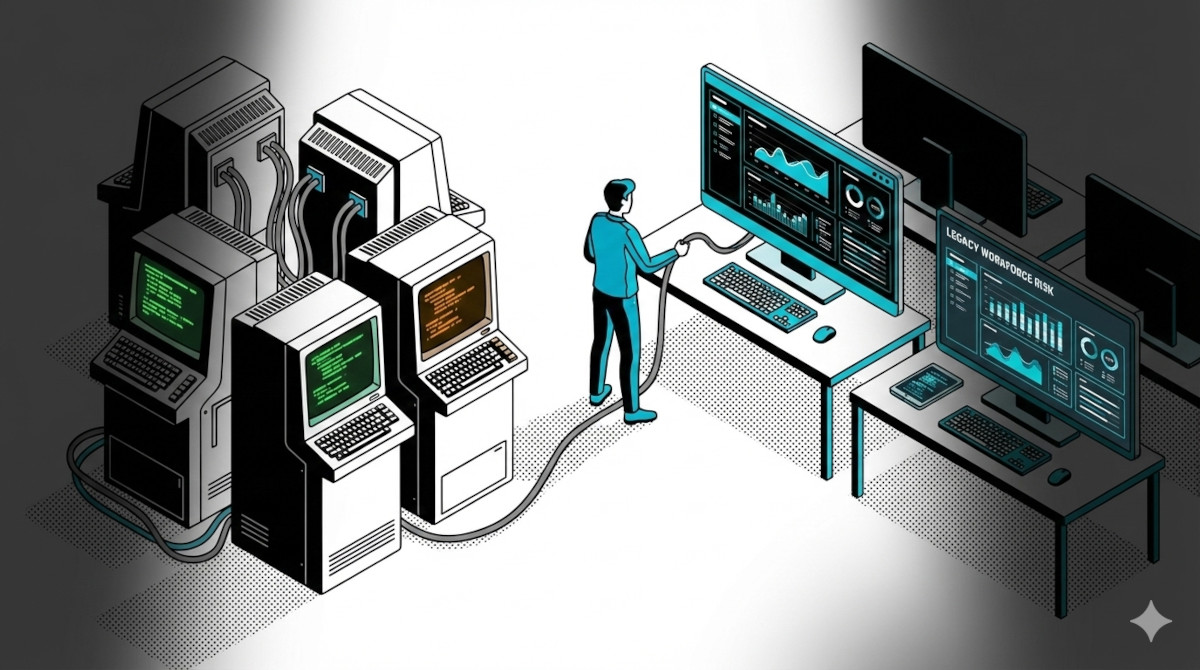
Across banking, healthcare, insurance, and manufacturing, enterprises still run their most critical operations on systems built 20, 30, even 40 years ago. COBOL, Assembler, PL/I, JCL, RPG, and other mainframe-era languages remain the backbone of payment clearing, medical claims processing, inventory management, and risk reporting. These systems work—until the people who understand them start leaving.
That moment has already arrived. The legacy-skilled workforce is aging out faster than organizations can replace it. Decades of institutional knowledge, undocumented logic paths, tacit operational behaviors, and tribal workflows now sit inside the heads of a shrinking group of experts. The supply of engineers trained in these languages has collapsed, and even well-funded enterprises are competing for a dwindling pool of talent.
As a result, organizations face a growing fragility within operations. Simple changes take longer. Incident response depends on people who may retire next quarter. And modernization efforts slow because no one has a complete map of how systems actually work. The risk is not hypothetical—it’s structural.
Why Legacy Talent Scarcity Has Become an Enterprise-Level Threat
The retirement wave that has been predicted for more than a decade is no longer theoretical—it’s reshaping IT operations in real time. In many enterprises, 30–50% of the engineers who built or maintained core systems are already at or near retirement age. When they leave, they take irreplaceable context with them: undocumented business rules, exception paths, operational workarounds, and decades of system intuition that no onboarding plan can fully capture.
At the same time, the pipeline of new talent is drying up. Fewer universities teach COBOL, Assembler, or PL/I. Most early-career engineers gravitate toward cloud-native ecosystems, not mainframes. This asymmetry—high attrition, low replenishment—creates a structural talent deficit that cannot be solved through hiring alone.
Operational fragility increases as teams become dependent on a small number of subject-matter experts. Incidents take longer to resolve. Regression risks rise. Changes require excessive coordination because no single person has a full view of legacy logic. Onboarding becomes a months-long process as new engineers piece together fragmented documentation, outdated diagrams, and tribal knowledge scattered across teams.
These dynamics compound risk for regulated enterprises. Compliance windows shrink. Audit responsiveness depends on people who may not be available. And modernization timelines slip because teams cannot reliably interpret what the legacy system is doing today—let alone how it will behave under transformation.
The Hidden Operational, Compliance, and Continuity Costs of Workforce Risk
Workforce dependency within legacy environments doesn’t show up on a balance sheet, yet it shapes nearly every operational and financial outcome. When only a handful of engineers understand how foundational systems behave, organizations inherit a set of hidden risks that compound quietly until they surface as outages, delays, or missed regulatory deadlines.
Operationally, the impact is immediate. Incident response times stretch because the one engineer who knows the failing module is unavailable. Routine code changes trigger unexpected regressions because downstream logic was never documented. Maintenance windows become unpredictable, and system stability increasingly relies on human memory rather than institutional knowledge. Even a minor interruption—a sick day, a PTO request, a contractor transition—can limit an entire team’s ability to support mission-critical functions.
For regulated industries, the stakes are even higher. Basel IV, HIPAA, PCI-DSS, and NIST frameworks all assume that systems are understandable, documented, and controllable—assumptions that collapse when documentation gaps are wide and SMEs are scarce. Organizations operating under these mandates face audit exposure, slower compliance reporting, and difficulty proving system integrity. Without reliable knowledge transfer, even routine regulatory requests can trigger multi-week delays.
There is also the financial burden. Time-to-change increases, modernization efforts stall, and technical debt accumulates faster than teams can plan around it. The “bus factor” becomes a Board-level concern: if the only systems engineer who knows how a 1998 COBOL module processes core transactions leaves tomorrow, what happens to business continuity? Most enterprises have no clear answer—and the uncertainty itself becomes a material risk.
Why Most Organizations Still Can’t See Their True Legacy Workforce Exposure
Despite the scale of the problem, most enterprises underestimate how vulnerable they are. Leadership teams often assume the risk is manageable because systems are “stable,” outages are rare, or the senior engineers seem confident in their control of the environment. But stability is misleading—systems may run smoothly precisely because those experts are still present. The real exposure emerges when they’re not.
Documentation gaps are the primary blind spot. In many organizations, 40% or more of legacy code has either outdated documentation or none at all. Critical business rules—especially those embedded in COBOL copybooks, JCL routines, or PL/I data flows—were never formally captured. Teams rely on memory, tribal knowledge, and comments buried deep in modules that haven’t been touched in years. Without accurate documentation, it becomes nearly impossible to quantify the real risk profile of a system or the workforce supporting it.
Legacy workloads also sit outside modern observability frameworks. Unlike cloud-native environments, mainframes and midrange systems rarely generate the telemetry needed to understand dependency paths, operational behavior, or ownership patterns. This makes it difficult for CIOs, CTOs, and engineering leaders to assess how workforce limitations intersect with system complexity.
And because workforce risks accumulate slowly, many organizations have no structured way to measure them. There is no dashboard that shows how many modules depend on a single SME, how many core processes lack documentation, or how close the team is to a retirement cliff. Decisions are made on instinct rather than data—leaving leadership to “guess” their true exposure.
This is precisely the gap the Legacy Workforce Risk Analyzer is designed to address.
Introducing the Legacy Workforce Risk Analyzer
The Legacy Workforce Risk Analyzer was created to give organizations a clear, data-driven view of how exposed they are to workforce-related risks within their legacy environments. For many enterprises, this is the first time they can quantify what has historically been an invisible—but deeply consequential—operational vulnerability.
We built the tool for CIOs, CTOs, engineering leaders, platform owners, and modernization teams who need better visibility into the human dependencies underpinning their most critical systems. These leaders are under mounting pressure—from regulatory mandates, modernization roadmaps, and evolving business demands—to understand not only what their systems do, but who keeps them operational.
The Analyzer highlights the fragility created by talent scarcity, undocumented logic, aging platforms, and reliance on a shrinking cohort of subject-matter experts. By structuring these factors into a consistent scoring model, the tool helps organizations identify where they are most vulnerable long before those risks materialize as outages, compliance gaps, or modernization delays.
How the Risk Analyzer Models Workforce Vulnerability
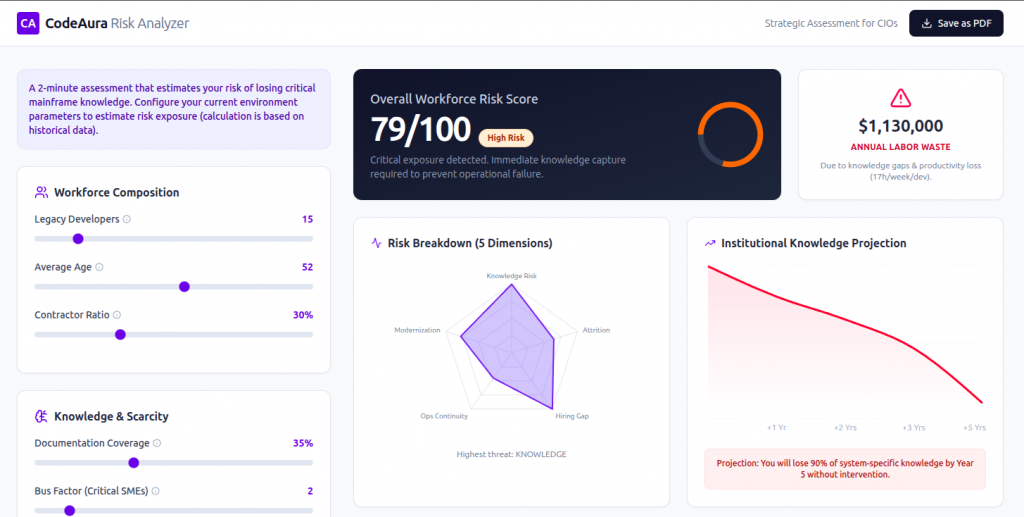
The Legacy Workforce Risk Analyzer translates fragmented, qualitative concerns into a structured, quantitative model that leaders can act on. Instead of relying on anecdotes—“our COBOL expert might retire soon”—the tool analyzes key parameters that are strongly correlated with workforce fragility across regulated industries.
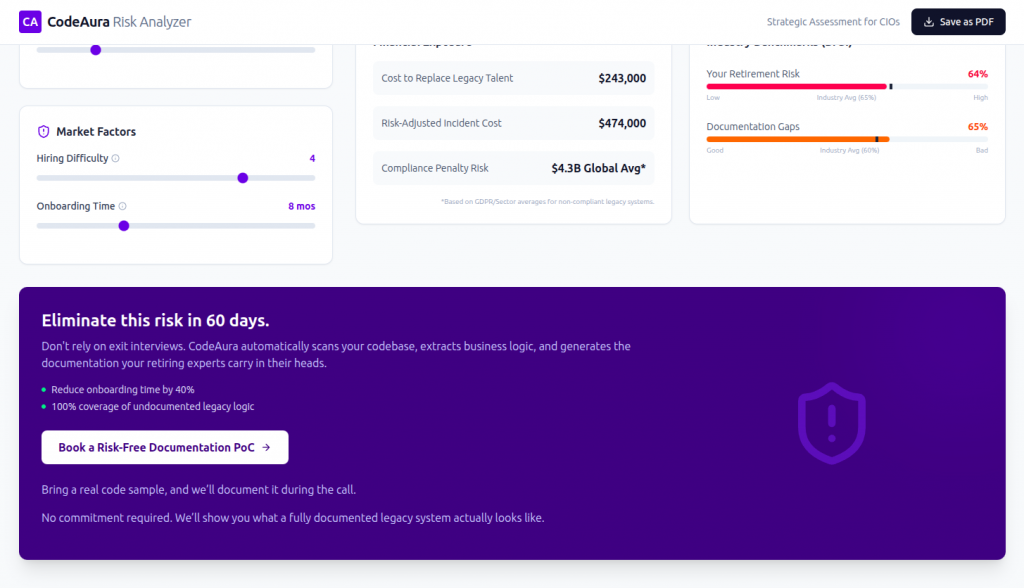
The process is intentionally simple. Users enter a few foundational inputs: team size, proportion of legacy-skilled engineers, expected retirements or departures, documentation coverage, system age, and the mix of technologies in use (COBOL, Assembler, PL/I, JCL, RPG, and others). These signals reflect the real-world patterns observed across enterprises struggling with slow onboarding, declining talent availability, and increasing operational risk.
The model then benchmarks this information against historical patterns and industry norms. For example, it identifies when a system’s SME dependency is dangerously high, when documentation gaps imply low knowledge redundancy, or when the skill scarcity for a particular language increases the likelihood of operational delays. The output is an instant Legacy Workforce Risk Score that summarizes overall exposure and breaks it into constituent dimensions: retirement risk, institutional knowledge gaps, documentation adequacy, talent scarcity, and operational continuity threats.
Each dimension is presented in a way that enables leaders to interpret not just where they stand today, but why. The Analyzer is designed to elevate conversations from general concern to measurable insight—turning implicit workforce risk into explicit, actionable intelligence.
Interpreting Your Legacy Workforce Risk Scorex
A Legacy Workforce Risk Score is more than a numeric output—it’s a snapshot of how dependent your organization has become on a shrinking, irreplaceable workforce. The score exposes patterns that may not be visible day-to-day, especially in environments where systems are “stable” but heavily reliant on a small number of long-tenured experts.
A high score typically indicates deep structural risk: critical workloads owned by one or two SMEs, limited documentation, aging code that only a handful of engineers can interpret, or technologies so scarce that onboarding new talent requires months instead of weeks. These conditions signal that even minor personnel changes could disrupt incident response, maintenance, or compliance activities.
A moderate score often reflects partial fragmentation of knowledge—some documentation exists, but gaps remain in logic flows or operational procedures. Teams may be balanced on paper, yet still face significant delays when newer engineers attempt to contribute or take ownership of legacy modules.
A low score, meanwhile, suggests a healthier distribution of knowledge, more robust documentation, and a workforce with enough redundancy to support long-term stability. But in regulated sectors, “low risk” does not mean “no risk.” System age, audit expectations, and modernization timelines all influence how aggressively teams should proceed with knowledge capture or architectural transformation.
Ultimately, the score provides an early indicator of modernization readiness. It highlights where legacy environments are vulnerable, where knowledge loss is accelerating, and where documentation and workforce planning should begin before transformation efforts stall. Organizations use it as an entry point—clarifying where to focus their next steps, whether that’s strengthening their documentation baseline or initiating a structured modernization path.
Why Every Regulated Enterprise Needs to Act Now
For enterprises operating in banking, healthcare, insurance, and manufacturing, legacy workforce risk is no longer a secondary concern—it is a core operational dependency. The systems powering payments, claims, underwriting, supply chains, and compliance reporting were never designed to outlast the people who built them. Yet today, those individuals are retiring faster than organizations can respond.
The urgency comes from three converging pressures. First, regulatory expectations are tightening: HIPAA demands clearer audit trails, Basel IV requires more transparent risk calculations, and NIST frameworks assume systems are fully understood and documented. These mandates become increasingly difficult to meet when knowledge is trapped in the minds of a handful of SMEs.
Second, modernization timelines are compressing. Strategies that once spanned five to ten years are now being re-evaluated because cloud migration, risk transformation, and digital initiatives depend on code that few people can interpret. Without addressing workforce exposure, modernization becomes a multi-year gamble rather than a controlled program.
Third, operational continuity is becoming more fragile. Unplanned attrition, contract turnover, or even short-term absences can limit a team’s ability to manage incidents or support customer-critical workloads. The financial impact—lost productivity, delayed projects, extended SLAs—grows with every undocumented module and every overextended SME.
Acting now does not require a full modernization program on day one. It begins with visibility. Tools like the Legacy Workforce Risk Analyzer help organizations understand the scope of their exposure so they can prioritize documentation, plan for talent transitions, and create structured pathways toward modernization. In a landscape where workforce risk is accelerating, inaction is the most expensive option.