Why 40% of Legacy Code Being Undocumented Is a Business Risk (Not Just a Technical Problem)

Documentation Is Not a Technical Task—It’s a Business Safeguard
Most organizations still treat documentation as a secondary concern—something to be completed after development, if time permits. It’s often viewed as a technical hygiene task, owned by engineering teams and disconnected from broader business priorities.
This perception is not just outdated—it’s dangerous.
In legacy environments, documentation is not merely about explaining how code works. It is the only reliable lens through which an organization can understand how its critical systems behave, how decisions are encoded, and where risks are embedded. When that lens is missing or incomplete, the organization is effectively operating without visibility into some of its most important assets.
The issue becomes more pronounced in regulated industries. Financial institutions, healthcare providers, and large manufacturers depend on systems that have evolved over decades. These systems process sensitive data, enforce business rules, and support mission-critical operations. Yet, in many cases, the knowledge required to understand them is fragmented, outdated, or entirely absent.
This creates a fundamental disconnect: businesses rely heavily on systems they do not fully understand.
And when understanding is limited, control is limited.
What is often dismissed as a “developer inconvenience” quickly escalates into something far more significant. Decisions take longer because teams must first interpret the system. Changes introduce risk because dependencies are unclear. Audits become more complex because there is no authoritative source of truth.
In this context, documentation is no longer a passive artifact. It becomes a form of operational control—a mechanism that enables organizations to move with confidence, respond to change, and manage risk proactively.
The absence of documentation, therefore, is not a technical gap. It is a business vulnerability.
The Hidden Reality: Why 40% of Legacy Systems Lack Documentation
Across industries, a consistent and concerning pattern has emerged: a significant portion of legacy systems operate with little to no reliable documentation. In many enterprises, more than 40% of system components are either undocumented or poorly documented—creating blind spots that accumulate over time.
This is not the result of negligence. It is the natural outcome of how legacy systems evolve.
Most enterprise systems were not built in a single phase. They have been extended, patched, and reworked over decades to accommodate new business requirements, regulatory changes, and technological shifts. Each iteration introduces new layers of complexity, often without revisiting or updating existing documentation.
Over time, documentation becomes fragmented.
Some of it exists in outdated files. Some lives in internal wikis that no one trusts. Some is embedded in comments written years ago by developers who are no longer with the organization. And in many cases, critical knowledge exists only in the minds of a few experienced team members.
This creates an environment where the system’s true behavior is not fully captured anywhere.
Compounding the issue is the pace of change. In modern enterprises, systems are expected to adapt continuously—whether to support new digital channels, integrate with external platforms, or comply with evolving regulations. Documentation, when handled manually, cannot keep up with this rate of change. It quickly becomes obsolete, further eroding trust in its accuracy.
As a result, teams often stop relying on documentation altogether.
Instead, they rely on trial-and-error, institutional memory, and informal knowledge sharing. While this may work in the short term, it introduces long-term instability. Every new change is made with partial understanding. Every investigation starts from scratch. Every onboarding process becomes slower and more resource-intensive.
But the most critical insight is this:
The problem is not just that documentation is missing. It’s that the absence of documentation compounds risk across every layer of the organization.
And that risk becomes most visible when systems need to change.
The Compounding Risks of Undocumented Systems Across the Enterprise
The absence of documentation does not create a single point of failure—it introduces a network of risks that affect operations, finances, talent, and compliance simultaneously. These risks are often invisible until a critical moment forces the organization to confront them.
Operational Risk
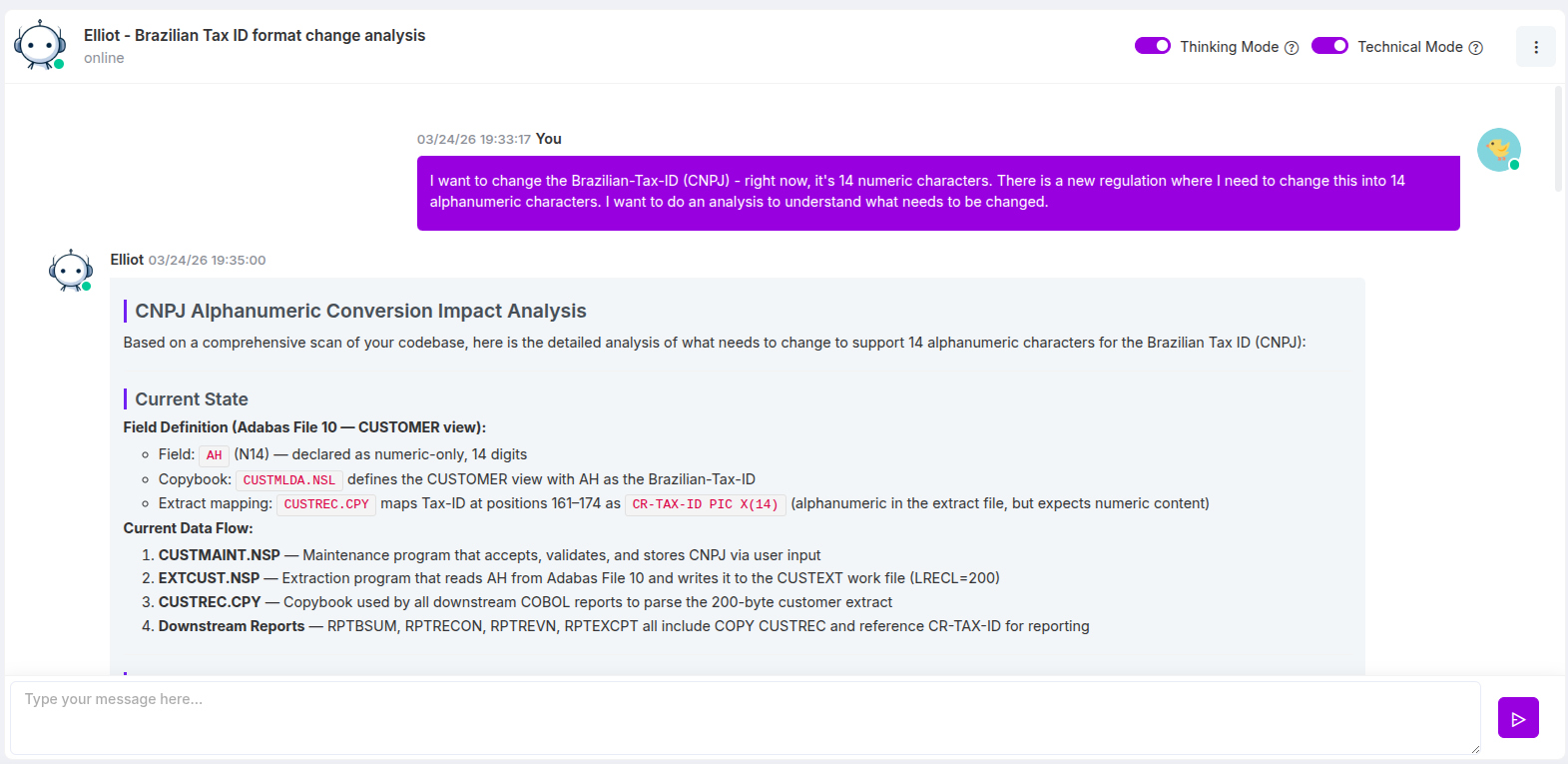
When systems are not fully understood, even routine changes become high-risk activities. Teams lack clarity on dependencies, data flows, and downstream impacts. As a result, small modifications can trigger unintended consequences across the system.
Incidents take longer to resolve because engineers must first interpret how the system behaves before they can fix it. Troubleshooting becomes reactive rather than structured. Over time, this erodes system stability and slows the organization’s ability to respond to business needs.
“When no one fully understands a system, every change becomes a risk.”
A clear, shared understanding of system behavior is not optional—it is foundational to operational reliability.
Financial Risk
Undocumented systems introduce persistent inefficiencies that directly impact the bottom line. Development cycles are extended because teams spend significant time deciphering existing code before making changes. Maintenance costs increase as complexity compounds and productivity declines.
In many enterprises, this translates into thousands of hours annually spent on rediscovery rather than delivery.
Budget overruns become more likely, not because of poor planning, but because the true complexity of the system is hidden. What appears to be a simple change often requires deep investigation, rework, and validation.
Reducing time spent interpreting code is one of the most immediate ways to improve delivery efficiency and control costs.
Talent and Knowledge Risk
In undocumented environments, knowledge becomes concentrated in individuals rather than systems. Over time, this creates dependency on a small number of experienced employees who understand how critical systems function.
This introduces a structural risk.
If those individuals leave, retire, or are unavailable, the organization loses not just people—but operational continuity. New team members face steep onboarding curves, and institutional knowledge becomes increasingly difficult to recover.
“In many organizations, critical systems are understood by a handful of people—or sometimes just one.”
Transforming individual expertise into shared, accessible knowledge is essential for long-term resilience.
Compliance and Audit Risk
For regulated enterprises, undocumented systems create a serious compliance challenge. Organizations must be able to demonstrate how systems process data, enforce rules, and meet regulatory requirements.
Without clear documentation, this becomes difficult—and in some cases, impossible.
Audit cycles become longer and more resource-intensive. Teams must manually trace logic, validate assumptions, and reconstruct system behavior under pressure. This increases the likelihood of gaps, inconsistencies, and potential non-compliance.
As regulatory expectations continue to rise, the cost of this uncertainty grows.
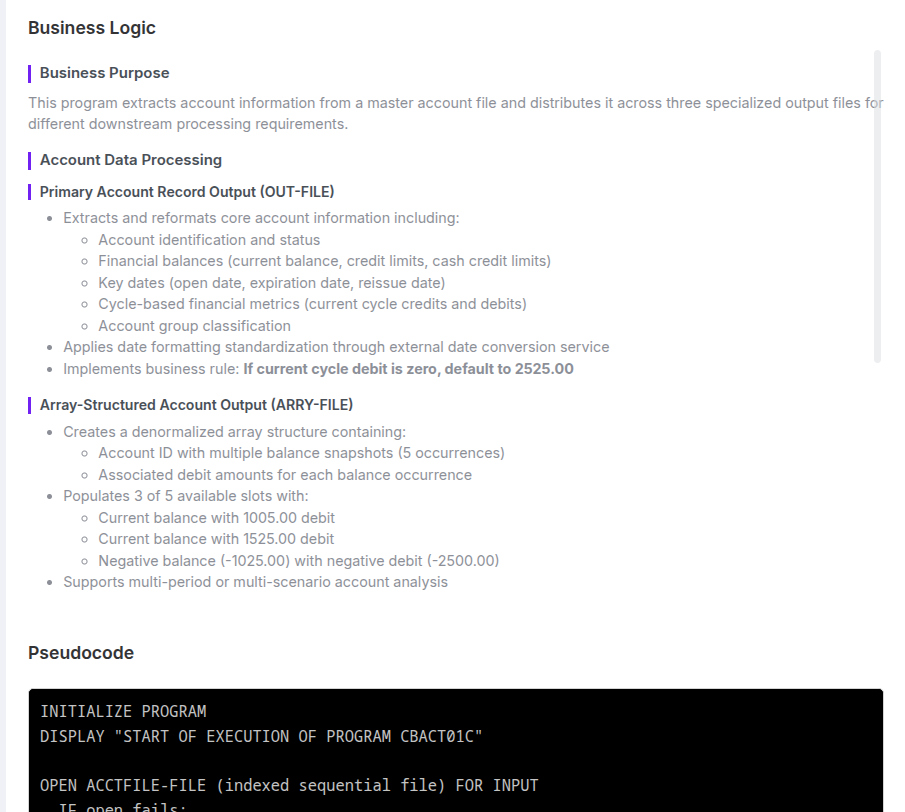
Understanding where sensitive logic resides—and how it operates—is critical for maintaining audit readiness and reducing regulatory exposure.
Across all four dimensions, the pattern is consistent: undocumented systems limit visibility, and limited visibility increases risk.
What begins as a documentation gap evolves into a business-wide constraint—impacting speed, cost, resilience, and compliance.
Why Traditional Documentation Approaches Break at Scale
If documentation is so critical, why do so many organizations still struggle with it?
The answer lies in how documentation has traditionally been created and maintained.
In most enterprises, documentation is a manual process—written by developers, updated inconsistently, and often treated as a secondary task to “real” engineering work. While this approach may function in smaller, modern systems, it breaks down entirely in legacy environments where complexity, scale, and rate of change are significantly higher.
The first issue is time.
Creating meaningful documentation requires deep system understanding, careful structuring, and ongoing maintenance. In fast-moving environments, teams prioritize delivery over documentation. As deadlines approach, documentation is postponed, reduced in scope, or skipped altogether. Over time, this creates immediate gaps.
The second issue is decay.
Even when documentation is created, it rarely stays accurate. Systems evolve continuously—new features are added, logic is modified, integrations change. Unless documentation is updated in parallel with every change, it quickly becomes outdated. And once teams lose trust in its accuracy, they stop using it entirely.
This leads to a paradox: documentation exists, but it is no longer useful.
The third issue is inconsistency.
Different teams document in different ways, using different formats, tools, and levels of detail. Some focus on high-level architecture, others on code comments, and others on process flows. The result is a fragmented knowledge landscape where no single source provides a complete picture of the system.
This fragmentation makes it difficult to answer even basic questions:
- How does this system handle a specific business rule?
- What dependencies exist between components?
- Where are compliance-sensitive processes implemented?
Finally, traditional documentation is not designed for accessibility.
Most documentation is written for developers, by developers. It assumes technical context and familiarity with the system. This excludes key stakeholders—compliance officers, business analysts, auditors, and executives—who also need to understand how systems operate, but from a different perspective.
“Manual documentation doesn’t scale—and in legacy systems, scale is exactly what’s needed.”
In large enterprises with millions of lines of legacy code, expecting manual documentation to remain accurate, consistent, and accessible is unrealistic. The model itself is fundamentally misaligned with the complexity it is meant to support.
As a result, organizations are left with a growing gap between what their systems do and what they can confidently explain.
And that gap is where risk continues to accumulate.
From Static Files to Living Systems: Rethinking Documentation
The failure of traditional documentation is not due to lack of effort—it is due to a fundamentally outdated model.
Documentation has long been treated as a static artifact: created at a point in time, stored in isolation, and expected to remain relevant as systems evolve around it. In legacy environments, where change is constant and complexity is layered, this model cannot keep pace.
What organizations need instead is a shift in mindset:
Documentation must become a living system.
A living documentation system is not something teams manually maintain—it is something that evolves alongside the codebase, continuously reflecting the current state of the system. It is dynamic, context-aware, and deeply integrated into development workflows.
This shift is not just technical—it is strategic.
When documentation becomes living and reliable, it transforms from a passive reference into an active operational asset. Teams no longer need to search for information or question its accuracy. Instead, they can interact with a continuously updated source of truth that reflects how the system actually behaves.
This approach is built on a few key principles.
First, documentation must be automatically generated.
Relying on manual input introduces inconsistency and delay. Automation ensures that documentation is created comprehensively and consistently across all layers of the system—from individual files to full architectures.
Second, it must be continuously updated.
Every code change, every deployment, every modification should be reflected in the documentation in real time. This eliminates the problem of decay and ensures long-term reliability.
Third, it must be accessible across roles.
Developers, architects, compliance officers, and business stakeholders all require different views of the same system. A living documentation system translates technical complexity into formats that each audience can understand and use.
Fourth, it must be embedded into workflows.
Documentation should not live in separate tools or isolated repositories. It should be part of how teams build, analyze, and operate systems—available at the moment it is needed.
This model fundamentally changes how organizations interact with their systems.
Instead of relying on fragmented knowledge and outdated artifacts, they gain a continuously evolving understanding of their technology landscape. Decisions become faster, changes become safer, and risks become more visible.
In this context, documentation is no longer a record of the past.
It becomes a real-time representation of the present—and a foundation for making better decisions about the future.
Operationalizing Knowledge: How CodeAura Transforms Documentation
The shift from static documentation to living systems requires more than process improvement—it requires a fundamentally different approach to how knowledge is captured, structured, and delivered.
This is where CodeAura operates.
Rather than treating documentation as a byproduct of development, CodeAura positions it as an integrated layer within the system itself—continuously generated, context-aware, and immediately accessible. It transforms documentation from fragmented artifacts into a unified knowledge system that serves both technical and business stakeholders.
Automated Documentation at Scale
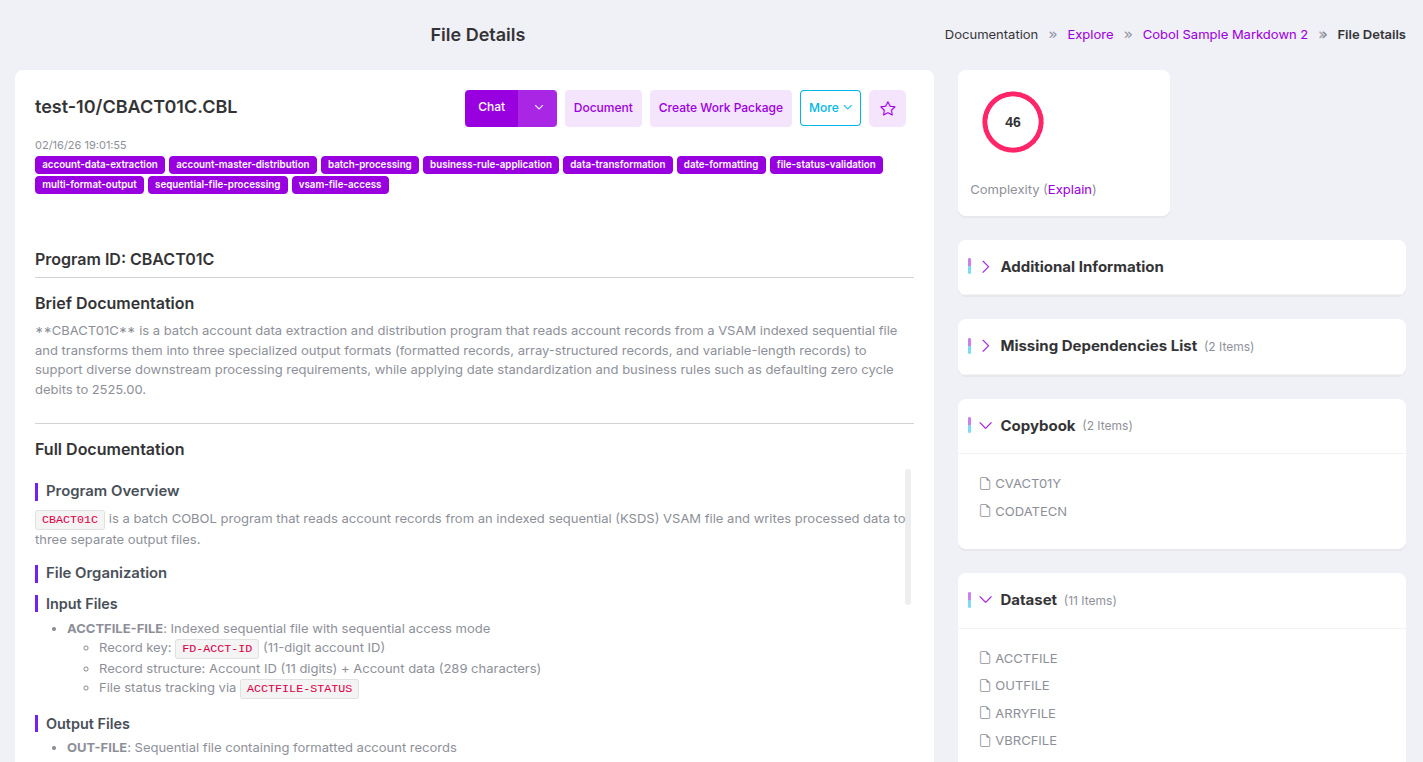
CodeAura eliminates the need for manual documentation by generating it directly from the codebase. It produces structured insights at multiple levels—file, module, and system—ensuring comprehensive coverage without relying on developer intervention.
This approach addresses one of the most persistent gaps in legacy environments: incomplete visibility.
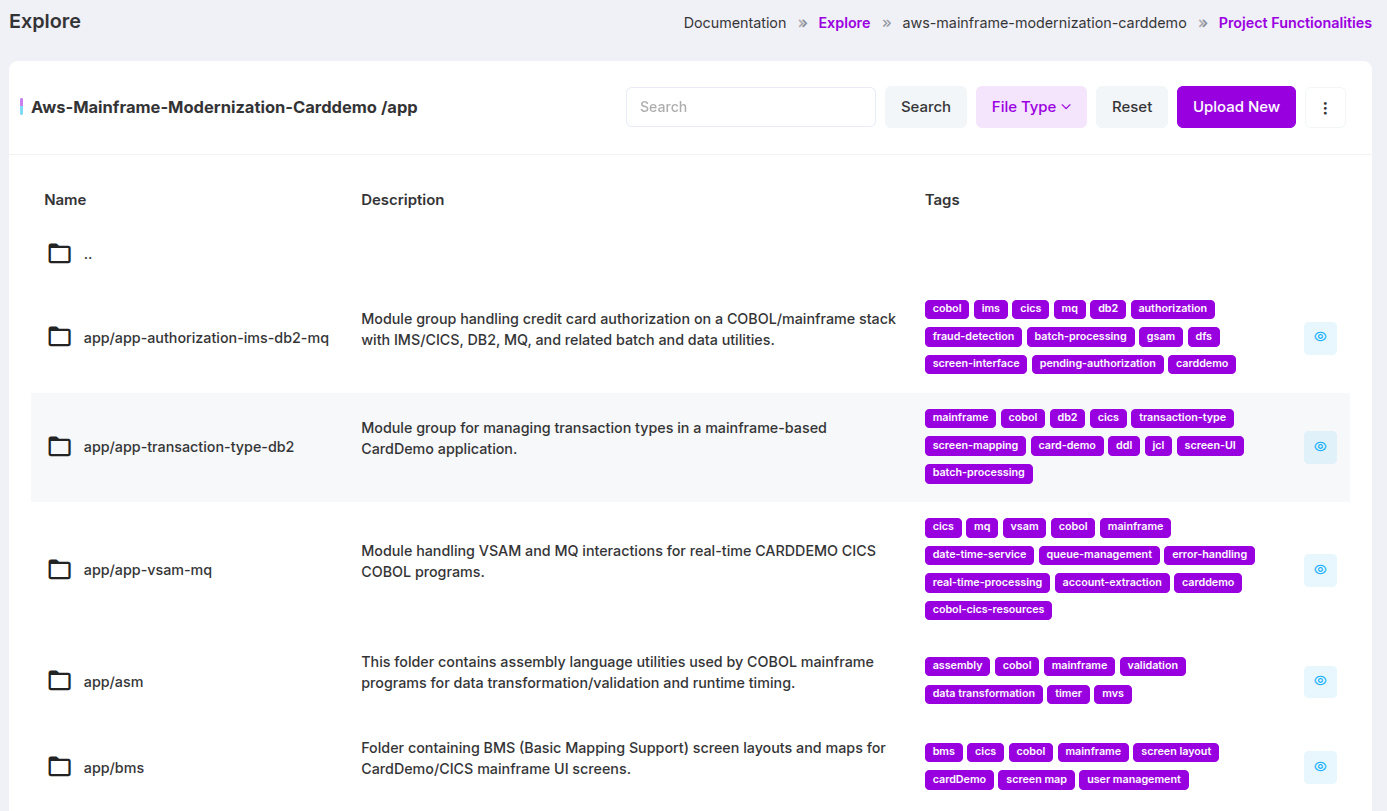
Instead of spending weeks assembling partial documentation, teams gain immediate access to a complete and consistent view of their systems.
Real-Time Updates
One of the core limitations of traditional documentation is that it becomes outdated almost immediately. CodeAura resolves this by synchronizing documentation with the system in real time.
As code evolves, documentation evolves with it.
This ensures that teams are always working with accurate, current information—eliminating the uncertainty that typically surrounds legacy systems.
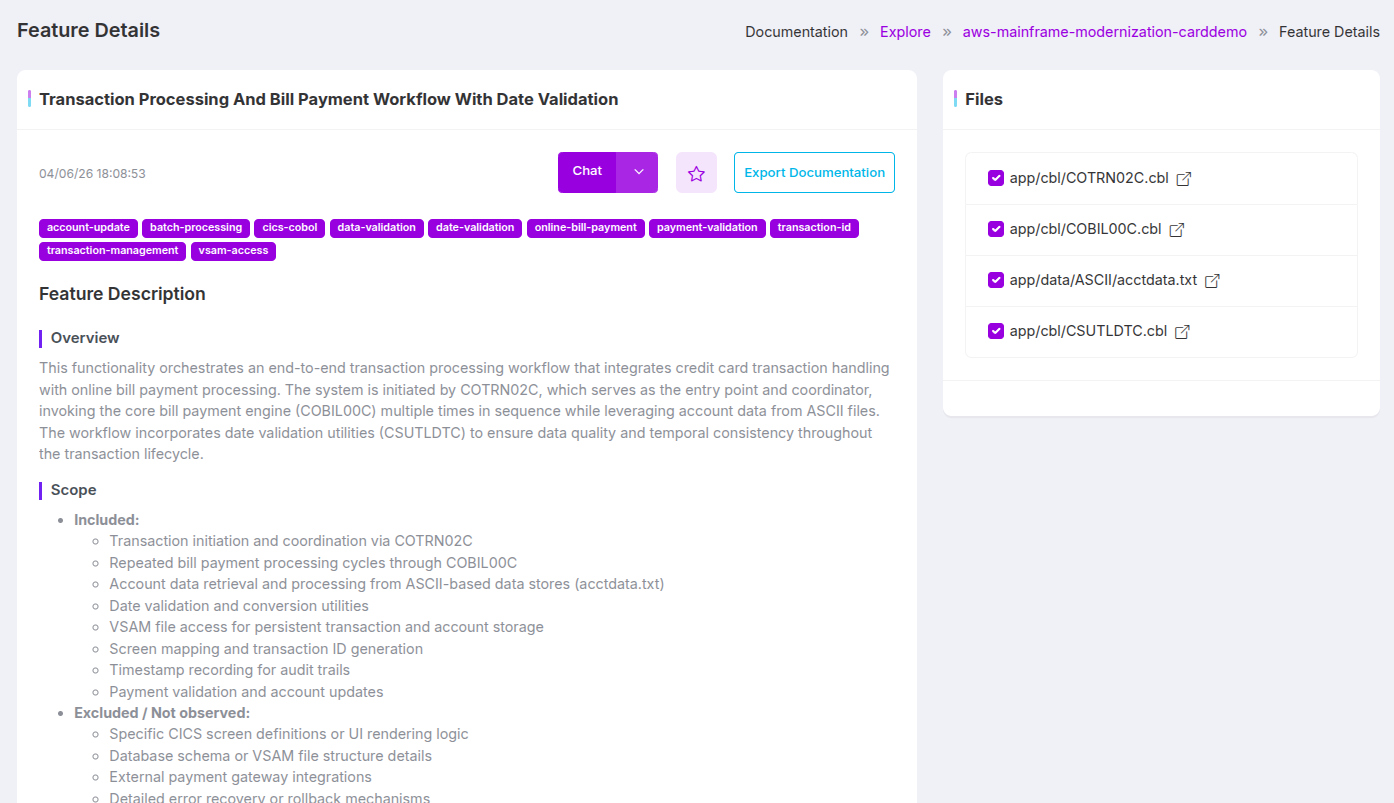
The result is a persistent source of truth that teams can rely on, even as systems grow and change.
Business Logic Extraction
Legacy systems often encode critical business rules deep within complex code structures, making them difficult to interpret outside of engineering teams.
CodeAura extracts this logic and translates it into structured, human-readable formats—such as pseudocode, workflows, and summarized logic flows. This bridges the gap between technical implementation and business understanding.
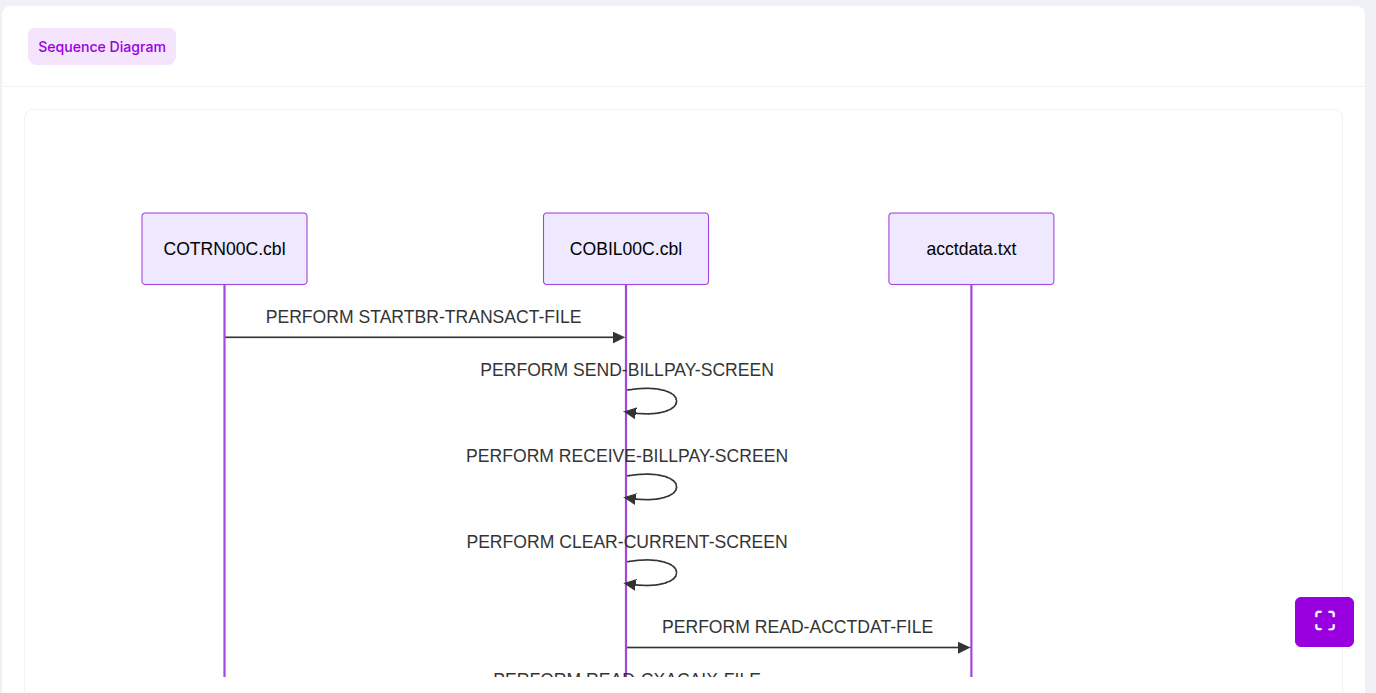
This capability is particularly valuable in regulated environments, where understanding how decisions are made within systems is essential for both operations and compliance.
Knowledge Accessibility
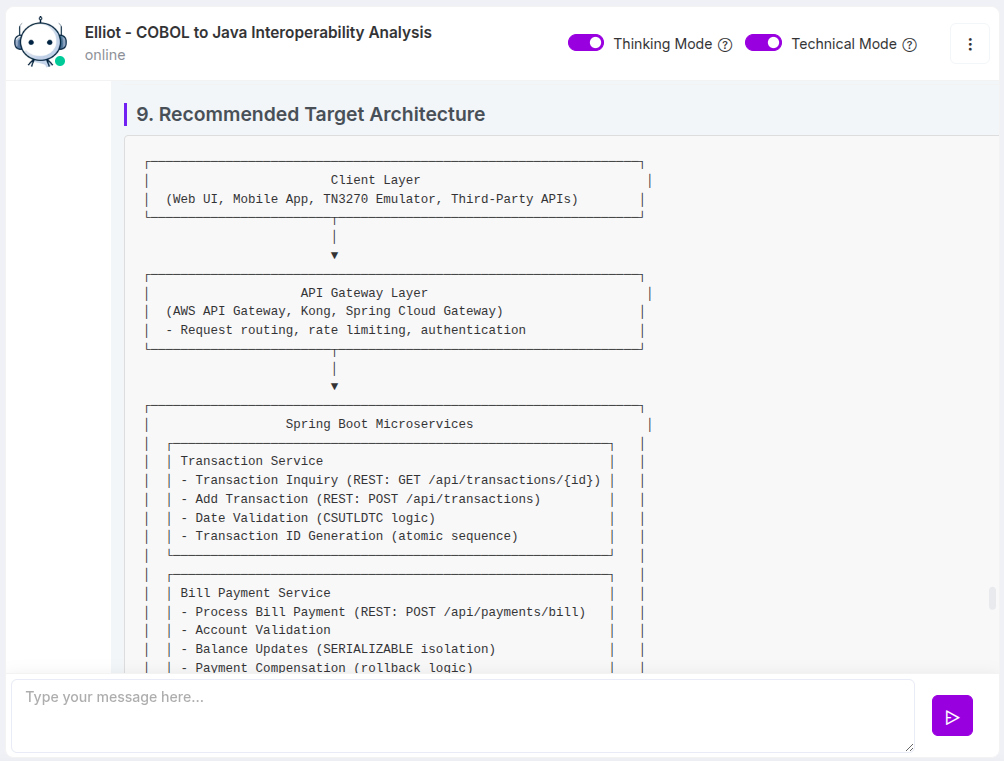
In most organizations, accessing system knowledge requires navigating multiple tools, documents, and people. CodeAura consolidates this into a single, queryable interface.
Through its AI-powered knowledge system, users can ask questions about the system and receive contextual, accurate answers—whether they are developers investigating dependencies or compliance teams validating processes.
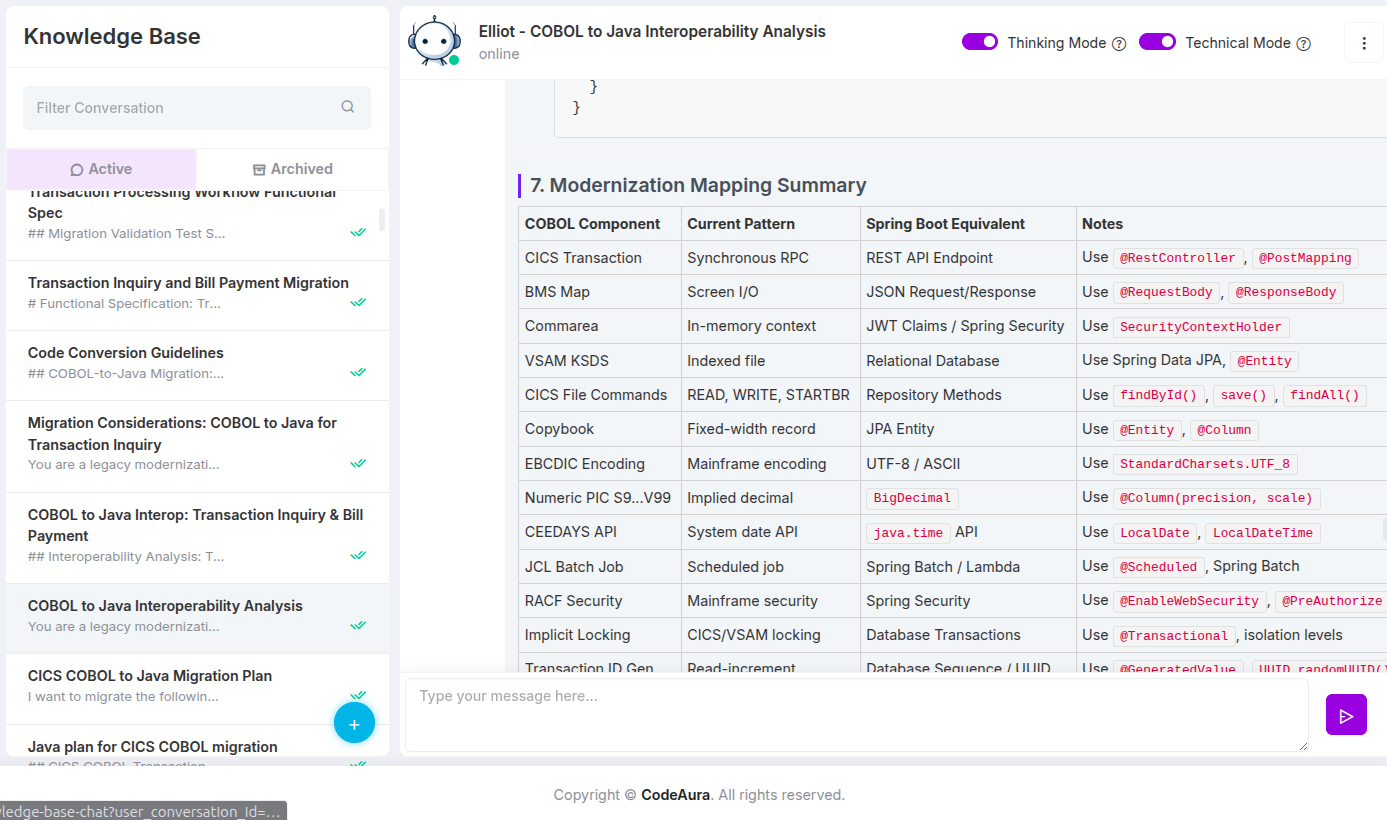
This transforms knowledge from something that must be searched for into something that can be accessed instantly.
By embedding documentation into the system itself, CodeAura removes the friction that has historically made documentation unreliable and underutilized.
It enables organizations to move from fragmented understanding to continuous clarity—reducing risk, accelerating delivery, and strengthening operational control.
From Fragility to Control: The Shift to Documentation Maturity
The impact of documentation is most clearly understood when viewed as a transformation—from fragmented, unreliable knowledge to a structured, continuously accessible system of record.
In traditional environments, documentation is inconsistent, incomplete, and often distrusted. Teams operate with partial visibility, relying on experience and informal knowledge to navigate complex systems. This creates friction at every level of the organization, from development to compliance.
In contrast, organizations that adopt an AI-driven, living documentation model shift toward a state of operational clarity and control.
The difference is not incremental—it is structural.
| Traditional State | AI-Driven State |
|---|---|
| Sparse or outdated documentation | Comprehensive, continuously updated documentation |
| Knowledge concentrated in individuals | Knowledge distributed and accessible across teams |
| Long onboarding cycles | Accelerated onboarding and productivity |
| High risk during system changes | Greater confidence in change management |
| Reactive issue resolution | Proactive system understanding |
This transformation has immediate and measurable effects.
New team members become productive faster because they can understand systems without relying on tribal knowledge. Engineering teams spend less time interpreting code and more time delivering value. Incidents are resolved more efficiently because system behavior is clearly documented and traceable.
At an organizational level, decision-making improves.
Leaders gain clearer visibility into how systems operate, where dependencies exist, and where risks may be hidden. This enables more accurate planning, better prioritization of modernization efforts, and stronger alignment between technology and business objectives.
Most importantly, the organization moves from a position of fragility to one of control.
Instead of reacting to uncertainty, teams operate with a shared understanding of their systems. Instead of depending on individuals, they rely on a structured knowledge foundation. Instead of fearing change, they can approach it with confidence.
This is what documentation maturity looks like in practice—not more documents, but better visibility, accessibility, and trust in the knowledge that drives the business.
The Strategic Imperative: Treating Knowledge as Infrastructure
In modern enterprises, technology is no longer just a support function—it is the backbone of operations, decision-making, and compliance. Yet within this foundation, one critical element is consistently overlooked: structured, accessible knowledge.
Undocumented or poorly documented systems represent a fundamental weakness in that foundation.
Organizations invest heavily in infrastructure resilience, cybersecurity, and scalability. They implement redundancy, monitoring, and governance frameworks to ensure stability and control. But when the systems themselves are not fully understood, these investments are undermined.
Because you cannot control what you cannot see.
Documentation, in this context, is not a secondary concern. It is a form of infrastructure—just as critical as the systems it describes. It enables visibility into how technology operates, how decisions are executed, and where risks are embedded.
Without it, organizations are forced to operate on assumptions.
With it, they can operate with certainty.
This distinction becomes especially important in environments shaped by regulatory pressure and rapid change. Whether adapting to new compliance requirements, modernizing legacy systems, or integrating with emerging platforms, organizations must be able to understand and explain their systems with precision.
That capability is not optional—it is foundational to resilience and growth.
“In modern organizations, knowledge is infrastructure. And undocumented systems represent a failure of that infrastructure.”
As enterprises continue to modernize, the focus will increasingly shift from simply upgrading technology to ensuring that technology is fully understood, governed, and aligned with business objectives.
This is where competitive advantage begins to emerge.
Organizations that treat documentation as infrastructure gain more than clarity. They gain speed, confidence, and control. They reduce risk not by reacting to issues, but by eliminating the uncertainty that causes them.
And ultimately, they position themselves to evolve—without losing visibility into the systems that power their business.