Efficiency Through Clarity: How Documentation Drives Team Performance and Knowledge Retention
The Hidden Inefficiency: Relearning What You Already Know
Every enterprise that runs on legacy systems has experienced the same frustration: a project grinds to a halt not because of a lack of skill, but because no one remembers why something was built the way it was. A data validation rule hidden deep in COBOL logic, a batch job that must run in a specific sequence — these details often exist only in the heads of a few long-tenured experts. When those experts retire or move on, teams are left to rediscover the same logic over and over again.
This relearning cycle is more than a minor nuisance — it’s an operational drain. Developers spend weeks tracing dependencies, QA teams struggle to understand failure patterns, and business analysts wait for technical explanations before they can model new processes. What looks like a “slow sprint” is often a symptom of missing knowledge. In regulated sectors such as banking or healthcare, this inefficiency compounds risk: undocumented behavior can directly affect compliance validation, data integrity, and audit readiness.
What makes this problem insidious is its invisibility. Most organizations measure delivery velocity, not the cost of rediscovery. Yet, across a typical enterprise with aging codebases and fragmented documentation, the productivity loss can exceed 25–30% annually. The result is a paradox — highly capable teams spending disproportionate time learning what their predecessors already knew.
CodeAura approaches this inefficiency as a knowledge problem, not just a process issue. By capturing and structuring legacy system intelligence through AI-powered analysis, it transforms what was once tribal memory into institutional knowledge. The payoff isn’t just clarity — it’s continuity.
The Cost of Lost Knowledge in Regulated Enterprises
When a senior developer retires or a key system analyst leaves, their departure often exposes how fragile an organization’s knowledge fabric really is. In enterprises where legacy systems underpin critical operations—claims processing, payments, or compliance reporting—these knowledge gaps have measurable consequences. What was once a simple change request can become a six-month onboarding exercise just to understand the system’s behavior.
Industry data suggests that onboarding a new developer into a legacy environment can consume 400–600 hours before they achieve full productivity. Multiply that across a 40-person IT team with annual turnover, and the cost of lost knowledge can reach $1.5 million per year in wasted time and rework. But the hidden cost runs deeper: missed release deadlines, delayed audits, and recurring compliance exceptions due to incomplete system understanding.
In regulated industries, knowledge isn’t just an operational asset — it’s a compliance control. Basel IV, HIPAA, and NIST frameworks all depend on traceable system logic and verifiable control mapping. When documentation is missing or outdated, every audit becomes an archaeology project. Compliance officers chase fragmented spreadsheets, while developers scramble to recreate the rationale behind critical configurations.
The result is a form of organizational amnesia — where every change reopens old wounds and every audit replays the same fire drill. It’s not a talent problem, it’s a documentation problem.
CodeAura eliminates this cost by transforming undocumented legacy code into a continuously updated, AI-generated knowledge base. Every logic path, dependency, and business rule is automatically captured and contextualized, ensuring that expertise persists even as teams evolve. The outcome is predictable onboarding, consistent compliance, and a dramatic reduction in rediscovery cycles.
From Chaos to Clarity: CodeAura’s AI-Driven Documentation Engine
Enterprises don’t struggle with complexity because their systems are poorly built — they struggle because their knowledge about those systems is fragmented, outdated, and siloed. Over time, documentation falls behind code changes, tribal knowledge becomes institutional risk, and operational clarity gives way to confusion. CodeAura’s AI-driven documentation engine is designed to reverse that pattern by transforming legacy code into living, discoverable intelligence.
At its core, CodeAura applies AI-assisted contextual analysis to legacy environments — from COBOL and JCL to database procedures and interface definitions. Instead of static code scans, it performs deep semantic interpretation, mapping data flows, control logic, and process interactions. This analysis produces a dynamic documentation layer that automatically updates as systems evolve, ensuring accuracy without manual upkeep.
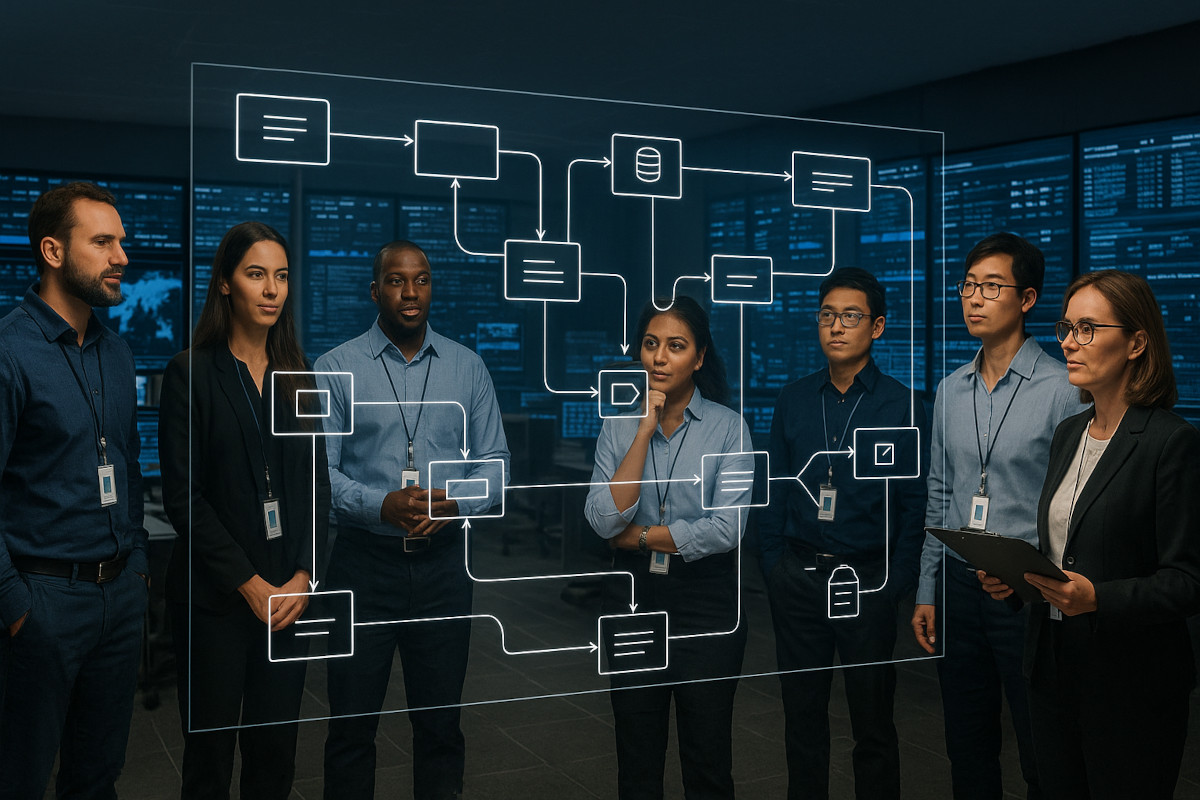
But the real power lies in how this intelligence is shared. CodeAura creates a unified, searchable knowledge fabric that connects IT, finance, and compliance teams. A compliance officer can trace how a Basel IV capital rule propagates through a calculation engine; a developer can instantly locate dependencies affected by a change request; a CFO can visualize how modernization will impact operational cost drivers. The result is not just documentation — it’s alignment.
Unlike traditional documentation tools, CodeAura’s system isn’t an afterthought; it’s embedded in the modernization lifecycle. Teams can query the system through chat interfaces integrated with Slack, JIRA, or Discord, enabling real-time collaboration around technical and non-technical insights. This turns knowledge from a passive archive into an active decision enabler.
By making legacy systems transparent and explainable, CodeAura turns chaos into clarity — helping enterprises move faster, reduce compliance friction, and retain critical system intelligence for the long term.
Collaboration Without Bottlenecks
In large, regulated enterprises, collaboration often breaks down at the intersection of technology and oversight. Developers operate in one context, compliance teams in another, and business analysts in yet another — each relying on fragmented, outdated information. The result is a constant pattern of clarifications, meetings, and handoffs that stall progress. Every time a system change touches finance rules, audit data, or security controls, teams pause to interpret what the system actually does.
CodeAura removes these friction points by creating a single source of truth for technical and operational understanding. Its AI-driven documentation unifies code logic, business rules, and compliance mappings into a shared, queryable knowledge base. Instead of waiting for explanations from a subject matter expert, any stakeholder — from a developer to a regulatory officer — can explore the exact logic flow or dependency through CodeAura’s interactive interface.
This transparency transforms collaboration.
Cross-functional projects move faster because everyone operates from the same information baseline.
Rework and duplicate audits decline as teams reuse validated insights rather than recreating them.
Support tickets drop because self-service knowledge reduces reliance on legacy specialists.
For example, a financial institution using CodeAura to modernize a core ledger system saw a 40% reduction in compliance review cycles and eliminated redundant testing across three departments. What previously required a chain of email clarifications now takes a single search.
CodeAura doesn’t just document systems — it democratizes their understanding. By doing so, it replaces dependency-driven workflows with knowledge-driven collaboration, enabling teams to act decisively without waiting for translation across silos. In complex, high-stakes environments, that clarity is not just efficient — it’s transformative.
The Knowledge Retention Dividend
When knowledge lives only in people’s heads, it depreciates the moment they walk out the door. Enterprises have long accepted this as inevitable — the quiet cost of turnover, retirement, or reorganization. But in environments where systems must meet continuous audit scrutiny and regulatory standards, this loss isn’t just inconvenient; it’s a structural risk. The organizations that thrive are those that transform individual expertise into institutional intelligence.
This is where CodeAura’s AI-generated documentation delivers exponential returns — the knowledge retention dividend. By continuously analyzing and documenting every logic path, integration, and business rule, CodeAura preserves operational knowledge as a living, evolving asset. Instead of static manuals or outdated wikis, teams inherit a context-aware knowledge base that grows alongside the codebase.
The impact is quantifiable. Enterprises using AI-powered documentation report:
65% faster onboarding for new developers and analysts.
50% reduction in dependency on legacy SMEs for day-to-day queries.
Significant savings in audit preparation and regulatory review cycles.
More importantly, retained knowledge reduces uncertainty. Every new initiative — whether it’s a migration, integration, or compliance update — starts from a foundation of verified understanding. That means fewer assumptions, fewer errors, and faster time-to-value.
CodeAura turns what was once a liability — the fragility of human memory — into a strategic advantage. The organization no longer depends on who remembers what, but on what the system already knows. That’s not just retention — it’s resilience.
Clarity Compounds Efficiency
In every large enterprise, productivity is often measured by output — lines of code delivered, tickets resolved, or features released. Yet beneath those metrics lies a quieter determinant of success: how clearly teams understand the systems they manage. Clarity reduces rework, accelerates onboarding, and minimizes compliance risk. Over time, these incremental gains multiply, creating what can only be described as compound efficiency.
This is the effect of living documentation — knowledge that grows, adapts, and remains accurate as systems evolve. When every stakeholder can instantly access the “why” and “how” behind system logic, decision-making becomes faster and more confident. Developers focus on innovation instead of reverse-engineering. Compliance teams validate controls with precision instead of approximation. Finance and operations can align modernization investments with measurable ROI.
CodeAura’s Knowledge Intelligence Platform operationalizes this clarity. By merging AI-driven code analysis with real-time documentation, it transforms fragmented understanding into continuous organizational insight. The result is a self-reinforcing cycle: better documentation drives better collaboration, which in turn produces cleaner systems and faster delivery — compounding efficiency across every function.
For enterprises burdened by legacy systems and regulatory complexity, this is more than modernization; it’s a redefinition of how teams work. Clear knowledge isn’t just a productivity tool — it’s the foundation of sustainable performance.
Discover how CodeAura’s Knowledge Intelligence Platform transforms clarity into compounding efficiency — Schedule a session with CodeAura today.