
What Developers Actually Need From Modernization Platforms (And Why Most Tools Miss the Mark)
Why Developer Friction Is the Silent Killer of Modernization Programs
Modernization programs often fail quietly. Systems migrate. Budgets are consumed. Yet progress slows, quality suffers, and timelines slip. When this happens, the root cause is frequently attributed to scope creep or technical complexity. In reality, the issue is often simpler—and more damaging: developer friction.
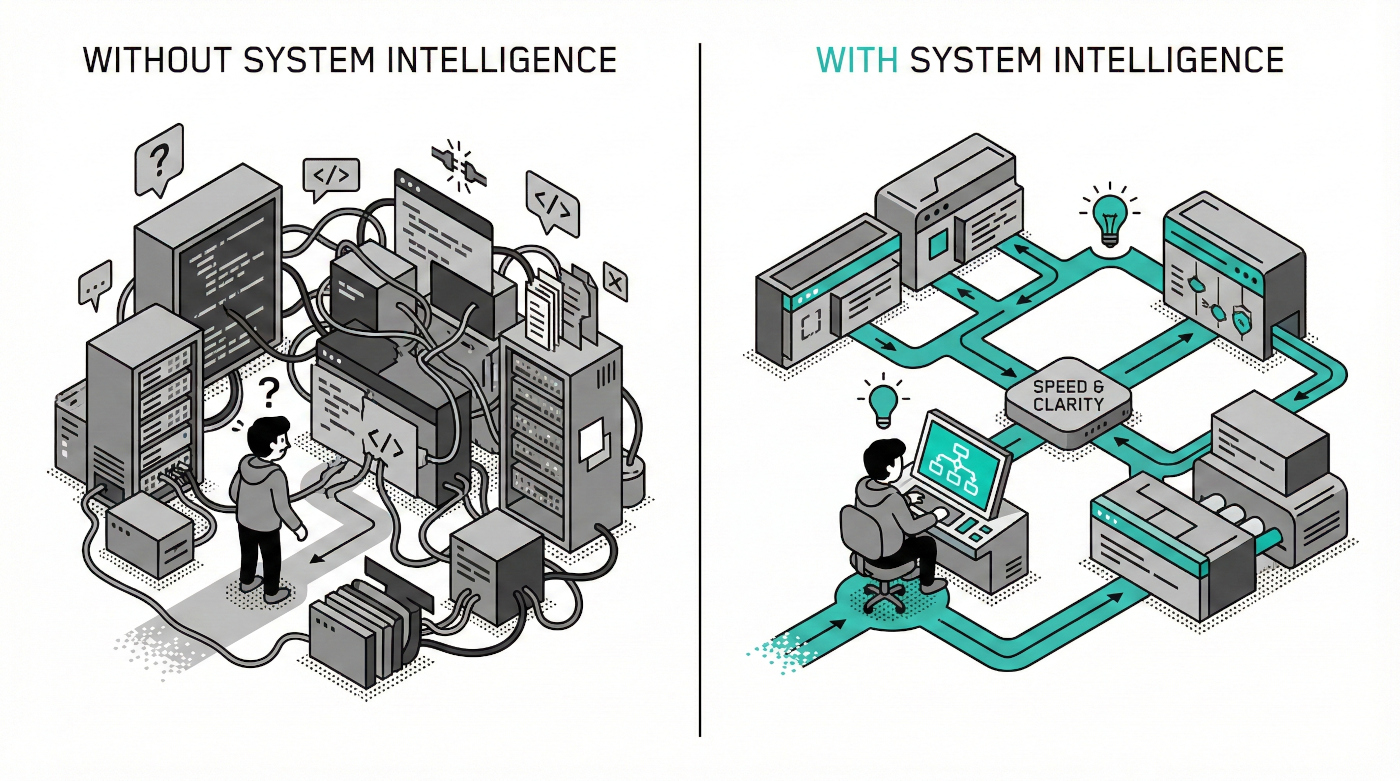
Developer friction emerges when teams spend more time searching for context than writing code. They hesitate to make changes because system behavior is unclear. They rely on tribal knowledge, outdated documentation, or constant interruptions to SMEs. Every decision carries hidden risk, so progress slows to a crawl.
This friction is rarely visible in executive dashboards. Work continues. Commits are made. But velocity declines and error rates increase. Teams compensate with more reviews, more testing, and more process. The modernization program becomes heavier just to move at the same pace.
Over time, friction turns into disengagement. Developers stop trusting tools that promise clarity but deliver noise. They bypass platforms and build their own understanding through ad hoc means. The organization invests more in modernization infrastructure, yet adoption declines.
Modernization fails not because developers resist change, but because tools fail to meet them where work actually happens.
What Developers Are Actually Trying to Do During Modernization
To understand why most platforms miss the mark, it helps to look at what developers are really trying to accomplish during modernization.
They are not trying to admire architecture diagrams or read lengthy documentation. They are trying to answer specific questions, quickly and reliably. What happens if I change this logic? Where does this data go next? Who depends on this behavior? What edge cases should I worry about?
Modernization work amplifies these needs. Developers inherit unfamiliar systems, integrate with fragile dependencies, and operate under compliance constraints. The cost of being wrong is high. Confidence matters as much as speed.
In this context, tools that surface static information or abstract views fall short. Developers need live, actionable context tied directly to the code and behavior they are modifying. When that context is missing, friction grows.
The gap between what developers need and what most platforms provide explains why adoption struggles—even in well-funded transformation programs.
Where Most Modernization Platforms Miss the Mark
Most modernization platforms are built from the top down. They prioritize visibility for executives, architectural alignment for leaders, or compliance reporting for auditors. While these perspectives matter, they often come at the expense of developer usability.
Many tools focus on static artifacts—architecture diagrams, dependency graphs, documentation repositories. These are helpful for orientation, but insufficient for day-to-day engineering decisions. They describe structure, not behavior. Developers still have to infer how systems actually work under real conditions.
Other platforms emphasize tool sprawl. Code analysis lives in one place, observability in another, documentation somewhere else. Developers are forced to context-switch constantly, stitching together understanding from fragmented sources. The cognitive load is high, and trust in the platform erodes.
Finally, many modernization tools are optimized for one phase of the journey. They work well during assessment or migration, but quickly lose relevance once delivery moves on. From a developer’s perspective, these tools feel like overhead—useful to someone else, but not to them.
The result is predictable: developers bypass the platform. They rely on direct code inspection, informal conversations, or personal notes. The organization invests in modernization infrastructure, but the people doing the work derive little value from it.
The Gap Between Executive Visibility and Developer Usability
There is a structural tension in modernization tooling. Executives want abstraction, summaries, and risk indicators. Developers need precision, immediacy, and relevance. When platforms optimize exclusively for one audience, they fail the other.
Executive dashboards often hide the details developers care about. They show system health without explaining behavior. They report progress without exposing uncertainty. Developers are left to navigate complexity without adequate support.
Conversely, developer tools that focus narrowly on code can miss the broader context leaders need for governance and compliance. This creates parallel systems of understanding that drift apart over time.
The most damaging outcome is misalignment. Leadership believes visibility exists because dashboards are populated. Developers know that understanding is still manual and fragile. Trust breaks down on both sides.
Closing this gap requires a different approach—one where the same underlying system intelligence serves multiple audiences, without forcing developers to work through layers of abstraction that slow them down.
What Developers Need Instead: Context, Confidence, and Speed
When developers evaluate modernization platforms, they do so through a simple lens: does this help me do my job better, faster, and with less risk? Most feature checklists miss this point. What developers actually need is a combination of context, confidence, and speed.
Context means understanding behavior, not just structure. Developers need to see how logic executes, where data flows, and which dependencies are affected by a change. This context must be close to the code they are working on, not buried in external tools or static documents.
Confidence comes from knowing the impact of a change before it is deployed. Developers want to understand edge cases, downstream effects, and compliance implications without relying on guesswork or constant SME intervention. Confidence reduces defensive coding and excessive process.
Speed is the outcome of the first two. When context is readily available and confidence is high, developers move faster naturally. They spend less time investigating, waiting, and reworking. Velocity improves without sacrificing quality.
Platforms that fail to deliver these fundamentals create friction, regardless of how powerful they appear on paper. Platforms that deliver them earn adoption—even if they do fewer things.
Why System Intelligence Changes the Developer Experience
System intelligence fundamentally alters the developer experience by making understanding a built-in capability rather than a manual task. Instead of piecing together behavior from code, logs, and conversations, developers can access a shared, validated view of how the system works.
This reduces cognitive load. Developers no longer need to hold incomplete mental models or rely on memory and intuition. They can query behavior, trace flows, and assess impact with evidence. Decision-making becomes faster and less stressful.
System intelligence also improves collaboration. When developers, testers, and architects reference the same understanding, discussions move quickly from interpretation to action. Disagreements are resolved through shared visibility rather than opinion.
Most importantly, intelligence persists. As teams change and systems evolve, developers inherit context rather than reconstruct it. This continuity is what most modernization platforms fail to provide—and what developers value most.
How Better Developer Experience Improves Modernization Outcomes
Developer experience is often treated as a secondary concern in modernization programs—something to address after architecture and tooling decisions are made. In practice, it is one of the strongest predictors of outcome quality.
When developers have access to clear system intelligence, error rates decline. Changes are made with intent rather than caution. Testing becomes more targeted because expected behavior is understood upfront. Rework drops, and timelines stabilize.
This has a compounding effect. Faster, more confident developers reduce pressure on SMEs and architects. Knowledge bottlenecks ease. Compliance and risk teams receive clearer explanations because behavior is well understood. Modernization becomes more predictable, not because teams work harder, but because they work with less uncertainty.
Organizations that invest in developer-centric intelligence consistently see better results: fewer late-stage surprises, smoother handoffs, and systems that are easier to evolve after migration. Developer experience is not a “soft” metric—it is an operational lever.
Modernization Platforms That Developers Actually Adopt Win by Default
The ultimate test of a modernization platform is adoption. If developers do not use it in their daily work, its value is theoretical—no matter how impressive its features appear in demos.
Platforms that win adoption do so by embedding understanding directly into the developer workflow. They reduce friction instead of adding process. They answer real questions instead of generating more artifacts. Over time, they become the default way teams reason about systems.
Once adoption is achieved, everything else follows. Visibility improves organically. Compliance evidence becomes easier to produce. Modernization accelerates without forcing behavior change.
This is why developer experience is not a secondary concern—it is foundational. Modernization platforms that serve developers well create alignment across the organization. Those that do not are quietly bypassed.
In the end, the most successful modernization initiatives are not driven by mandates or dashboards. They are driven by tools that developers choose to use—because those tools make complex systems easier to understand and safer to change.
If developers don’t adopt the platform, modernization slows—no matter how good the architecture looks.