
The Hidden Integration Tax of Legacy Systems — And How It Compounds Over Time
Why Integration Becomes the Most Expensive Part of Legacy Systems
As enterprise systems age, the cost center that grows fastest is rarely the core application itself. It is integration. What begins as a manageable set of interfaces gradually becomes a dense web of dependencies that absorbs disproportionate time, budget, and risk.
This happens because legacy systems are rarely isolated. Over time, they become central hubs for data, transactions, and business logic. Each new product, channel, partner, or regulatory requirement adds another integration point. While the core system may change slowly, the surface area around it expands continuously.
Integration work is also inherently cross-cutting. It requires coordination across teams, environments, vendors, and governance bodies. A change that looks small in one system can have cascading effects elsewhere. As a result, integration effort grows non-linearly with system age and organizational complexity.
For many enterprises, integration quietly overtakes core development as the dominant driver of cost and delay. Yet it is rarely treated as a first-class problem. Modernization initiatives focus on migrating platforms or refactoring code, while integration drag is accepted as an unavoidable side effect.
Understanding why integration becomes so expensive is the first step toward addressing it. That requires naming the problem clearly.
What the “Integration Tax” Actually Is
The integration tax is the cumulative overhead imposed by connecting, maintaining, and changing systems whose behavior is not fully understood. It is paid in time, cost, risk, and lost agility.
This tax has several components. There is the engineering cost of building and maintaining interfaces, often customized and fragile. There is the coordination cost of aligning multiple teams and stakeholders for even minor changes. There is the risk cost of unintended side effects, outages, or data inconsistencies. And there is the opportunity cost of delayed initiatives and constrained innovation.
What makes the integration tax particularly damaging is that it is largely invisible. It does not appear as a single line item. It is spread across projects, teams, and budgets. Each integration seems reasonable in isolation. The cumulative burden only becomes clear over time.
APIs, middleware, and integration platforms can reduce friction at the edges, but they do not eliminate the tax if underlying behavior remains opaque. Without clear understanding of dependencies and data flows, each new connection adds uncertainty.
The integration tax is not a technical flaw. It is a structural consequence of growth without sustained system understanding. Left unaddressed, it compounds—slowing delivery, increasing risk, and making every future change more expensive than the last.
How Legacy Systems Accumulate Integration Debt
Integration debt accumulates incrementally, often as a byproduct of success. Each time a legacy system supports a new channel, product, partner, or regulatory requirement, an integration is added to meet an immediate need. The focus is speed and continuity, not long-term coherence.
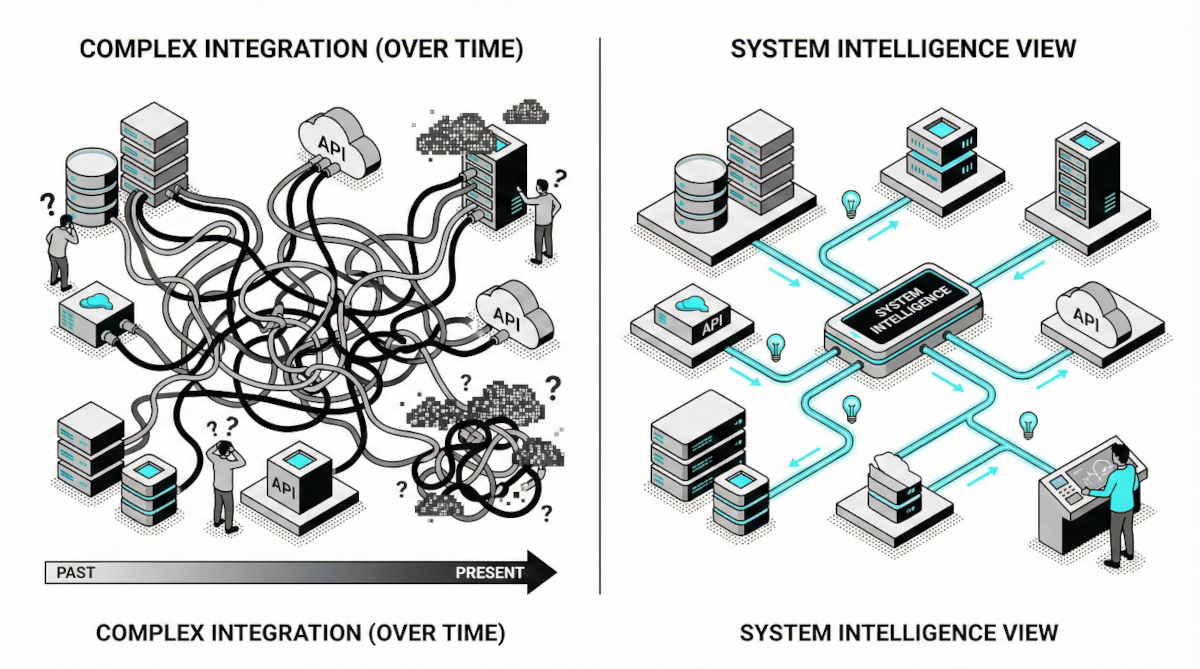
Over time, these integrations become point-to-point and brittle. Interfaces are built with implicit assumptions about data formats, timing, and behavior that are rarely documented. Exceptions are handled locally. Workarounds are introduced to meet deadlines. What starts as a clean connection becomes layered with special cases.
Because legacy systems often embed business logic deeply, integrations are forced to compensate for behaviors that are difficult to change directly. Logic leaks out of the core and into surrounding systems, increasing coupling and reducing clarity about where decisions are actually made.
As teams change and documentation decays, understanding of these integrations erodes. Each new change requires rediscovery: tracing flows, validating assumptions, and testing defensively. Integration debt grows not because teams are careless, but because knowledge does not persist.
This debt is cumulative. Every additional integration inherits the fragility of those that came before it. Over time, the system becomes harder to change not because it lacks APIs, but because no one fully understands how existing integrations behave.
Why APIs Alone Don’t Eliminate Integration Complexity
APIs are often positioned as the cure for integration problems. They standardize access, decouple consumers from internal implementations, and promise flexibility. While APIs are essential, they are not sufficient on their own.
APIs define interfaces, not behavior. They specify what can be called, not how data is transformed, what rules are applied, or how exceptions are handled downstream. Without this behavioral understanding, APIs become thin veneers over complex, opaque systems.
In many enterprises, APIs are layered on top of legacy logic without addressing underlying uncertainty. This can actually increase the integration tax. More consumers rely on behaviors that are poorly understood, amplifying the impact of any change or inconsistency.
Additionally, APIs multiply integration points. Each new consumer adds dependencies that must be managed and tested. Without clear visibility into how APIs interact with core systems and with each other, the web of dependencies grows more complex, not less.
APIs reduce friction at the boundary, but they do not remove the need to understand what happens beyond it. Without sustained system intelligence, enterprises trade one form of integration complexity for another.
How the Integration Tax Compounds Over Time
The most damaging aspect of the integration tax is not its initial cost, but how it compounds. Each new integration increases the surface area of the system, adding dependencies that must be considered for every future change.
As integrations multiply, change impact analysis becomes slower and less reliable. Teams respond by adding more testing, more approvals, and more coordination steps. What was once a technical task becomes an organizational bottleneck. Delivery timelines stretch not because work is harder, but because uncertainty has increased.
This compounding effect also reduces optionality. Enterprises become reluctant to modernize or replace core systems because the integration blast radius feels unmanageable. Integration tax locks systems in place, even when their strategic value declines.
Financially, the compounding cost is subtle but significant. Each integration adds incremental OPEX—support, monitoring, incident response—that persists year after year. Over time, these costs rival or exceed the original development investment.
The longer integration debt remains unmanaged, the more expensive and risky every subsequent initiative becomes. Integration tax is not linear; it accelerates as complexity grows.
The Compliance and Operational Risk of Fragile Integrations
In regulated enterprises, fragile integrations introduce risks that go beyond delivery inefficiency. When data moves across systems through poorly understood interfaces, compliance assurance becomes fragile as well.
Regulators expect enterprises to explain how data is transformed, validated, and controlled across system boundaries. When integrations are opaque, answering these questions requires manual reconstruction. Each integration becomes a potential audit finding or remediation trigger.
Operational risk follows a similar pattern. Integration failures are often hard to diagnose because responsibility is diffuse and behavior is implicit. Incidents cascade across systems, increasing downtime and recovery effort. Root cause analysis becomes speculative.
These risks compound with scale. As more systems depend on fragile integrations, the cost of failure increases. What might have been a localized issue becomes an enterprise-wide event.
Integration tax is therefore not just a technical burden. It is a compliance and resilience liability that grows quietly until it becomes unavoidable.
How System Intelligence Makes Integration Predictable Again
System intelligence addresses the root cause of the integration tax: lack of shared, durable understanding of system behavior. By making execution paths, data flows, and dependencies explicit, it replaces guesswork with evidence.
With system intelligence in place, integration work starts from clarity. Teams can see which systems consume which data, how transformations occur, and where exceptions are handled. Change impact analysis becomes faster and more reliable because dependencies are visible rather than inferred.
This predictability reduces defensive engineering. Instead of over-testing and over-coordinating to compensate for uncertainty, teams can target effort where it matters. Integration changes become smaller, safer, and easier to reason about.
System intelligence also creates a common language across teams. Architects, developers, integration leads, and compliance teams work from the same understanding of how systems interact. This alignment reduces handoff loss and shortens decision cycles.
Most importantly, intelligence persists. As integrations evolve, understanding evolves with them. This prevents the re-accumulation of integration debt and turns integration from a source of fragility into a manageable discipline.
Reducing the Integration Tax Without Stopping the Business
Enterprises rarely have the luxury of pausing operations to fix integration debt. Reducing the integration tax must happen incrementally, alongside ongoing delivery.
The first step is visibility. By introducing system intelligence, enterprises can identify the most brittle and high-impact integrations without rewriting everything. This allows targeted intervention rather than wholesale replacement.
Next comes prioritization. Not all integrations are equal. Some drive disproportionate risk, cost, or compliance exposure. Focusing modernization effort on these hotspots produces outsized returns.
Finally, enterprises shift how new integrations are built. Instead of adding opaque connections, teams capture behavioral understanding as part of delivery. Each new integration strengthens the intelligence layer rather than adding to future debt.
Over time, this approach bends the cost curve. Integration work becomes more predictable. Risk declines. Change velocity improves. The integration tax does not disappear overnight, but it stops compounding.
The enterprises that succeed are not those that eliminate integrations, but those that make them understandable. In a landscape of constant change, system intelligence is what turns integration from a hidden tax into a controlled investment.
If every integration feels risky, the problem isn’t the API—it’s the lack of understanding.
Schedule a conversation to explore how to reduce the hidden integration tax.