
Brazil’s Alphanumeric CNPJ Is Coming: What Enterprises Need to Know Before July 2026
Brazil’s CNPJ change is coming, and IT teams should not wait
Brazil’s CNPJ is changing in July 2026, and companies should not wait until the rollout date to discover whether their systems can handle letters inside a valid business identifier. Receita Federal has confirmed that the transition to an alphanumeric CNPJ format will be progressive, that the new identifier will keep 14 positions, and that existing numeric CNPJs will remain valid.
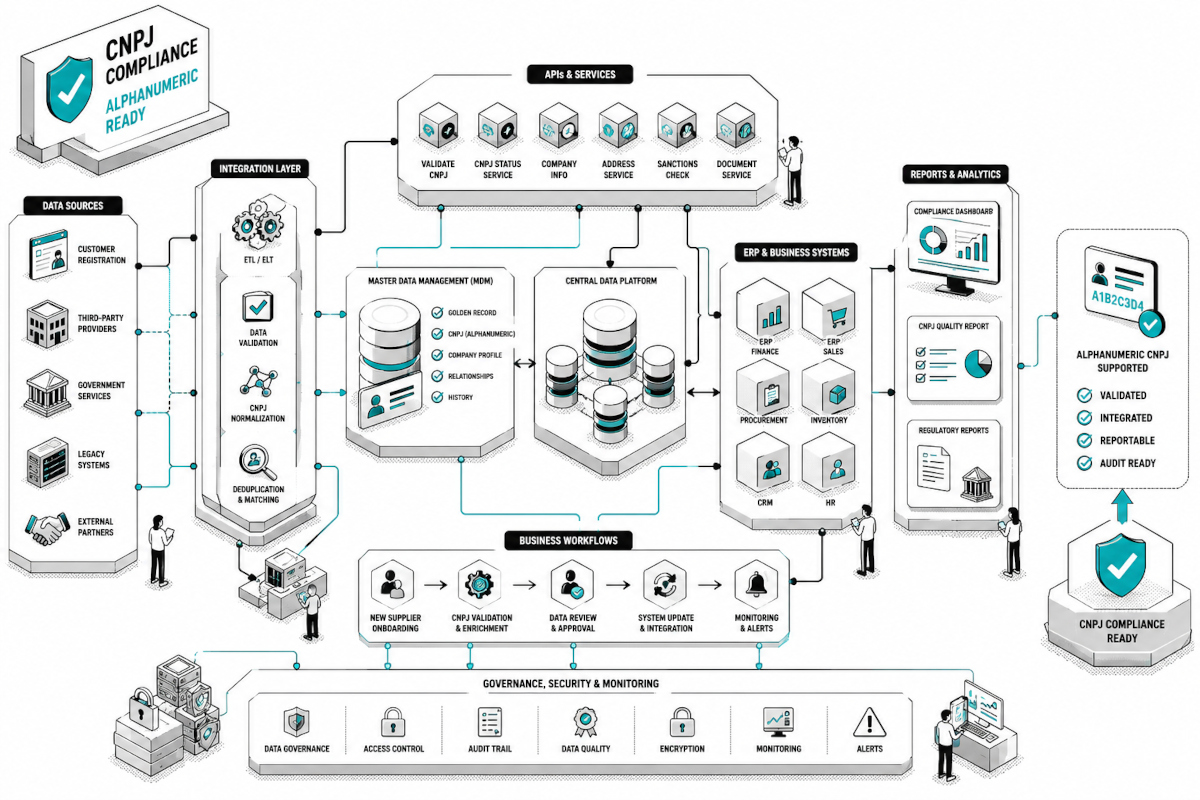
On paper, that may look like a simple registration update. In practice, it is a system-readiness issue. For decades, many enterprise applications have treated CNPJ as a number: something that contains only digits, fits neatly into numeric fields, follows fixed masks, and passes validation routines built around the current format. Those assumptions may now need to be found, reviewed, and updated before new alphanumeric CNPJs begin appearing in production workflows.
The risk is not that every system will fail. The risk is that companies may not know which systems are exposed. A supplier onboarding form, ERP master-data table, API integration, tax reporting workflow, billing process, or legacy validation routine may quietly reject a valid new CNPJ because it was never designed to accept letters. That kind of issue is manageable when identified early. It becomes disruptive when discovered during customer registration, invoice processing, vendor setup, or regulatory reporting.
For enterprise technology leaders, the first question is not “How do we rewrite everything?” It is simpler and more urgent: where does CNPJ exist across our systems today? That discovery work is the foundation for every readiness decision that follows. It also aligns with CodeAura’s core modernization principle: complex systems should be documented and understood before they are changed.
What is changing in the CNPJ format
The CNPJ is not being replaced. It is being expanded.
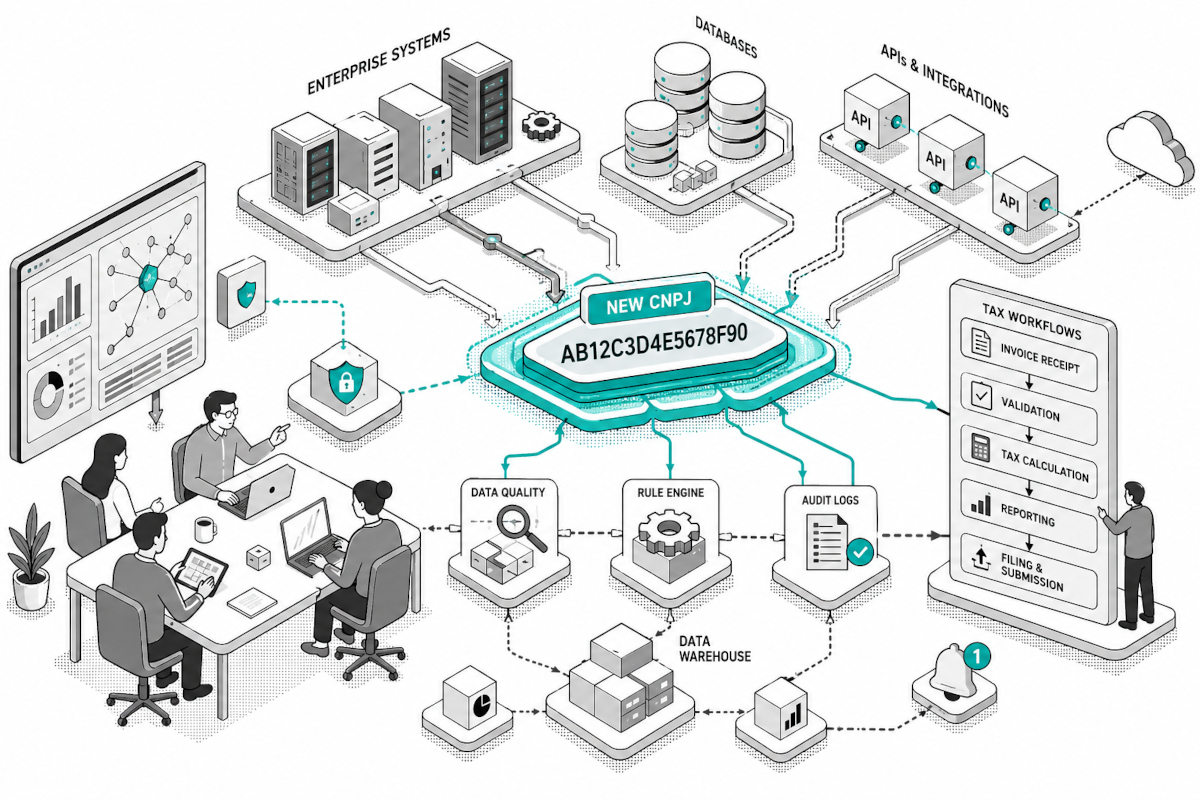
Starting in July 2026, Brazil’s Receita Federal will begin issuing CNPJs that may include both letters and numbers. The identifier will continue to have 14 positions, preserving the overall structure that companies, systems, and public agencies already recognize. The important change is that the first 12 positions may become alphanumeric, while the final two verification digits will remain numeric.
Existing CNPJs will not be converted into the new format. Numeric CNPJs already assigned to companies will remain valid. The change applies to new registrations issued after the rollout begins, which means enterprises will need to support both formats: the current numeric CNPJ and the new alphanumeric CNPJ.
That dual-format reality is what makes readiness important. Many systems may appear compliant because they can store or display today’s numeric CNPJs without issue. But once a new supplier, customer, branch, partner, or legal entity receives an alphanumeric CNPJ, any system that assumes “CNPJ equals digits only” may reject it, strip characters, fail validation, or send incorrect data to another application.
For business leaders, the key point is simple: this is not a change to old identifiers. It is a change to what valid future identifiers can look like. Enterprise systems need to be ready before those identifiers enter real workflows.
Why a small format change can create large system impact
The alphanumeric CNPJ change may look small because the identifier remains 14 positions long. But enterprise systems often depend on assumptions that are older, deeper, and more fragile than the visible format itself.
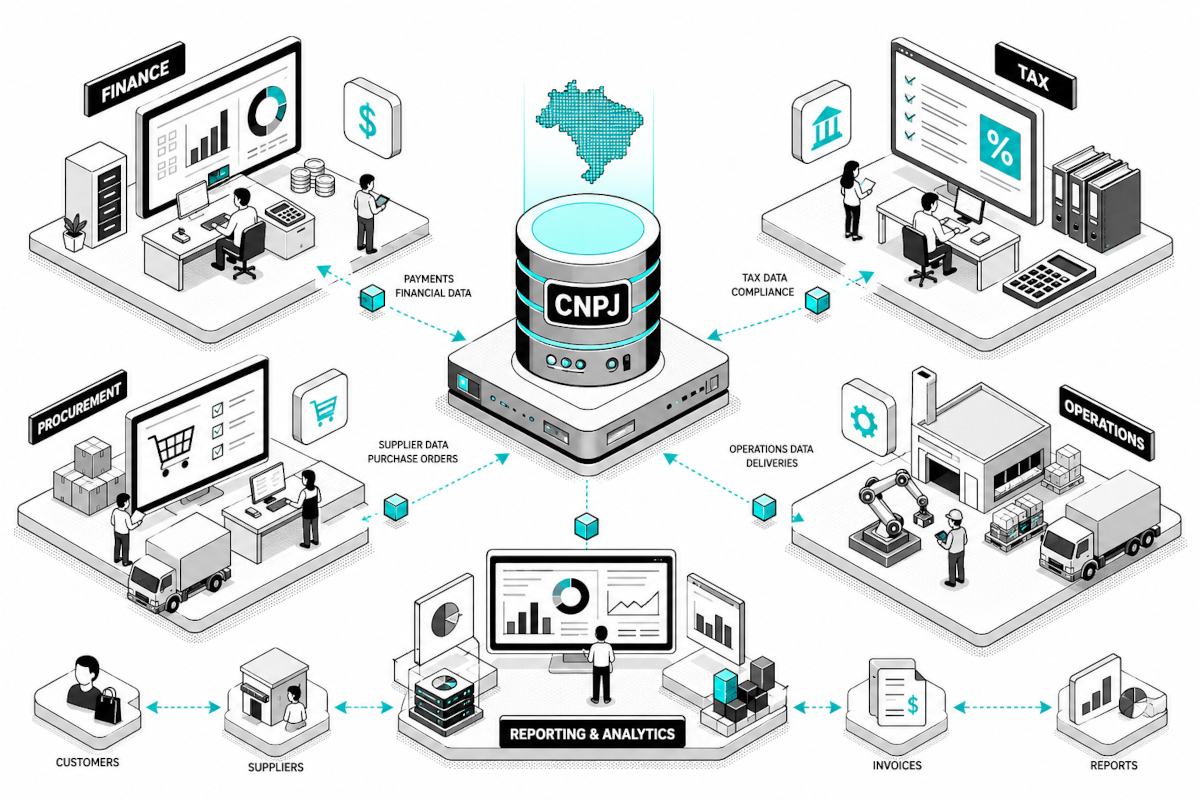
In many environments, CNPJ is not just a field on a form. It is a value that moves across databases, ERP records, CRM profiles, tax workflows, supplier portals, customer onboarding processes, billing systems, payment files, reporting tools, and integrations with government or third-party platforms. If any part of that chain assumes the CNPJ is always numeric, the new format can create issues.
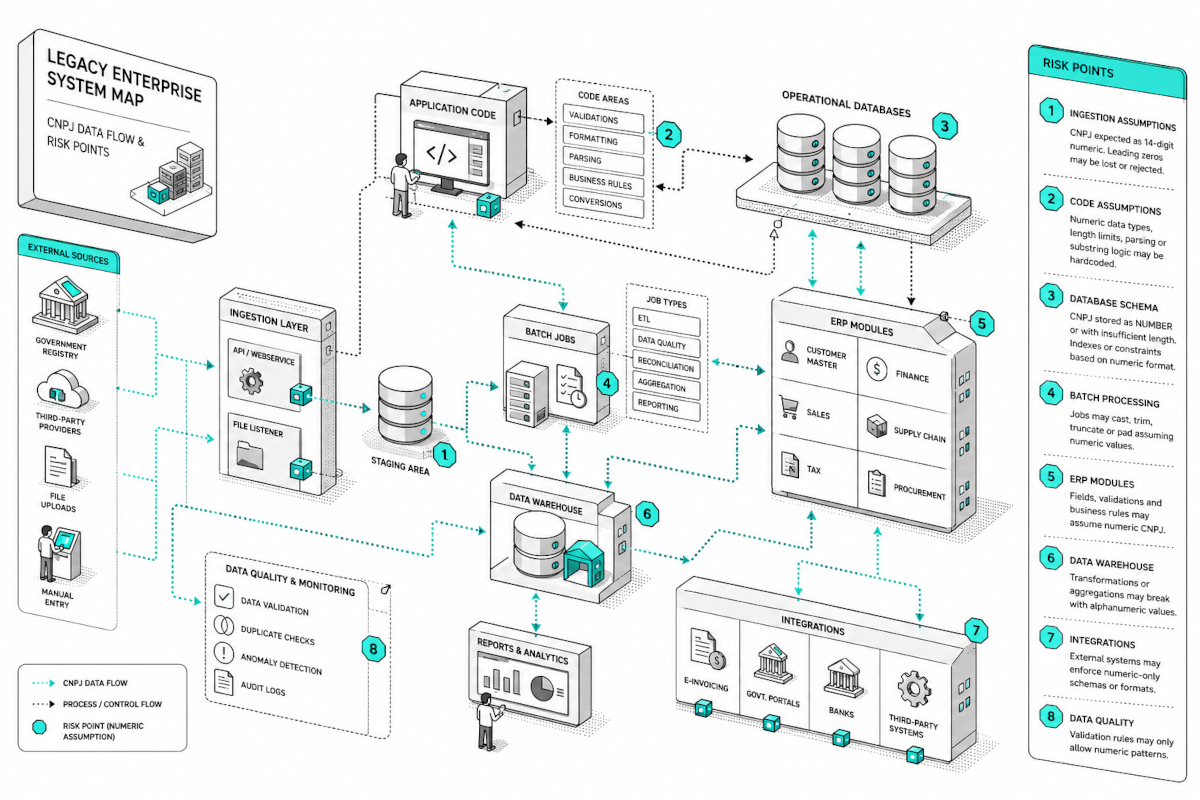
Common assumptions may include numeric-only database columns, validation rules that reject letters, input masks that only allow digits, API schemas that define CNPJ as a number instead of text, spreadsheet formulas that remove leading characters, or legacy routines that strip non-numeric values before processing. These assumptions are easy to overlook because they may have worked correctly for years under the current format.
The impact may not appear as a major system outage. It may show up as smaller but costly operational friction: a valid supplier cannot be registered, a customer record fails validation, an invoice workflow stops, an integration rejects a payload, a report excludes records, or a business team creates manual workarounds to keep a process moving.
That is why this change belongs on the IT readiness agenda. It is not only a tax or registration update. It is a data, integration, validation, and legacy-system dependency issue.
Where CNPJ dependencies may be hiding
CNPJ values often appear in more places than teams expect. They may begin as registration data, but over time they become part of operational workflows, master data, integrations, reports, controls, and legacy business logic.
A single CNPJ may appear across ERP customer and supplier records, CRM accounts, procurement systems, billing and invoicing workflows, fiscal document processes, payment files, tax reporting platforms, data warehouses, APIs, mainframes, batch jobs, BI dashboards, and validation libraries. It may also exist in spreadsheets, exported reports, audit files, data quality rules, and custom applications built around local business processes.
This matters because readiness is not only about changing one field in one application. In a large enterprise, the same identifier may be copied, transformed, validated, masked, joined, exported, imported, and reconciled across many systems. One application may store the new CNPJ correctly, while another downstream process rejects it because the integration contract, database field, or validation logic still expects digits only.
Legacy environments add another layer of complexity. Older systems may not have clear documentation showing where CNPJ is used, how it is validated, or which workflows depend on it. Business rules may be embedded inside code, scripts, stored procedures, batch jobs, or integration routines that few people still understand. CodeAura is designed to help enterprises recover that system knowledge by documenting codebases, extracting business logic, mapping dependencies, and creating a searchable understanding layer before modernization work begins.
For the alphanumeric CNPJ, that visibility is the starting point. Before teams can decide what to change, they need to know where CNPJ already lives.
Why early discovery matters
The alphanumeric CNPJ change creates a discovery challenge before it creates a remediation challenge. Most enterprises cannot fix what they have not found. That is why the first step is not code changes, vendor coordination, or testing. The first step is building an accurate inventory of where CNPJ appears and how each system handles it.
Early discovery gives teams time to answer practical questions. Which applications store CNPJ as a numeric field? Which forms enforce digit-only input? Which APIs define CNPJ as a number rather than a string? Which validation routines assume the current numeric format? Which reports, tax workflows, batch jobs, or integrations transform CNPJ values before sending them downstream?
Those questions matter because the impact may cross business and technology boundaries. A rejected CNPJ could delay supplier onboarding. A failed validation could block customer registration. A broken integration could interrupt invoicing or tax reporting. A report could exclude new records because an ETL job does not recognize the new format. A manual workaround could appear in one team and quietly create data quality issues for another.
Starting early also gives organizations time to prioritize. Not every CNPJ dependency carries the same risk. A public-facing onboarding workflow, fiscal document process, ERP master-data table, or government reporting integration may require earlier attention than an internal archive or low-volume report. Discovery helps teams separate critical workflows from lower-risk references.
This is what makes the July 2026 timeline important. The change is manageable when organizations use the remaining time to find dependencies, assess impact, plan updates, test integrations, and coordinate with vendors. It becomes risky when the first alphanumeric CNPJ appears in a production process and teams are forced to troubleshoot under pressure.
How CodeAura helps enterprises prepare
Preparing for the alphanumeric CNPJ starts with visibility. Before an enterprise can update validation logic, adjust database fields, revise API schemas, or coordinate vendor changes, it needs to know where CNPJ appears across its technology estate and business workflows.
CodeAura helps support that readiness process through four practical workstreams.
Discovery focuses on finding where CNPJ exists today. This may include source code, databases, configuration files, APIs, validation routines, batch jobs, reports, ERP-related integrations, and legacy applications. For this campaign, Discovery is the most important starting point because many organizations are likely to have CNPJ dependencies they have not fully mapped.
Analysis helps teams understand which findings matter most. Not every CNPJ reference requires the same response. Some may be harmless labels or reports. Others may sit inside critical workflows such as supplier onboarding, invoicing, customer registration, tax reporting, or payment processing. CodeAura’s broader platform approach is built around documenting systems, extracting business logic, mapping dependencies, and turning complex codebases into usable system intelligence.
Code Changes can then support targeted updates where systems need to accept the new format. That may include changing numeric-only validations, updating field handling, revising input masks, adjusting integration payloads, or improving logic that assumes CNPJ values contain only digits.
Custom support is relevant for complex environments where CNPJ logic is tied to legacy systems, ERP customizations, mainframe workflows, vendor integrations, or enterprise-specific tax and operational processes. These environments often require more than a simple search-and-replace exercise.
For most organizations, the right first move is a CNPJ Discovery Assessment. CodeAura can help identify where CNPJ values appear across systems, codebases, databases, APIs, and business workflows before the alphanumeric format goes into production.
Strategic takeaway: start with system visibility
The alphanumeric CNPJ is not a reason to panic. It is a reason to inspect.
The format change is clear, the timeline is known, and existing numeric CNPJs will remain valid. That gives enterprises time to prepare in a controlled way. But preparation depends on visibility. Organizations need to understand where CNPJ appears, how it is stored, how it is validated, and which business processes depend on it before new alphanumeric identifiers begin entering production workflows.
For CIOs, CTOs, enterprise architects, tax technology leaders, and ERP owners, the practical takeaway is straightforward: do not treat this as a last-mile compliance task. Treat it as a system-readiness initiative. The earlier teams identify CNPJ dependencies, the easier it becomes to prioritize remediation, coordinate with vendors, test integrations, and avoid operational workarounds later.
This is especially important in legacy and regulated environments, where business rules may be embedded in old code, undocumented workflows, batch jobs, database routines, or integrations that only a few people understand. CodeAura’s approach is built around system understanding before system transformation: document what exists, understand how it works, and modernize with greater control.
The first step is a CNPJ Discovery Assessment. CodeAura can help identify where CNPJ values appear across systems, codebases, databases, APIs, and business workflows before the alphanumeric format goes into production.