
The CNPJ Change Is Bigger Than Tax Compliance
Many companies will first interpret Brazil’s alphanumeric CNPJ format as a tax compliance update. That is understandable, but incomplete.
The official change begins in July 2026. The CNPJ will keep its current 14-character structure, but the first 12 positions may include letters and numbers, while the final two verification digits remain numeric. Existing numeric CNPJs will remain valid.
On paper, that may look like a formatting adjustment. In enterprise systems, it is something larger.
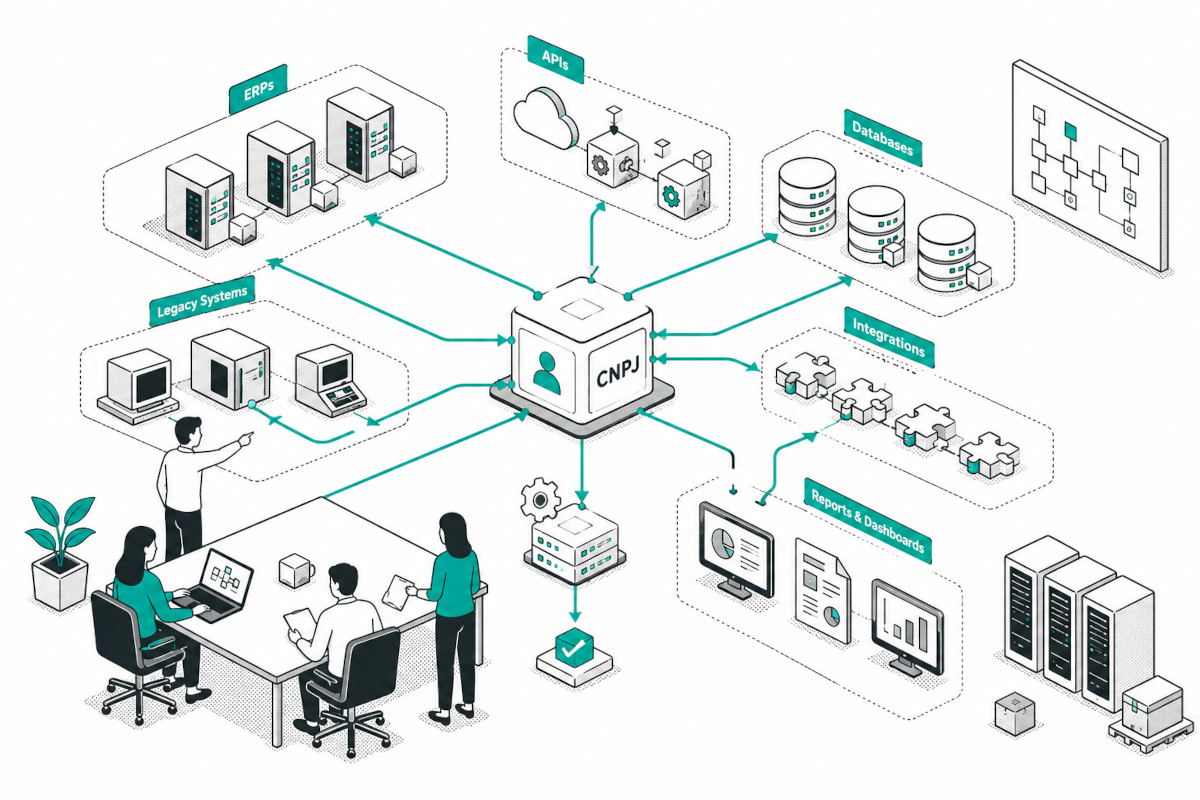
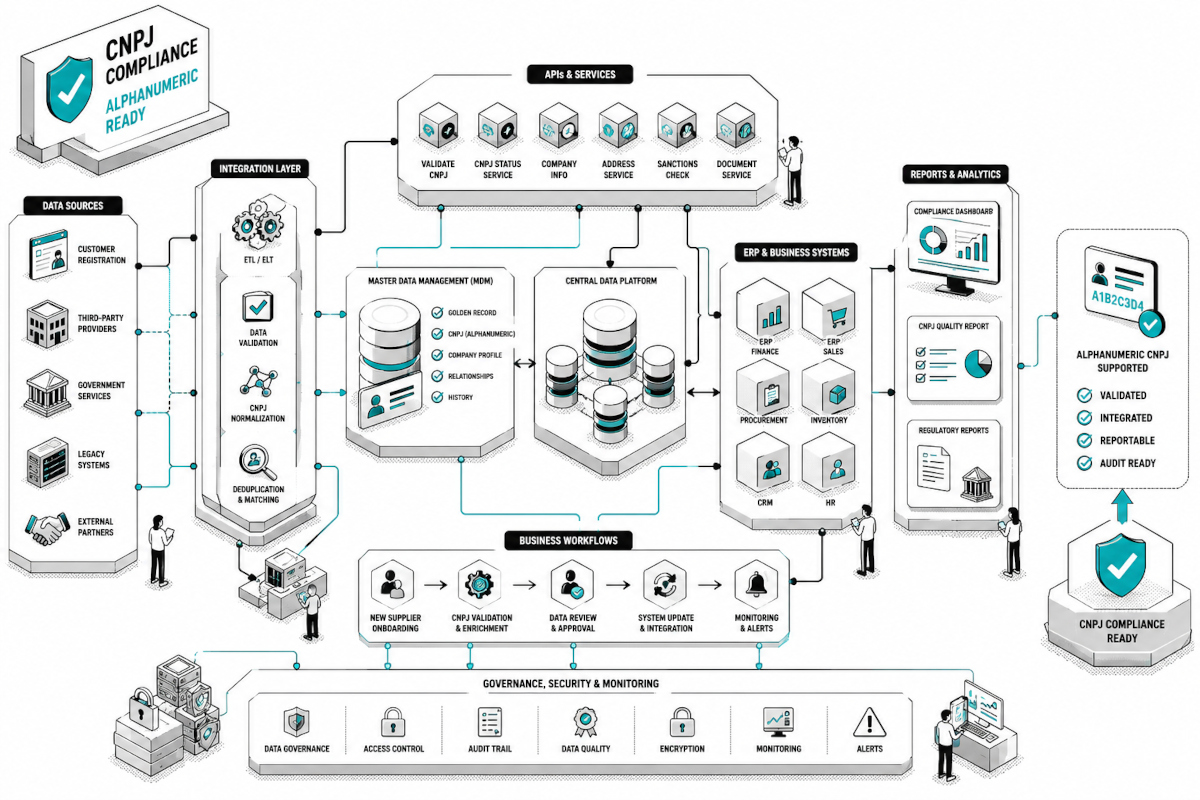
The real question is not only whether the tax team understands the new rule. The real question is whether the organization’s applications, databases, integrations, validation logic, APIs, reports, batch jobs, and legacy systems can correctly store, process, exchange, and report the new format.
For many organizations, CNPJ is not just a tax identifier. It is a data key, a validation rule, an integration field, a reporting dimension, a customer reference, a supplier reference, and a dependency inside everyday business workflows.
That is why the alphanumeric CNPJ should be treated as a systems-readiness project, not only a fiscal update.
Why CNPJ Is Embedded Across the Enterprise
The CNPJ often starts as a tax identifier, but it rarely stays confined to tax systems.
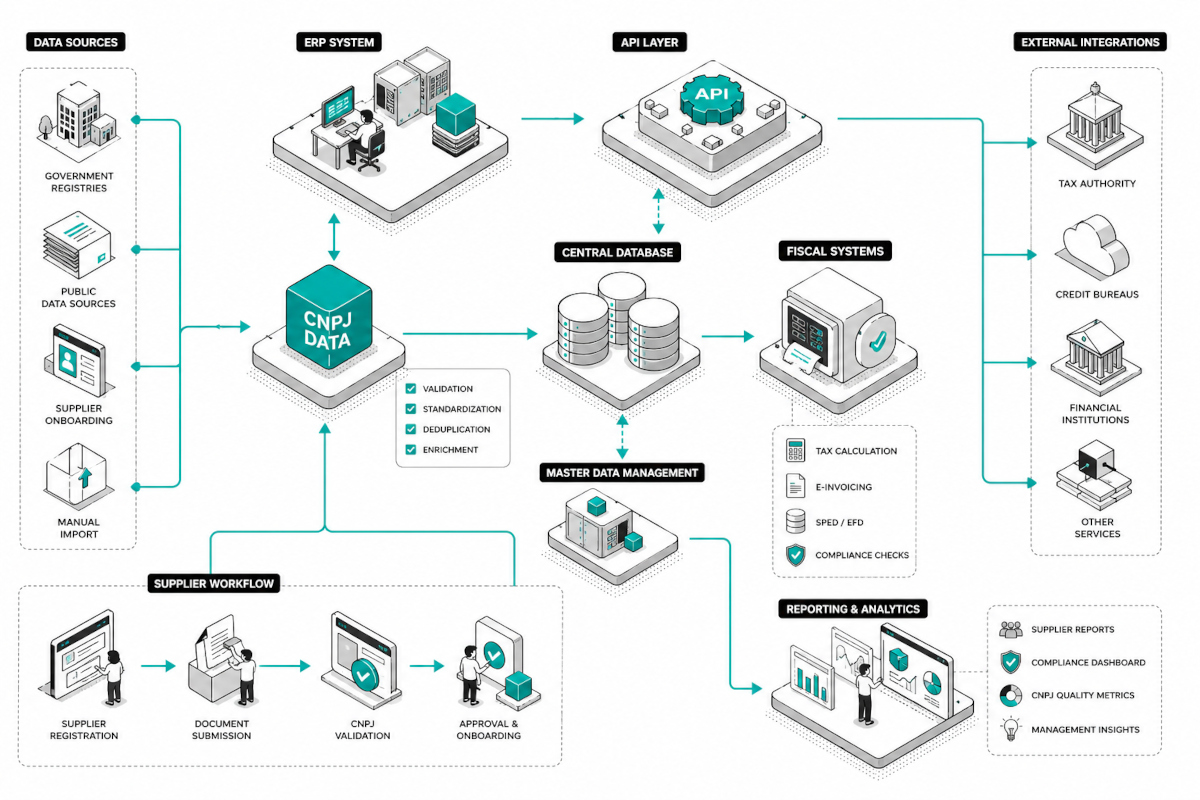
In many organizations, it becomes part of the operating fabric of the business. It appears in customer registration, supplier onboarding, billing, invoicing, procurement workflows, payment operations, ERP master data, CRM records, fiscal document processing, data warehouses, business intelligence reports, and third-party integrations.
That matters because every place CNPJ appears may contain an assumption about what the identifier looks like.
A procurement system may use CNPJ to validate suppliers. An ERP may use it as part of vendor master data. A billing system may pass it into fiscal document workflows. A data warehouse may use it as a reporting dimension. A CRM may store it as a customer attribute. An API may exchange it with banks, partners, government platforms, logistics providers, or tax technology vendors.
In other words, CNPJ is not just stored. It moves.
That movement creates dependency. When a business identifier travels across systems, even a small format change can create impact far beyond the original point of entry. A system that accepts the new alphanumeric CNPJ may still pass it to another system that rejects it. A database may store it correctly, while a reporting process transforms it incorrectly. A vendor platform may update its validation rules, while an internal legacy application still treats CNPJ as numeric-only.
This is why the CNPJ change should be assessed across the enterprise technology landscape, not only inside fiscal applications.
The Hidden Technical Assumption: “CNPJ Is Numeric”
The biggest risk in the alphanumeric CNPJ change is not the visible format. It is the hidden assumption behind thousands of small technical decisions: CNPJ is numeric.
That assumption may exist in places no one has reviewed in years.
A database column may define CNPJ as a number instead of text. A user form may reject letters before the data ever reaches the backend. A validation library may only allow 14 digits. A regular expression may be written to accept numbers and nothing else. An input mask may force numeric characters. An API contract may define the field as an integer. An ETL pipeline may cast the value as a number. A reporting job may strip punctuation, leading zeros, or unexpected characters. A legacy program may compare CNPJ values numerically instead of treating them as identifiers.
These are not unusual mistakes. They are normal outcomes of systems built for a world where CNPJ was always numeric.
The issue becomes harder because these assumptions are often scattered. Some may sit in modern applications. Others may be buried in stored procedures, batch jobs, ERP customizations, fiscal integrations, middleware, old Java or .NET services, COBOL programs, scripts, reports, and test suites.
This is why the change cannot be handled only by updating a field mask or replacing a validation function. The organization needs to find every place where CNPJ is stored, transformed, validated, exchanged, displayed, or used as logic.
The new CNPJ format exposes a broader modernization problem: many enterprises do not have a reliable map of where critical business identifiers live inside their systems. Without that map, even a simple regulatory change can become a complex dependency investigation.
Why Small Identifier Changes Can Break Large Workflows
Identifier-format changes are risky because identifiers travel through many layers of an enterprise system.
A company may update a front-end form to accept an alphanumeric CNPJ and still have problems downstream. The form may accept the value, but the backend API may reject it. The API may accept it, but the database column may not be able to store it. The database may store it, but an ETL job may transform it incorrectly. The analytics layer may display it incorrectly. A fiscal integration may reject it during document processing.
That is the challenge with business identifiers: they rarely belong to one application.
CNPJ values may pass through user interfaces, application logic, database schemas, API contracts, middleware, ERP customizations, batch jobs, reporting tools, audit logs, monitoring platforms, and third-party systems. Each layer may apply its own validation, transformation, formatting, or storage rule.
A system can appear ready at the point of entry while still failing later in the workflow.
For example, a supplier onboarding portal may accept the new CNPJ format, but the procurement workflow may fail when it sends the supplier record to an ERP. A billing application may store the value correctly, but a fiscal document integration may reject it. A data warehouse may load the identifier, but a reporting job may remove letters because it was built around numeric-only assumptions.
This is why readiness must be tested end to end. The question is not only, “Can this field accept letters?” The better question is, “Can every system that touches this identifier preserve, validate, exchange, and report it correctly?”
Why July 2026 Is Closer Than It Looks
July 2026 may sound far enough away for this to wait. For enterprise systems, it is not.
The Receita Federal has stated that the alphanumeric CNPJ will apply from July 2026 for new registrations, while existing CNPJs will remain valid. That creates a transition period where organizations may need to support both formats at the same time: long-standing numeric CNPJs and new alphanumeric CNPJs.
That dual-format reality matters. Systems cannot simply replace the old model with the new one. They need to preserve existing numeric identifiers while also accepting, validating, storing, exchanging, and reporting the new alphanumeric format.
For large organizations, that takes time.
Teams need to locate where CNPJ appears across applications, databases, APIs, files, reports, workflows, vendor systems, ERP modules, fiscal integrations, and legacy code. They need to review database schemas, validation logic, input masks, API contracts, ETL pipelines, batch jobs, and test data. They need to coordinate with ERP providers, fiscal software vendors, tax technology partners, payment systems, banks, logistics platforms, and other third parties that exchange CNPJ data.
Then comes the work of change: updating code, adjusting validation rules, modifying field handling, revising tests, validating integrations, and confirming that business workflows still function end to end.
Waiting increases the risk that the organization discovers hidden dependencies too late. The issue is manageable when teams begin with discovery and structured analysis. It becomes risky when leaders assume the CNPJ change is only a tax update and leave system readiness until the final months.
What Companies Should Do First
The first step is not to change code. The first step is to discover where CNPJ exists.
For most enterprises, the CNPJ footprint will be wider than expected. It may appear in application code, database schemas, API contracts, ERP configurations, fiscal integrations, spreadsheets, reports, test data, batch jobs, documentation, and third-party workflows. Until that footprint is mapped, teams are making decisions with partial visibility.
A practical readiness approach should begin with discovery. Organizations need to identify where CNPJ is stored, validated, transformed, transmitted, displayed, and reported. This includes obvious systems such as tax and ERP platforms, but also less obvious places such as supplier portals, data warehouses, middleware, analytics jobs, payment workflows, and legacy applications.
The second step is impact analysis. Not every CNPJ reference will require the same level of effort. Some fields may already be stored as text and need only validation updates. Others may be tied to numeric database columns, rigid API contracts, old reporting logic, or vendor systems that require coordination.
The third step is prioritization. High-risk systems should come first: systems that create fiscal documents, onboard customers or suppliers, process payments, exchange data with external parties, or support audit and compliance workflows.
Only after discovery, analysis, and prioritization should teams move into code changes. That work may include updating validation rules, changing field types, revising input masks, adjusting regex patterns, modifying ETL jobs, updating API contracts, expanding test data, and running regression tests across end-to-end workflows.
The goal is not to overcomplicate the CNPJ change. The goal is to avoid underestimating it. A structured approach helps companies turn a regulatory format change into a controlled systems-readiness project.
How CodeAura Helps with CNPJ Readiness
CodeAura helps enterprises move from uncertainty to readiness by making the CNPJ footprint visible before teams begin making changes.
That matters because the hardest part of the alphanumeric CNPJ transition is not updating one field. It is understanding where CNPJ appears, how it is used, and which systems depend on the old numeric-only assumption.
A CNPJ Discovery engagement helps organizations map where CNPJ exists across codebases, databases, APIs, documents, systems, integrations, and workflows. This gives IT and business leaders a clearer view of the real scope of impact before July 2026.
From there, Analysis helps assess which systems are affected, where numeric assumptions exist, and which changes should be prioritized. Some systems may only need validation updates. Others may require database changes, API contract review, ERP coordination, regression testing, or deeper legacy code remediation.
For teams ready to act, Code Changes can support updates to validation logic, field handling, input masks, regular expressions, test cases, and related application code. In more complex environments, Custom support can help with legacy systems, ERPs, fiscal integrations, mainframes, or large multi-system landscapes where CNPJ dependencies are distributed across many layers.
This fits CodeAura’s broader modernization approach: system understanding before system transformation. CodeAura is designed to help enterprises document complex systems, extract business logic, map dependencies, and create the context needed for safer modernization decisions.
For the CNPJ change, the practical starting point is clear: before changing code, discover where CNPJ exists. A CNPJ Discovery and Impact Assessment can help identify hidden dependencies before they become production issues.
Strategic Takeaway
The alphanumeric CNPJ is not just a new tax identifier format. It is a systems-readiness test for every organization that stores, validates, exchanges, or reports Brazilian business identifiers.
For technology leaders, the lesson is broader than CNPJ. Enterprise systems often contain assumptions that were reasonable when they were built but risky when regulations, data formats, integrations, or business models change. Those assumptions may be embedded in code, databases, workflows, APIs, reports, and vendor connections.
The July 2026 change gives organizations a clear modernization trigger. It is specific enough to act on, but broad enough to reveal deeper fragility in the enterprise technology landscape.
Handled early, the change is manageable. Teams can discover where CNPJ exists, analyze the impact, prioritize high-risk systems, coordinate with vendors, update code, and test business workflows before the deadline.
Handled late, the same change can become a rushed dependency hunt across applications, integrations, databases, and legacy systems.
The practical takeaway is simple: do not start with assumptions.