

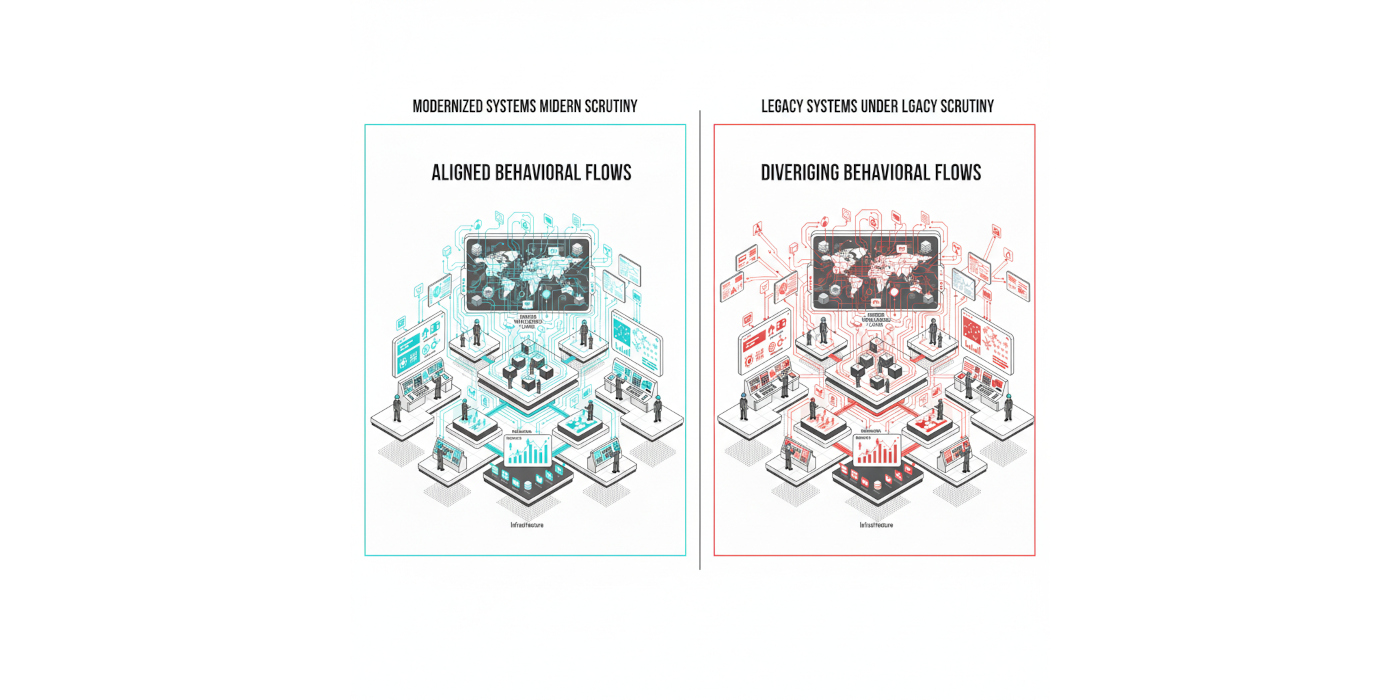
Why Code Migration Is Increasingly Scrutinized by Regulators
Regulators are paying closer attention to modernization efforts—not because enterprises are modernizing, but because of how they are doing it. As legacy systems are rewritten, replatformed, or decomposed, regulators are increasingly concerned with whether the resulting systems behave as expected under real operating conditions.
In regulated environments, system behavior is inseparable from compliance. Controls, reporting logic, exception handling, and data transformations are often embedded deep within legacy code. When that code is migrated, regulators expect enterprises to demonstrate that these behaviors have been preserved—not approximated, and not assumed.
This scrutiny is intensifying for several reasons. First, modernization is no longer rare or experimental; it is widespread and material. Second, regulatory frameworks are becoming more explicit about operational transparency, resilience, and data handling. Third, high-profile failures tied to system changes have shown that even small behavioral deviations can have outsized consequences.
As a result, regulators are shifting from accepting intent-based assurances to demanding evidence-based validation. Enterprises are expected to explain how a modernized system enforces the same controls, produces the same outcomes, and responds correctly to edge cases. Code migration alone is no longer sufficient proof of compliance.
This shift places new pressure on modernization programs. Quality is no longer judged solely by functional correctness or performance benchmarks, but by the enterprise’s ability to demonstrate behavioral continuity after transformation.
The Assumption That Migrated Code Behaves the Same Is a Dangerous One
A common assumption in modernization programs is that if code is faithfully translated or refactored, behavior will naturally carry over. This belief is understandable—but flawed.
Even when business logic is preserved line by line, behavior can change. Differences in runtime environments, data handling, transaction boundaries, concurrency models, and error propagation all introduce subtle variations. These changes may not surface in standard testing, but they can alter outcomes in edge cases, peak loads, or failure scenarios.
In regulated systems, those edge cases are often where compliance lives. Reporting thresholds, reconciliation logic, and exception workflows may trigger only under specific conditions. If those behaviors drift, the system can remain functionally “correct” while becoming non-compliant.
Traditional modernization metrics do not catch this. A system can pass regression tests, meet performance targets, and still violate regulatory expectations because behavior was assumed rather than validated.
This is why regulators are skeptical of claims that “nothing really changed.” From their perspective, everything changed: execution environment, technology stack, and operational context. Without explicit behavioral validation, equivalence is a belief—not a fact.
Recognizing this assumption as a risk is the first step toward modernization that regulators—and enterprises themselves—can trust.
What Behavioral Validation Actually Means
Behavioral validation goes beyond confirming that a system produces the right outputs for a set of expected inputs. It focuses on proving that a modernized system behaves the same way as its predecessor across the full range of conditions that matter to the business and to regulators.
This includes validating execution paths, decision logic, exception handling, and data transformations—not just end results. Behavioral validation asks whether the system responds the same way when transactions are delayed, data is incomplete, thresholds are crossed, or external dependencies fail.
In regulated environments, behavioral validation also requires traceability. Enterprises must be able to show how specific regulatory requirements are enforced in the modernized system and how those controls map back to legacy behavior. This is not a theoretical exercise; it is evidence that can withstand audit scrutiny.
Crucially, behavioral validation is comparative. It establishes equivalence between old and new systems, rather than validating each in isolation. Without this comparative lens, subtle differences remain invisible until they surface as compliance issues.
Behavioral validation, therefore, is not a testing phase—it is a discipline. It requires systematic capture of how systems behave, and a way to verify that behavior persists through migration.
Where Traditional Testing Falls Short in Regulated Environments
Traditional testing strategies were not designed to prove behavioral equivalence. Unit tests validate isolated logic. Integration tests validate connectivity. Regression tests validate known scenarios. None of these approaches guarantee that the full behavioral profile of a system has been preserved.
In regulated environments, this gap is critical. Many compliance-relevant behaviors occur infrequently or under exceptional conditions. They are rarely encoded in test suites, and often not documented explicitly. As a result, testing passes while compliance risk accumulates.
Another limitation is context loss. Tests often validate expected outcomes without preserving why those outcomes occur. When auditors ask how a control is enforced, test results alone are insufficient. They show success, not explanation.
Finally, testing is typically static. It validates behavior at a point in time. As systems evolve post-migration, tests age, assumptions drift, and coverage degrades. Behavioral assurance decays quietly.
This is why enterprises that rely solely on traditional testing struggle to satisfy regulators after modernization. Testing confirms functionality; it does not establish behavioral continuity.
Addressing this gap requires a different foundation—one that captures and validates behavior as a first-class concern.
How Behavioral Drift Creates Compliance Exposure
Behavioral drift rarely announces itself. It emerges gradually, through small differences introduced during migration and amplified over time as systems evolve. Individually, these changes may appear harmless. Collectively, they can create significant compliance exposure.
Drift occurs when modernized systems respond differently under specific conditions—edge cases, failure scenarios, timing differences, or data anomalies. A control that once blocked a transaction may now allow it through under rare conditions. A reporting calculation may differ slightly due to rounding, ordering, or concurrency changes. These deviations often escape detection because they do not affect day-to-day operations.
From a regulatory perspective, however, these differences matter. Compliance is defined not by average behavior, but by correctness under all required conditions. When behavior drifts, enterprises may unknowingly violate reporting rules, data handling obligations, or control requirements—even though the system appears stable.
The risk compounds after migration. As teams modify the modernized system without full understanding of its inherited behavior, drift accelerates. Each change introduces new uncertainty, and the distance from the original, compliant behavior grows. By the time an audit or regulatory inquiry surfaces the issue, reconstructing what changed—and when—becomes difficult and expensive.
This is why regulators increasingly challenge modernization programs. Without evidence that behavior has been preserved and remains controlled, enterprises cannot credibly assert compliance. Behavioral drift turns modernization into a latent risk multiplier.
Preventing this outcome requires more than better testing. It requires a way to continuously understand and validate behavior as systems change.
The Role of System Intelligence in Behavioral Validation
System intelligence provides the missing foundation for behavioral validation. By capturing how systems actually behave—across execution paths, data flows, and control logic—it creates a baseline that can be compared before and after migration.
With system intelligence in place, behavioral equivalence can be demonstrated rather than assumed. Enterprises can show that specific behaviors existed in the legacy system and continue to exist in the modernized one. Differences are identified explicitly, assessed deliberately, and either corrected or formally accepted.
This intelligence also enables ongoing validation. As changes are introduced post-migration, their impact on behavior can be assessed against the established baseline. Drift is detected early, before it manifests as a compliance issue.
For compliance and audit teams, system intelligence transforms assurance. Instead of relying on narratives and point-in-time evidence, they gain access to structured, current explanations of system behavior. Controls can be traced. Data lineage can be verified. Assertions can be supported with evidence.
Most importantly, system intelligence shifts behavioral validation from a reactive activity to a continuous capability. Compliance is no longer dependent on rediscovery during audits or incidents. It is embedded into how systems are understood and governed.
This sets the stage for a more confident modernization model—one where compliance is verifiable, not inferred.
What Regulators Expect Enterprises to Prove After Modernization
Regulators do not expect enterprises to eliminate all risk during modernization. They do expect enterprises to understand it. After a system is migrated, regulators increasingly ask for evidence that behavior has been preserved, controls remain effective, and obligations are still being met.
This evidence typically falls into three categories.
First, behavioral traceability. Enterprises must be able to explain how critical business rules, controls, and decision logic operate in the modernized system, and how those behaviors correspond to the legacy implementation. This includes exception handling, thresholds, and conditional paths—not just happy flows.
Second, data lineage and handling. Regulators expect clear explanations of how data moves through the system, where it is transformed, and where controls are applied. This is especially critical for sensitive, financial, or regulated data elements.
Third, change accountability. Modernized systems continue to evolve. Regulators expect enterprises to demonstrate that changes are assessed for compliance impact, and that behavioral differences are intentional, reviewed, and approved—not accidental.
Without these proofs, compliance assertions rely on trust rather than evidence. In today’s regulatory climate, that is increasingly insufficient.
Modernizing With Confidence: Making Compliance Verifiable, Not Assumed
Modernization does not have to increase compliance risk. The risk arises when behavior is assumed rather than verified, and when understanding decays after migration.
Enterprises that modernize with confidence treat behavioral validation as a core requirement, not an afterthought. They invest in capturing system intelligence before, during, and after migration. They use that intelligence to compare behavior, detect drift, and support compliance claims with evidence.
This approach changes the modernization conversation. Quality is no longer defined solely by delivery metrics. Compliance is no longer dependent on manual reconstruction. Modernization becomes defensible—to regulators, to auditors, and to internal risk leaders.
For regulated enterprises, this is the only sustainable path forward. As systems change faster and scrutiny increases, compliance must be embedded into how systems are understood, not bolted on after the fact.
Code migration without behavioral validation is not just a technical risk. It is a compliance risk. Modernizing with system intelligence turns that risk into a managed, measurable, and controllable outcome.
Code migration alone does not prove compliance. Regulated enterprises need to demonstrate that system behavior, controls, and data handling remain intact after modernization. CodeAura helps teams validate behavioral equivalence and preserve system intelligence as auditable evidence.