

Regex Is Not Validation
The new alphanumeric CNPJ is not validated by regex alone.
A regular expression can confirm that a value has the expected shape: 14 positions, allowed characters in the right places, and numeric check digits at the end. That matters, but it is only the first layer of validation. The harder question is whether the final two check digits were calculated correctly.
That distinction is important because many existing CNPJ routines were written for a numeric-only world. They often assume that every character in the identifier can be parsed as an integer. That assumption becomes unsafe when the first 12 positions may contain letters. Receita Federal has confirmed that the new format will keep 14 positions, with the final two positions remaining numeric check digits, and that the change will not invalidate existing CNPJs.
For development teams, the risk is subtle. A frontend team may update the mask. A backend team may update the regex. A database column may already be stored as text. On paper, the system appears ready. But if the validation function still loops through each character and treats it as a digit, the first alphanumeric CNPJ that reaches that code path may fail.
The reverse can also happen. A system may accept a value because it matches the new pattern, but skip the check-digit calculation entirely. That creates a different problem: structurally valid identifiers may be allowed even when their verification digits are wrong.
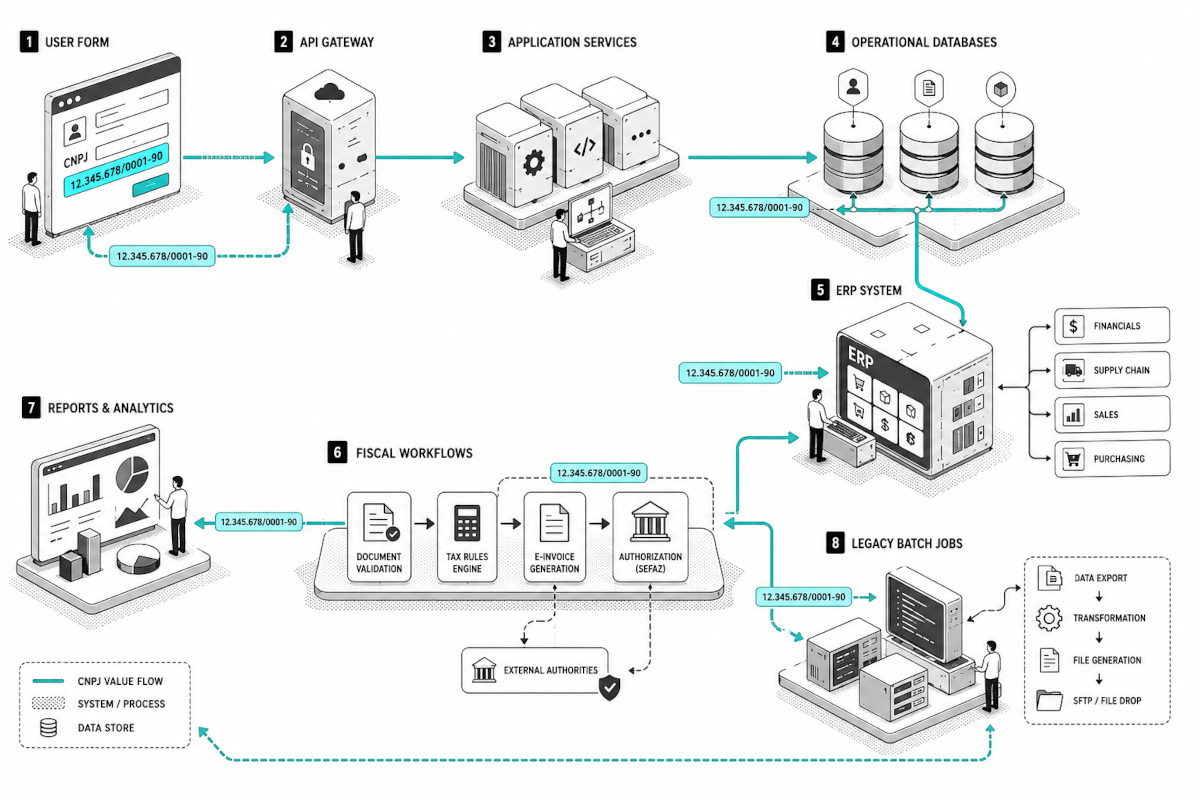
The new CNPJ format therefore requires more than a field-level change. Teams need to inspect the actual validation logic behind forms, APIs, ERP extensions, fiscal integrations, shared utility libraries, batch jobs, and legacy routines. The official rule keeps modulo 11 in place, but alphanumeric characters must be converted before the calculation. Receita’s FAQ describes this conversion using the character’s ASCII decimal value minus 48; for example, A has ASCII value 65, so it becomes 17 for the modulo 11 calculation.
The practical takeaway is simple: updating the regex is necessary, but not sufficient. Any CNPJ validation routine that assumes the first 12 characters are numeric must be found, reviewed, updated, and tested before the alphanumeric format enters production in July 2026. That is the implementation risk this article focuses on.
What Changes in the CNPJ Format?
The new CNPJ keeps the same overall size: 14 positions. That is important because many systems already enforce a 14-character normalized value or a formatted value such as XX.XXX.XXX/XXXX-XX.
The change is in the composition of those positions. Under the alphanumeric model, the first 12 positions may contain letters and numbers, while the final two positions remain numeric check digits. Receita Federal describes the new structure as 14 positions, with the first 12 positions alphanumeric and the final two positions reserved for the verification digits calculated by modulo 11.
This means the format changes from a numeric-only identifier to a mixed-character identifier, but it does not become an arbitrary string. It still has structure. It still has check digits. It still needs validation logic.
Existing numeric CNPJs are not being replaced or invalidated. Receita Federal has stated that current CNPJ numbers will remain valid and that their verification digits will not be changed. For enterprise systems, this creates a coexistence requirement: applications, databases, APIs, batch jobs, ERP customizations, and integrations need to support both existing numeric CNPJs and new alphanumeric CNPJs.
That coexistence matters because many systems have CNPJ assumptions embedded in different places. A database field may already be text, but an API schema may still describe the value as numeric. A UI may allow letters, but a backend service may reject them. A batch import may preserve the value correctly, while a stored procedure strips non-digits and breaks the identifier.
The format change is therefore small on paper but broad in implementation. The safest approach is to treat the alphanumeric CNPJ as a system-wide compatibility update, not a single field-mask change.
Why Regex Is Not Enough
Regex answers one question: does this value look like a CNPJ? It does not answer whether the check digits are correct, whether the CNPJ exists, whether it is active, or whether it is accepted by a specific fiscal, ERP, banking, procurement, or government integration.
For the alphanumeric CNPJ, teams should separate validation into three layers.
Structural validation checks the shape of the value. This includes length, allowed characters, punctuation handling, and whether the final two positions are numeric. Receita Federal’s published guidance confirms that the new CNPJ keeps 14 positions, with alphanumeric characters in the first 12 positions and numeric verification digits in the final two positions.
Check-digit validation confirms that the final two digits match the official calculation. This is where many legacy functions may fail. The alphanumeric CNPJ still uses modulo 11, but the characters used in the calculation must first be converted using the official ASCII-minus-48 rule. A value can match the new pattern and still have invalid check digits.
Business validation answers a different question: is this CNPJ usable in the business process? That may involve checking whether the entity is registered, active, eligible for a transaction, accepted by an external tax authority system, or recognized by a third-party provider. This layer should not be confused with regex or check-digit validation.
The implementation mistake is assuming that one layer replaces the others. Updating a regex may prevent immediate input rejection, but it does not make the validation algorithm correct. Calling an external service may confirm registration status, but it does not remove the need for local validation in forms, APIs, batch jobs, imports, and fiscal workflows.
For developers, the practical rule is this: pattern matching should reject obviously malformed values, but it should not be treated as the full validation strategy. The new CNPJ requires systems to validate structure, calculate check digits correctly, and preserve business-level checks where they already exist. That is why the campaign brief emphasizes that teams should not stop at regex changes when preparing for the alphanumeric format.
The ASCII-48 Conversion Rule
The key technical change in the alphanumeric CNPJ is how the first 12 characters are prepared for the check-digit calculation.
For numeric CNPJs, validation routines could usually treat each character as a digit. For the alphanumeric CNPJ, that is no longer safe. Before applying modulo 11, each character must be converted into a numeric calculation value using this rule:
Calculation value = ASCII decimal value of the character - 48Receita Federal’s FAQ gives the example of the letter A: its ASCII decimal value is 65; subtracting 48 produces 17, which is the value used in the modulo 11 calculation.
That gives developers a simple but important mapping:
0 → ASCII 48 → 0
1 → ASCII 49 → 1
9 → ASCII 57 → 9
A → ASCII 65 → 17
B → ASCII 66 → 18
C → ASCII 67 → 19
Z → ASCII 90 → 42
This is why the change is backward-compatible for numeric characters. The character 0 still becomes 0, 1 still becomes 1, and 9 still becomes 9. Numeric-only CNPJs can continue to validate under the same conceptual modulo 11 process. The difference is that letters now produce calculation values greater than 9.
For example, a normalized CNPJ-like value such as:
12ABC34501DE35would use the first 12 characters for the first check-digit calculation:
1  2  A   B   C   3  4  5  0  1  D   E
1  2  17  18  19  3  4  5  0  1  20  21
That conversion step is where many old validators will break. A routine that does something like “parse each character as an integer” may work for 12345678000195, but fail when it reaches A, B, C, D, or E. A routine that strips non-digits may be even more dangerous because it changes the identifier before validation.
Production implementations should also normalize input before calculation. In practical terms, this usually means removing punctuation, handling formatted and unformatted values consistently, and applying uppercase normalization according to the official specification and the organization’s validation standards. The important point is that the check-digit calculation must operate on the intended 14-character CNPJ value, not on a partially transformed or digit-only version of it.
For development teams, the implementation requirement is clear: do not just widen the accepted character set. Update the validation routine so it converts alphanumeric characters correctly, then applies the official modulo 11 logic. The uploaded campaign brief makes this the central technical point of the article: old CNPJ validation functions may fail because they assume every character is numeric.
Modulo 11 Still Matters
The alphanumeric CNPJ does not replace check-digit validation. It keeps the modulo 11 model, but changes the values that are fed into the calculation.
That is the technical distinction developers need to keep clear. The validation routine is not simply:
accept letters + keep old digit parserIt is closer to:
normalize input
convert each of the first 12 characters using ASCII-48
apply the official modulo 11 calculation
compare the calculated digits with the final two digits
Receita Federal has published specific technical documentation for calculating the verification digit of the alphanumeric CNPJ, including a manual and reference files for calculation. The campaign brief also emphasizes that modulo 11 continues to apply, but the validation routine must be adjusted for alphanumeric input.
At a high level, the process works in two passes.
First, the system normalizes the CNPJ by removing punctuation and preparing the 14-character value. For the first check digit, it uses the first 12 characters. Each character is converted into its calculation value. Numeric characters keep their familiar values because 0 through 9 map cleanly through the ASCII-minus-48 rule. Letters produce larger numeric values, such as A = 17, B = 18, and so on.
Second, the system applies the official weight sequence, sums the weighted values, calculates the remainder using division by 11, and derives the first check digit according to the official rule. Then it appends that first check digit and repeats the process to calculate the second check digit.
This means legacy code may need more than a small edit. A well-written numeric CNPJ validator may already have the modulo 11 structure in place, but the input-conversion step may be wrong for the new format. A brittle validator may fail earlier, especially if it strips non-digits, casts the full CNPJ to a number, or calls parseInt on each character.
The safest implementation pattern is to keep the algorithm explicit:
1. Normalize the value.
2. Confirm the expected structure.
3. Convert each calculation character using ASCII-48.
4. Apply the official modulo 11 weights.
5. Calculate the first check digit.
6. Append the first check digit.
7. Repeat for the second check digit.
8. Compare both calculated digits with the supplied final digits.
For enterprise teams, the important point is not just how the arithmetic works. It is where the arithmetic exists. Modulo 11 validation may be duplicated across frontend code, backend services, ERP extensions, stored procedures, API gateways, batch jobs, fiscal integrations, and legacy programs. Every copy of that logic can become a compatibility risk if it assumes numeric-only input.
Example Walkthrough: 12.ABC.345/01DE-35
Let’s walk through a simplified validation example using:
12.ABC.345/01DE-35This should be treated as a technical validation example, not as a real company identifier.
First, normalize the value by removing punctuation:
12ABC34501DE35The first 12 characters are used to calculate the first check digit:
12ABC34501DEThe last two characters are the supplied check digits:
35Now convert the first 12 characters using the ASCII-minus-48 rule:
| Character | ASCII value | Calculation value |
|---|---|---|
1 | 49 | 1 |
2 | 50 | 2 |
A | 65 | 17 |
B | 66 | 18 |
C | 67 | 19 |
3 | 51 | 3 |
4 | 52 | 4 |
5 | 53 | 5 |
0 | 48 | 0 |
1 | 49 | 1 |
D | 68 | 20 |
E | 69 | 21 |
For the first check digit, apply the standard CNPJ weight sequence:
5, 4, 3, 2, 9, 8, 7, 6, 5, 4, 3, 2The weighted calculation is:
| Value | Weight | Product |
|---|---|---|
| 1 | 5 | 5 |
| 2 | 4 | 8 |
| 17 | 3 | 51 |
| 18 | 2 | 36 |
| 19 | 9 | 171 |
| 3 | 8 | 24 |
| 4 | 7 | 28 |
| 5 | 6 | 30 |
| 0 | 5 | 0 |
| 1 | 4 | 4 |
| 20 | 3 | 60 |
| 21 | 2 | 42 |
The sum is:
459Then calculate the remainder:
459 mod 11 = 8Using the standard CNPJ modulo 11 rule:
11 - 8 = 3So the first calculated check digit is:
3That matches the first supplied check digit in 12ABC34501DE35.
Next, append the first calculated check digit and calculate the second one:
12ABC34501DE3For the second check digit, use the 13-character sequence with the next weight sequence:
6, 5, 4, 3, 2, 9, 8, 7, 6, 5, 4, 3, 2| Value | Weight | Product |
|---|---|---|
| 1 | 6 | 6 |
| 2 | 5 | 10 |
| 17 | 4 | 68 |
| 18 | 3 | 54 |
| 19 | 2 | 38 |
| 3 | 9 | 27 |
| 4 | 8 | 32 |
| 5 | 7 | 35 |
| 0 | 6 | 0 |
| 1 | 5 | 5 |
| 20 | 4 | 80 |
| 21 | 3 | 63 |
| 3 | 2 | 6 |
The sum is:
424Then calculate the remainder:
424 mod 11 = 6Apply the same check-digit rule:
11 - 6 = 5So the second calculated check digit is:
5The calculated check digits are therefore:
35That matches the supplied final digits in the example:
12.ABC.345/01DE-35The point of this walkthrough is not the arithmetic itself. It is the implementation pattern. The system must normalize the value, convert alphanumeric characters correctly, apply modulo 11, and compare the calculated digits with the supplied final digits. Any routine that strips letters, parses the CNPJ as a number, or validates only the pattern will produce unreliable results under the new format. The uploaded campaign brief identifies this exact risk: old validation logic may fail because it assumes every CNPJ character is numeric.
Common Implementation Mistakes and Where to Look
The most common mistake is treating the alphanumeric CNPJ as a regex update.
Regex matters, but it is only one part of the change. A system can accept the new shape of the identifier and still fail when the value reaches validation logic, integration code, reporting jobs, database routines, or fiscal workflows. The alphanumeric CNPJ affects every place where systems calculate, validate, transform, store, compare, export, or reject CNPJ values.
Teams should look especially closely for these implementation mistakes:
| Mistake | Why it creates risk |
|---|---|
| Only updating the regex | Allows the new format structurally but leaves check-digit validation broken. |
| Treating CNPJ as an integer or numeric type | Letters cannot be represented, and leading zeros may be lost. |
Using parseInt or equivalent logic on each character | Letter values must be calculated using ASCII minus 48, not parsed as digits. |
| Stripping non-digits before validation | This destroys the alphanumeric identifier. |
| Allowing letters in the UI but not in the API | Creates inconsistent behavior across channels. |
| Updating one validation function but not shared libraries | Leaves hidden code paths with old numeric-only assumptions. |
| Rejecting lowercase without a normalization strategy | May cause avoidable user or integration errors depending on input handling rules. |
| Ignoring formatted versus unformatted values | Systems may behave differently for 12.ABC.345/01DE-35 and 12ABC34501DE35. |
| Not updating test data | Old numeric-only fixtures will not expose alphanumeric defects. |
| Assuming third-party systems are already ready | External fiscal, ERP, banking, and procurement integrations may adopt the change on different timelines. |
| Duplicating validation logic inconsistently | Different systems may calculate or reject the same CNPJ differently. |
The second mistake is looking in only one place. CNPJ validation is often scattered across an enterprise architecture. It may live in obvious locations, such as frontend forms and backend validation services, but also in older and harder-to-find code paths.
Common places to inspect include:
| System layer | Examples of where CNPJ logic may exist |
|---|---|
| Frontend applications | Masks, regex, form validators, input normalization, client-side error messages |
| Backend services | API validation, DTOs, domain services, utility functions, request filters |
| Shared libraries | Reusable CNPJ validators, formatting helpers, data-cleaning packages |
| Databases | Stored procedures, triggers, constraints, ETL scripts, column assumptions |
| ERP systems | Custom fields, fiscal modules, supplier/customer registration workflows |
| CRM and procurement tools | Account creation, vendor onboarding, customer master data validation |
| API gateways | Payload validation, schema enforcement, request transformation |
| Data import/export tools | CSV processing, EDI flows, batch loaders, reporting extracts |
| Fiscal integrations | Tax reporting, invoice workflows, Receita-connected processes, third-party connectors |
| Legacy systems | COBOL programs, JCL jobs, mainframe routines, older Java/.NET applications |
| Test suites | Unit tests, integration tests, regression tests, mocked CNPJ data |
This is where modernization risk becomes a discovery problem. A technical team may know about the main validation service, but not about a stored procedure created years ago, a batch job maintained by a different team, or an ERP customization that silently strips letters before sending data downstream.
For regulated and operationally complex enterprises, that fragmentation matters. CNPJ validation may sit inside customer onboarding, supplier registration, invoicing, tax reporting, payments, credit checks, procurement, and audit workflows. A missed validator can become a production defect, an integration failure, or a compliance issue.
CodeAura is relevant here because the first step is not simply rewriting a function. It is finding every place where that function, or a variation of it, exists. CodeAura is designed to help teams analyze complex codebases, generate documentation, extract business logic, and build searchable knowledge bases across legacy and modern systems. That kind of system understanding helps teams locate validation assumptions before they become production failures.
CodeAura’s Role: Find, Understand, Update, Test
Updating CNPJ validation for the alphanumeric format is not only a coding task. It is an impact-analysis task.
Most enterprises do not have one CNPJ validator. They have many. Some are in shared libraries. Some are embedded in APIs. Some live inside ERP customizations, database procedures, fiscal integrations, batch jobs, or legacy applications. Some may have been copied years ago and modified by different teams.
That is why the first step should be discovery.
Analysis: CodeAura can help teams locate and review CNPJ validation logic across codebases, APIs, database routines, integrations, and legacy systems. This matters because the risk is not only in obvious validators. It may also appear in formatting helpers, data-cleaning functions, import routines, test fixtures, schema definitions, and business rules that reject anything outside the numeric-only format.
Code changes: Once affected paths are identified, CodeAura can help teams update validation functions, regex patterns, masks, schemas, tests, and related business logic so they support the alphanumeric CNPJ. The goal is not to blindly change every field that mentions CNPJ. The goal is to understand what each code path does, whether it validates structure, calculates check digits, transforms values, stores identifiers, or sends them to another system.
This is where CodeAura’s broader modernization approach is relevant. The platform is designed to help enterprises document source code, explain business logic, map dependencies, generate system knowledge, and support safer legacy-to-modern transformation. For a regulatory change like the alphanumeric CNPJ, that context can help teams move from guesswork to targeted remediation.
A practical preparation plan could follow three steps:
| Step | What teams should do |
|---|---|
| Discover | Find every code path that stores, validates, formats, imports, exports, calculates, or rejects CNPJ values. |
| Understand | Determine whether each path performs structural validation, check-digit validation, business validation, transformation, or persistence. |
| Modernize | Update the affected logic, add alphanumeric test cases, preserve numeric CNPJ behavior, and validate integrations end to end. |
The key point is control. The new CNPJ keeps modulo 11 validation, but any validation routine that assumes the first 12 characters are numeric must be found, reviewed, updated, and tested before the alphanumeric format enters production. That is exactly the kind of change where documentation-first modernization matters: teams need to understand the current system before they can safely change it.