Most organizations have documentation for their critical systems. The harder question is whether that documentation still reflects how those systems actually work today.
Architecture diagrams capture how applications were designed. Requirements documents describe what the business asked for at a particular point in time. Runbooks explain known operational procedures, while technical specifications record decisions made during previous projects. But production systems continue to evolve long after those documents are written. Regulatory requirements introduce new validations, customer exceptions become permanent, integrations are added, calculations change, batch processes gain dependencies, and emergency production fixes remain in place for years.
Not every one of those changes makes its way back into formal documentation. Over time, the organization can end up with two different representations of the same system: the documented version and the implemented version. That gap is one of the reasons legacy modernization is not only a technology problem. It is also a knowledge recovery problem.
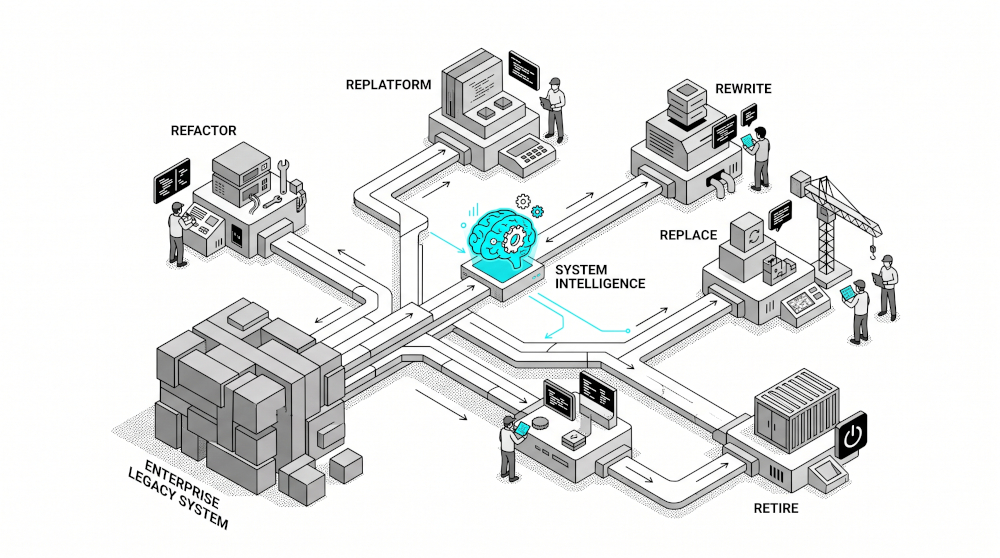
Before organizations decide what to migrate, rewrite, replace, or retire, they need to understand what their existing systems already know.
Documentation Records Intent. Code Records Implementation.
There is an important difference between understanding what a system was intended to do and understanding what it actually does in production.
A process document may describe the normal workflow, while the production code also contains years of exceptions and alternative paths. An architecture diagram may show the major systems involved, but the implementation can reveal additional file exchanges, scheduled jobs, database interactions, and downstream dependencies. A requirements document may describe a business rule in relatively simple terms, while the current implementation includes additional conditions, thresholds, calculations, and special cases introduced through subsequent changes.
Neither documentation nor source code should automatically be treated as the complete truth. Business context, operational knowledge, subject-matter experts, and historical decisions still matter. However, when an organization needs to establish how an existing application behaves before changing it, the implemented system becomes an essential source of evidence.
This is particularly important in long-lived enterprise applications. The longer a system has been operating, the more likely it is to contain decisions that are no longer obvious from the documents surrounding it. Modernization teams therefore need to reconcile what the organization believes the system does with what the software actually implements. The difference between those two views is often where modernization surprises begin.
Business Rules Rarely Announce Themselves as Business Rules
One of the most valuable forms of knowledge buried inside a legacy codebase is business logic, yet it is also one of the easiest to overlook.
Business rules do not usually appear inside a program under a heading labeled “Business Rules.” They appear as conditional branches, calculations, comparisons, lookups, thresholds, validation routines, sequence requirements, and exception paths. A few lines of code might determine whether a transaction is accepted or rejected, while a calculation could control a fee, entitlement, payment, adjustment, or reporting outcome.
The technical implementation can look ordinary even when the business significance is substantial. A date comparison may determine which processing path applies. A validation may exist because of a regulatory or operational requirement introduced years earlier. An exception may support a specific product, customer category, jurisdiction, or workflow that is still active even though the reasoning behind it is no longer widely understood.
That creates an important distinction between explaining code and recovering business knowledge. It is useful to know that a program compares two values and follows one of several branches. A modernization team also needs to understand why the comparison exists, what outcome it controls, and whether the same behavior needs to survive in the future-state system.
This is where business-logic extraction becomes more valuable than simple code summarization. CodeAura is designed to help teams identify and explain logic embedded in source code while also capturing related information such as pseudocode, inputs and outputs, validation behavior, dependencies, and program-level explanations. The objective is not simply to make old code easier to read, but to reveal the operational knowledge represented by that code.
The Hidden System Is Made of Relationships
Understanding individual programs is only part of the modernization challenge because enterprise systems rarely operate as isolated components. They function through relationships that have accumulated across applications, data stores, batch processes, interfaces, and operational workflows.
A COBOL program, for example, may read a file generated by an earlier batch job, invoke another program, update a database, create an output consumed by a downstream application, and ultimately influence a separate reporting or reconciliation process. A JCL workflow may coordinate multiple programs whose combined business significance is difficult to understand when each component is viewed independently. A legacy Java application may rely on shared services, stored procedures, scheduled tasks, and interfaces that were added incrementally over many years.
The result is that the impact of a change cannot always be determined by examining the component being changed. A program that appears relatively isolated may still be essential to another process. A field that appears unused may be consumed downstream. A batch step that looks redundant may still exist because another application expects its output. An integration that is expensive to maintain may nevertheless support a critical operational workflow.
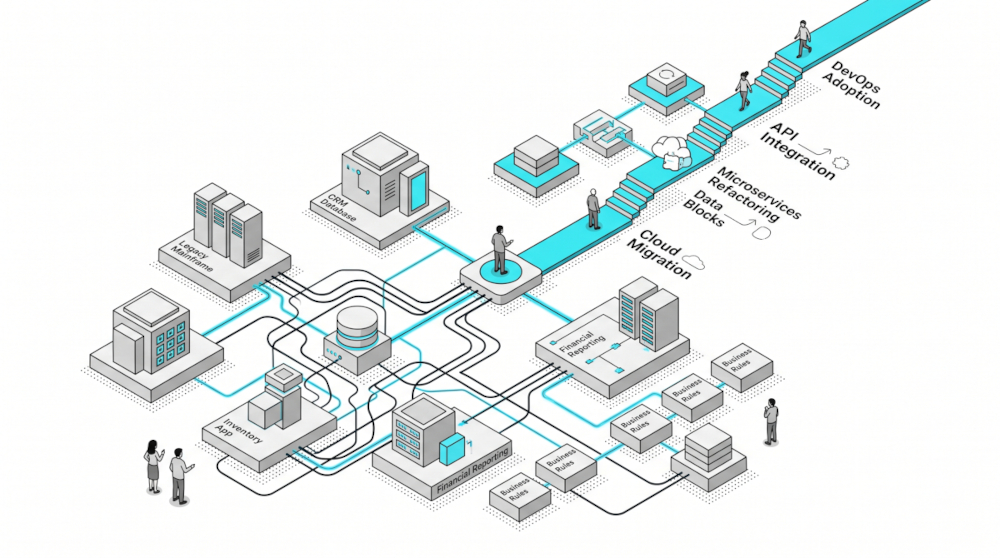
This is why a list of source files is not the same thing as a system map. Modernization teams need visibility into inputs and outputs, program dependencies, data movement, workflow sequencing, integrations, and downstream consumers. These relationships provide the context needed to answer one of the most important questions in any modernization effort: what else could be affected if this component changes?
Dependency analysis, input and output documentation, interaction diagrams, flowcharts, and broader system maps can help transform isolated code-level information into a more complete representation of system behavior. As documentation becomes connected in this way, it begins to support impact analysis and modernization planning rather than serving only as a reference.
Edge Cases Often Contain Valuable Institutional Knowledge
The primary path through an application is usually the easiest part to understand. The more difficult knowledge often sits in the exceptions, alternative branches, and validation logic that have accumulated over years of production use.
A system may behave differently when required data is missing, when a transaction exceeds a threshold, when a particular record type is encountered, or when a validation fails. One workflow may behave differently at month-end. A seemingly unrelated field may be checked because another process depends on it. An apparently obsolete condition may still exist because it supports a regulatory requirement, reconciliation process, historical product, or downstream system.
These conditions matter because legacy complexity is not always meaningless complexity. Some of it is technical debt and some of it reflects obsolete design choices that should eventually be removed. But other forms of complexity represent accumulated operational knowledge: exceptions discovered through years of real-world use, regulatory controls, customer requirements, reconciliation processes, and dependencies that were introduced for legitimate reasons.
A modernization project that treats all complexity as something to simplify risks removing behavior before understanding why it exists. At the same time, a project that translates every exception unchanged can preserve unnecessary complexity in the new environment. Neither approach is well founded unless teams first understand the purpose behind the behavior.
The objective of knowledge recovery is therefore not to preserve everything. It is to make existing behavior visible enough that teams can deliberately decide what should be preserved, redesigned, consolidated, or removed.
Tribal Knowledge Bridges the Gaps – Until It Disappears
Many enterprises compensate for incomplete documentation through experienced people. A long-serving developer knows where a critical calculation lives, an operator understands the sequence in which batch jobs must run, and a business analyst remembers why a particular exception was introduced. An architect may know that two applications are connected even though the relationship does not appear on the current architecture diagram.
This informal knowledge can keep complex systems operating for years, but it is a fragile model. People retire, employees change roles, vendors leave, teams reorganize, and modernization programs introduce engineers who were not present when the original decisions were made. When those transitions occur, knowledge that was never captured becomes difficult or impossible to recover.
The impact goes beyond slower onboarding. The organization may lose the ability to confidently explain why business-critical software behaves the way it does. That creates risk for maintenance, audits, incident response, migration planning, and any future effort to change the system.
Modernization readiness therefore includes institutional knowledge preservation. Organizations need to move away from a model in which the answer to an important system question is simply “ask the person who knows” and toward a persistent knowledge foundation that teams can inspect, search, validate, and improve over time.
CodeAura supports this approach by turning codebase analysis and documentation into a searchable knowledge layer that can serve both technical and non-technical users. Developers may investigate program behavior, architects may examine dependencies, business analysts may explore workflows, and compliance teams may need to understand where particular data or rules are implemented. The value is not only faster search, but broader organizational access to knowledge that was previously scattered across code, documents, and individual experience.
AI Can Turn Code Analysis Into Structured Knowledge Recovery
Recovering this level of system knowledge manually has traditionally required substantial effort. Engineers inspect programs individually, trace calls and data flows, interview subject-matter experts, compare code against old documentation, reconstruct workflows, and investigate unfamiliar conditions. These activities remain important, but they become difficult to perform consistently across a large application estate.
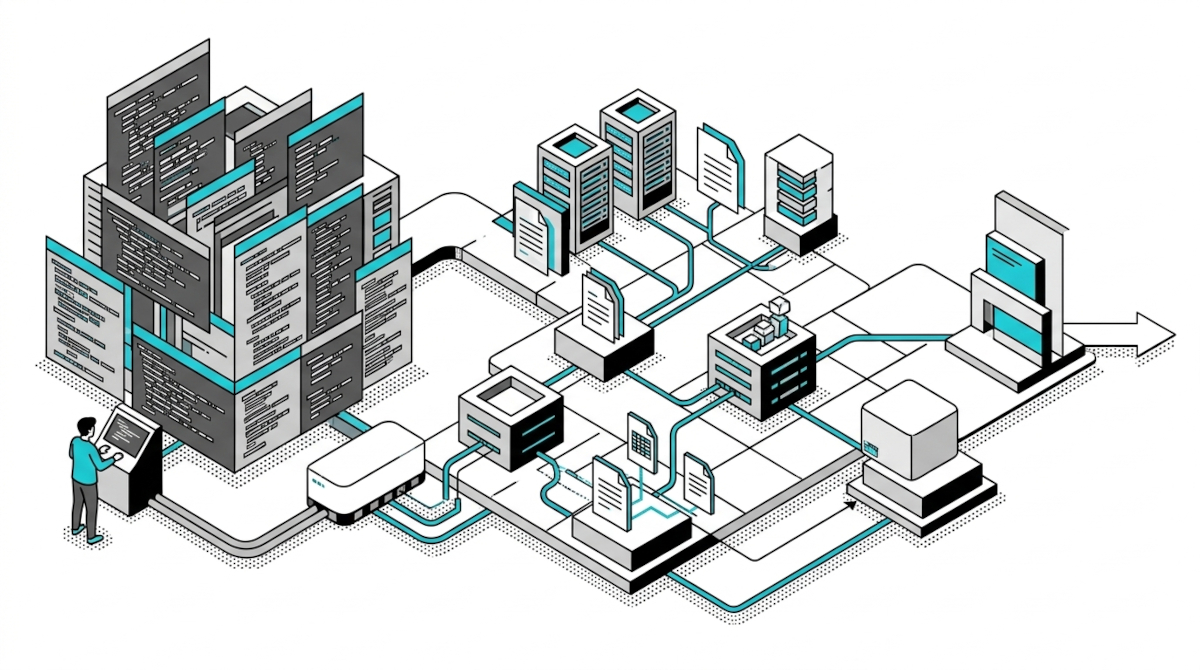
AI-assisted analysis changes the scale at which this work becomes practical. Instead of treating every source file as an isolated artifact that somebody must manually reverse-engineer, AI can help convert implementation details into structured information that can then be reviewed and connected across the wider system.
A source file can become a technical explanation. That explanation can reveal business logic, inputs and outputs, validations, dependencies, and workflow relationships. Those individual findings can then contribute to a searchable body of system knowledge that supports broader questions about architecture, impact, risk, and modernization priorities.
CodeAura is designed to support this progression through structured code documentation, pseudocode, business-logic extraction, dependency analysis, validation and error-handling documentation, complexity insights, diagrams, and an AI-powered knowledge base. The goal is to accelerate the work of discovering and organizing information that would otherwise require extensive manual investigation.
That does not mean AI should be assumed to understand every business rule perfectly without validation. A conditional can be detected in source code, but its full business significance may still require confirmation from someone who understands the process. A dependency can be identified, but the organization may need additional context to determine its operational importance. For critical and regulated systems, expert review remains an important part of the process.
The stronger model is therefore AI-assisted knowledge recovery. Automation helps surface, organize, and connect evidence from the software, while engineers, architects, business experts, and risk teams apply the context required to validate meaning and make decisions.
Recover the Knowledge Before Deciding What to Change
Once business rules, dependencies, workflows, data movement, exception behavior, and system relationships become visible, documentation begins to serve a larger purpose. It becomes an input to modernization decision-making.
Instead of asking only how an application can be migrated, teams can begin asking which components contain the most critical business logic, where the greatest concentration of dependencies exists, which workflows would create the largest downstream impact if changed, and where sensitive or regulated data is processed. They can investigate which components may be modernized independently, which behaviors must be preserved, and which areas should be simplified rather than translated into a new technology stack.
These questions move the organization beyond static documentation and toward system intelligence. The objective is no longer simply to know that a program exists or to generate a description of what it does. The objective is to connect knowledge across the application estate so teams can reason about business importance, technical relationships, operational risk, and modernization priorities.
Legacy code is therefore more than outdated technology. In many enterprises, it is also a repository of accumulated business knowledge. Before an organization rewrites, converts, migrates, or replaces that software, the knowledge embedded within it needs to be recovered and understood.
Otherwise, modernization can succeed at removing the old system while unintentionally removing part of the organization’s operational memory with it.
What does your legacy code know that your organization doesn’t?
A Legacy Knowledge Recovery Assessment can help surface business logic, dependencies, workflows, validations, and other system knowledge that may not exist in your current documentation. Share a few details about your legacy environment to identify where deeper system understanding could support your modernization planning.