Refactor, Replatform, Rewrite, Replace or Retire? How to Choose the Right Modernization Path
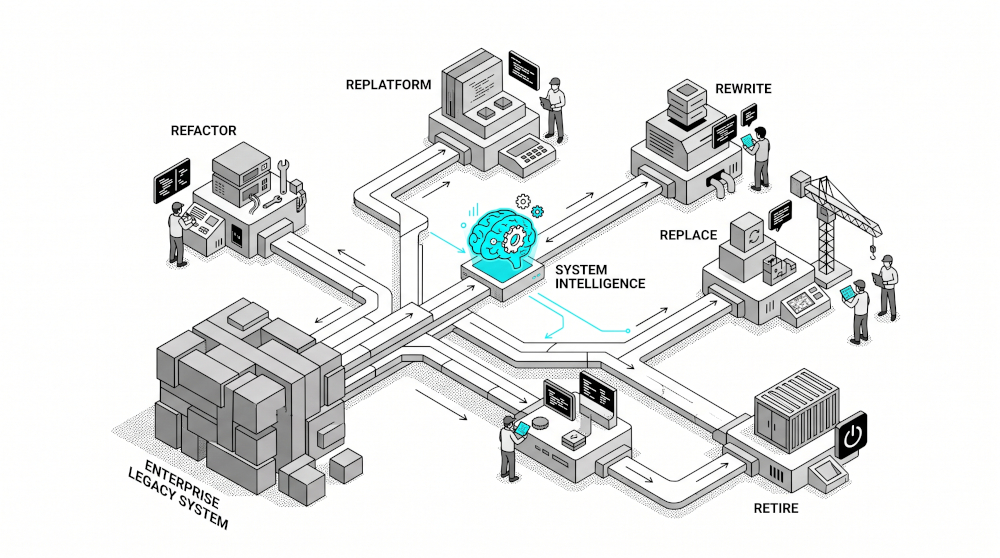
Once an organization understands what its legacy systems do and where modernization should begin, the next challenge is deciding what kind of change each component actually needs.
That decision is often oversimplified.
Legacy modernization is frequently described as if there were one obvious destination: move the application to the cloud, convert COBOL to Java, replace the monolith, or rewrite the system on a modern technology stack. In reality, large enterprise estates rarely benefit from a single treatment applied uniformly across every application and module.
Some components may need only targeted refactoring. Others may be strong candidates for replatforming. Certain applications may justify a rewrite because their architecture or maintainability constraints are too significant to address incrementally. Commercial or SaaS products may replace capabilities that no longer need to be built internally. Some systems may need to remain in place for years, while others should simply be retired.
The modernization question is therefore not only, “How do we get off this legacy technology?”
A more useful question is: what is the right transformation path for each part of the system, based on what the organization now understands about its business role, dependencies, complexity, and future value?
That distinction matters because the wrong modernization approach can reproduce the same problems in a newer environment.
Modernization Is Not a Single Technical Destination
The word modernization often creates an image of complete replacement. An aging application is transformed into something newer, cleaner, cloud-based, and easier to maintain.
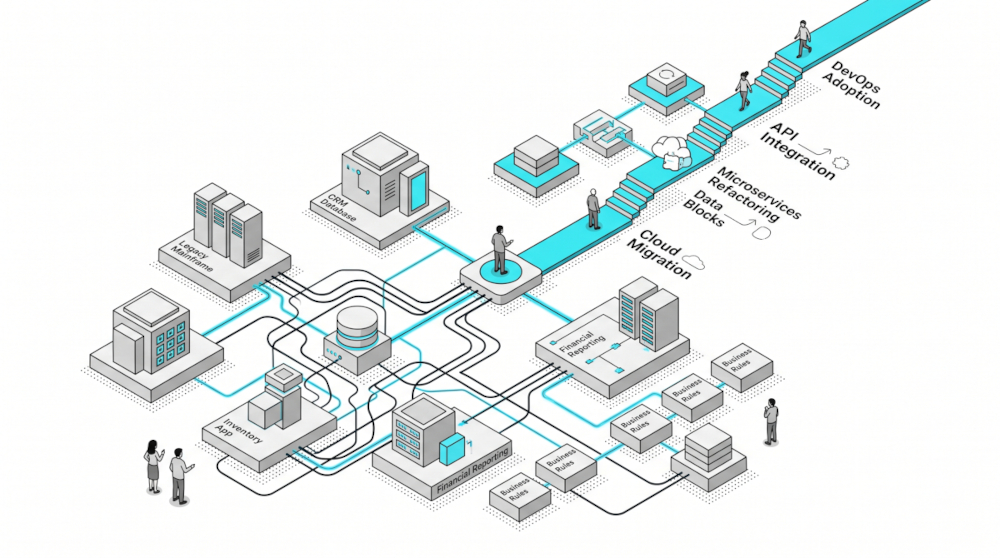
In practice, modernization is usually a portfolio of decisions rather than a single migration event.
An enterprise application may contain dozens or hundreds of components with very different characteristics. One module may implement stable business logic that has changed little in years. Another may be tightly coupled to multiple downstream systems. A third may contain functionality that the business no longer needs. A fourth may support a process that has become strategically important and now needs modern APIs, better scalability, or easier integration with analytics and AI systems.
Treating each of these components identically can create unnecessary cost and risk.
A large-scale rewrite, for example, may force teams to recreate stable functionality that does not need redesign. A direct code translation may preserve obsolete logic and architectural constraints. Replatforming can address infrastructure concerns without improving maintainability. Replacing an application with a packaged product may simplify technology ownership while introducing process changes the business is not prepared to make.
This is why a modernization strategy needs to distinguish between the technology being used and the capability being delivered.
The goal is not to make every system look modern. The goal is to choose a transformation approach that supports the future business while preserving the behavior and controls that still matter.
Refactor When the Core Logic Still Has Value
Refactoring is appropriate when the system’s core behavior remains valuable, but the implementation is difficult to maintain, extend, or integrate.
The application may still support an important business process, and its underlying logic may be well understood and trusted. The problem is that years of incremental change have made the code harder to work with. Functions may be overly complex, responsibilities may be poorly separated, interfaces may be unclear, or technical debt may make even modest changes expensive.
In this situation, throwing away the entire system can create more disruption than value.
A refactoring approach focuses on improving the internal structure of the software while preserving required external behavior. Teams may simplify logic, separate responsibilities, reduce duplication, introduce clearer interfaces, improve maintainability, or reorganize code into more manageable components.
The important prerequisite is understanding which behaviors need to remain unchanged.
Without that context, a refactoring effort can unintentionally alter business rules or remove exceptions that appear unnecessary from a purely technical perspective. This is one reason documentation and business-logic recovery should precede transformation. Teams need to know what the code represents before they decide how aggressively it can be simplified.
Refactoring is therefore not merely code cleanup. In a legacy environment, it is a controlled transformation that depends on a reliable understanding of the existing system.
Replatform When the Infrastructure Is the Primary Constraint
Replatforming becomes relevant when an application still serves the business adequately but the underlying runtime, infrastructure, operating environment, or deployment model is creating cost, scalability, support, or operational constraints.
An organization may want to move workloads away from aging infrastructure, improve deployment processes, increase resilience, or take advantage of cloud platforms without redesigning the entire application at once.
This can be a pragmatic modernization path because it limits the amount of change introduced at one time. Instead of rewriting all application logic, the organization focuses on moving the workload to a more suitable platform while preserving much of its existing behavior.
However, replatforming has limits.
Moving an application to new infrastructure does not automatically resolve tightly coupled architecture, difficult code, undocumented business rules, or poor integration patterns. If the primary modernization problem is maintainability or architecture rather than infrastructure, replatforming may improve the hosting environment while leaving the deeper constraints intact.
The key decision is therefore whether infrastructure is the dominant issue or merely one visible symptom of a more complicated problem.
System intelligence helps make that distinction clearer because it allows teams to examine not only where an application runs, but also how it behaves, what it depends on, and what other modernization constraints exist around it.
Rewrite When the Existing Structure Limits the Future State
A rewrite is a more significant decision.
It becomes relevant when the business capability remains important but the existing implementation no longer provides a practical foundation for future needs.
The architecture may be too tightly coupled to support incremental change. The programming model may make integrations unusually difficult. The application may be constrained by technologies for which the organization can no longer maintain sufficient expertise. Years of accumulated technical debt may have reached the point where continuously modifying the current implementation becomes less attractive than creating a new one.
Even then, rewriting does not mean ignoring the old system.
In fact, the more significant the rewrite, the more important it becomes to understand the system being replaced.
A new implementation needs to preserve the business behaviors that are still required while deliberately excluding those that are obsolete. That requires teams to separate essential business logic from incidental implementation detail.
This is where legacy knowledge recovery becomes particularly valuable. Business rules, validations, workflows, dependencies, inputs and outputs, and edge cases all provide evidence about the behavior that the new application may need to reproduce.
Without this knowledge, a rewrite can easily become a rediscovery project in which the team learns about hidden requirements only after the new system reaches testing or production.
A rewrite should therefore be treated as a business capability reconstruction exercise, not simply a language replacement exercise.
Replace When the Capability No Longer Needs to Be Custom
Some legacy systems exist because there was no suitable alternative when they were created.
Years later, the same business capability may be available through a commercial platform, industry solution, cloud service, or standardized enterprise product.
In these situations, replacement can be more sensible than continuing to modernize custom software.
The decision, however, depends on understanding how much business differentiation is actually embedded inside the current system.
A legacy application may appear to support a standard function, but years of customization could mean that it also implements specialized workflows, calculations, interfaces, or reporting requirements that are important to the organization. Replacing it without understanding those differences can create significant process disruption or result in expensive customization of the replacement platform.
System knowledge therefore matters even when the technical strategy is to abandon the old application.
Teams need to identify which capabilities are standard, which are truly differentiating, which integrations must be preserved, and which historical customizations no longer provide enough value to justify carrying them forward.
The question is not only whether another product can perform the same general function. It is whether the organization understands the gap between what the current system actually does and what the replacement can provide.
Retire What No Longer Creates Value
Modernization programs often focus on what needs to be transformed, but one of the most valuable decisions can be determining what should not survive the transformation at all.
Large enterprise estates accumulate applications, modules, jobs, reports, interfaces, and processes over many years. Some remain because nobody is certain whether they are still required. Others support a process that has already changed but were never formally decommissioned. Some continue running because the cost and risk of investigating them has historically appeared greater than the cost of leaving them alone.
This creates a form of technical accumulation in which organizations maintain systems because they lack enough evidence to confidently remove them.
Retirement therefore also depends on system understanding.
Before decommissioning a component, teams need to know whether other systems depend on it, whether its outputs are still consumed, whether it supports reporting or audit requirements, and whether any business process still relies on its behavior.
Dependency analysis can be particularly valuable here. A component with no meaningful downstream consumers and no active business role may be a retirement candidate. A component that appears obsolete but still feeds another process clearly requires additional investigation.
Retirement is not simply the absence of modernization. It is a deliberate modernization decision that removes unnecessary complexity from the estate.
Why Blind Code Translation Can Preserve the Wrong Things
Language conversion is one area where modernization strategy can become particularly misleading.
A transformation such as COBOL to Java can be useful when the organization has a clear reason for changing the language and understands the system being translated. The risk arises when code conversion becomes the strategy rather than one possible execution method within a broader modernization plan.
A direct translation can reproduce existing business logic, but it can also reproduce outdated structures, unnecessary complexity, obsolete workflows, and tightly coupled design decisions. The new application may use a modern language while retaining many of the characteristics that made the original difficult to maintain.
This is sometimes described informally as moving technical debt rather than resolving it.
The alternative is not to discard all existing logic. It is to understand what the logic represents before choosing what should happen to it.
Some business rules need to be preserved exactly. Others may need to be redesigned. Certain dependencies may need to be removed before conversion. A batch-oriented workflow may need to become service-based. Some programs may require translation, while adjacent components may be better refactored, replaced, or retired.
This is why modernization needs to operate at the level of systems, modules, and capabilities rather than assuming that an entire estate should follow one transformation path.
CodeAura supports legacy-to-modern migration workflows, including transformations involving technologies such as COBOL and JCL, but its stronger role is to provide the context needed before and during that transformation. Documentation, business-logic extraction, dependency analysis, system maps, and searchable knowledge help teams understand what is being changed rather than treating migration as a purely syntactic conversion problem.
The Right Modernization Path Depends on Context
There is no universally correct choice between refactoring, replatforming, rewriting, replacing, retaining, or retiring.
The right answer depends on what the component does, how important it is to the business, how tightly connected it is to other systems, how difficult it is to maintain, what future capabilities are required, and what level of operational or compliance sensitivity surrounds it.
A highly stable legacy application may remain in place while its interfaces are modernized. A tightly coupled module may need refactoring before any migration can occur. A specialized business capability may justify a rewrite, while a standard back-office function may be better replaced by a commercial platform. A system with no continuing strategic or operational value may be retired instead of modernized at all.
In many estates, multiple strategies will coexist.
That is not inconsistency. It is often a sign that the organization is treating modernization as an evidence-based portfolio decision rather than a technology mandate.
The critical requirement is context.
Teams need enough understanding of business logic, dependencies, architecture, workflows, complexity, and operational importance to know why one modernization path makes more sense than another.
This is where the progression from documentation to system intelligence becomes practical. Documentation reveals what exists. System intelligence explains how the pieces fit together. Modernization planning uses that context to decide what should change and how.
Modernize the Capability, Not Just the Code
The most important modernization decision is not which programming language should replace the old one.
It is what the organization wants the business capability to become.
Once that future state is clear, teams can determine whether the existing implementation should be improved, moved, reconstructed, replaced, integrated differently, or removed entirely.
This avoids a common modernization trap: defining success as the disappearance of an old technology rather than the creation of a more maintainable, adaptable, and understandable system.
For regulated enterprises, that distinction is particularly important. Modernization must preserve required business behavior, maintain operational continuity, support compliance expectations, and provide enough traceability for teams to understand how the future-state system relates to the one it replaces.
AI-assisted modernization can help accelerate analysis, transformation, code migration, documentation, and validation. But those activities are most effective when they are grounded in context about the existing system.
The modernization path should therefore follow a deliberate sequence: first document what exists, then understand how it behaves and what it supports, and only then determine whether each capability should be refactored, replatformed, rewritten, replaced, retained, or retired.
The goal is not to transform everything in the same way.
It is to choose the right transformation for the right part of the system.
Which modernization path fits your legacy environment?
A Modernization Readiness Assessment can help establish how business logic, dependencies, complexity, and system context should influence your transformation strategy. Share a few details about your legacy environment to start identifying which areas may require refactoring, replatforming, migration, replacement, or deeper analysis.