
Where CNPJ Hides in Your Enterprise Systems: ERP, CRM, APIs, Reports, and Legacy Code
Before You Update CNPJ Logic, Find Where CNPJ Lives
Before companies can update their systems for the alphanumeric CNPJ, they need to answer a simpler question: where does CNPJ appear today?
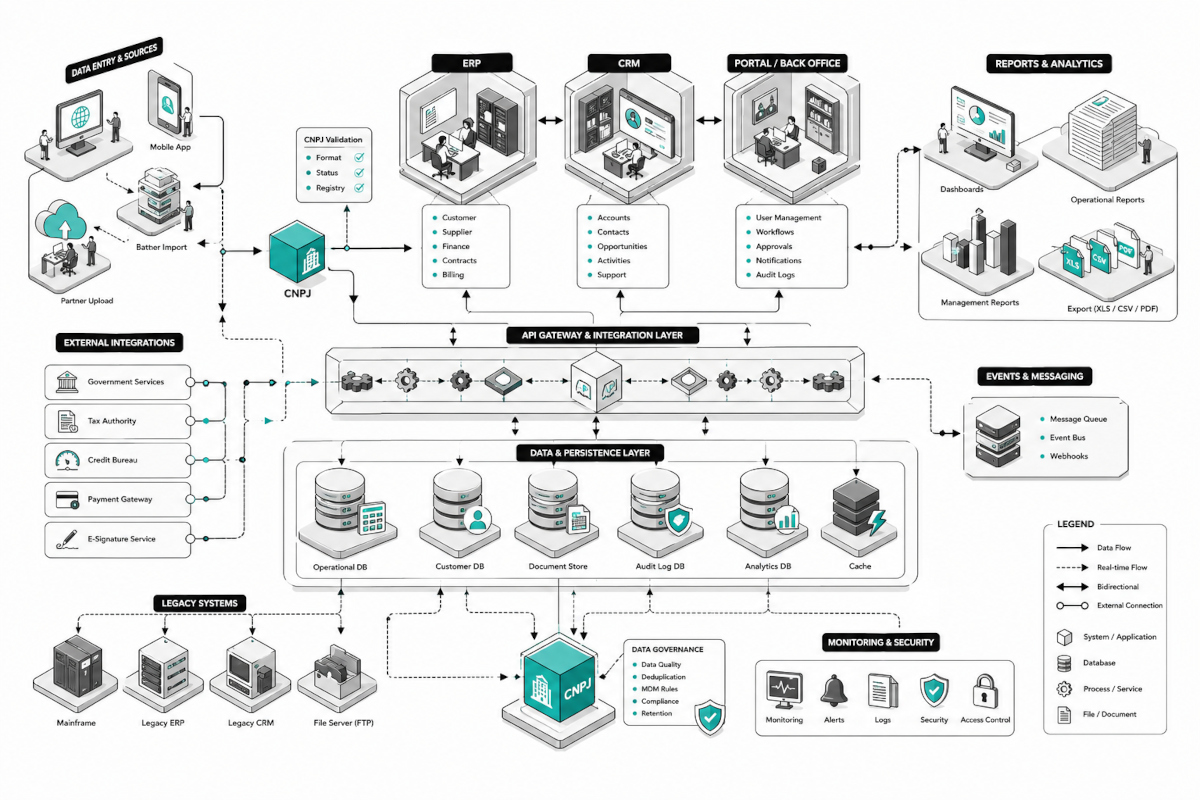
That question is harder than it sounds. In many enterprises, CNPJ is not confined to a tax registration screen or a fiscal database. Over time, it becomes part of the operational plumbing of the business. It moves through ERP records, CRM profiles, supplier onboarding flows, billing systems, customer portals, API payloads, reports, spreadsheets, data warehouses, validation routines, and legacy code.
This matters because Brazil’s Receita Federal has confirmed that the alphanumeric CNPJ will be assigned from July 2026 for new registrations, while existing numeric CNPJs will remain valid. The new format keeps 14 positions, with the first 12 positions able to contain letters and numbers and the final two verification digits remaining numeric.
For IT leaders, enterprise architects, application owners, and integration teams, the first challenge is not rewriting validation logic. It is building a reliable map of where CNPJ is stored, checked, transformed, exchanged, reported, or used as a key. Without that map, modernization work becomes guesswork.
The risk is not that every system will fail. The risk is that teams may only fix the obvious systems while hidden dependencies remain untouched. A tax platform may be ready, but a CRM field, API schema, ETL job, BI report, legacy batch process, or supplier portal may still assume that CNPJ is numeric.
That is why CNPJ readiness should begin with discovery. Before impact analysis, before remediation planning, and before code changes, organizations need visibility into where this identifier actually lives across their systems, data, integrations, and business workflows.
Why CNPJ Spreads Across Enterprise Systems
CNPJ is often treated as a tax identifier, but inside enterprise systems it usually becomes something broader: a shared business identifier.
That happens because CNPJ is useful across many operational processes. It may identify a customer, supplier, branch, legal entity, billing account, tax record, contract party, payment recipient, or reporting unit. It may also act as a matching key between systems that were never designed together but now depend on the same identifier to reconcile records.
In an ERP system, CNPJ may sit inside vendor master data, customer master data, tax tables, invoice records, branch records, and payment workflows. In a CRM, it may be used to identify corporate accounts, connect subsidiaries, validate onboarding forms, or match leads to existing customers. In procurement systems, it may help verify suppliers, route approvals, or connect purchase orders to legal entities.
The same identifier can also travel through APIs, middleware, data warehouses, spreadsheets, audit reports, and third-party platforms. A field that began as a registration number can become a search field, a reporting dimension, a validation rule, an integration attribute, or a reconciliation key.
This is why alphanumeric CNPJ readiness cannot be limited to one application owner or one fiscal system. The CNPJ may be used by tax, finance, procurement, sales, compliance, operations, data, and integration teams at the same time. Each team may see only its part of the process, while the full dependency chain remains undocumented.
The practical challenge is not only whether the enterprise can store a new alphanumeric value. It is whether every system that receives, validates, transforms, exchanges, reports, or depends on that value can continue to work as expected.
Common Places Where CNPJ Appears
In many enterprises, CNPJ appears in more places than a central tax or registration system. It often moves across business applications, technical layers, reporting environments, and older platforms that still support critical operations.
In business applications, CNPJ may appear in ERP systems, CRM platforms, procurement tools, billing and invoicing systems, customer portals, supplier portals, fiscal platforms, financial applications, compliance systems, and vendor management workflows. These systems may use CNPJ to register companies, validate suppliers, issue invoices, connect branches, manage contracts, or support tax reporting.
In the technical layer, CNPJ may be embedded in source code, database schemas, stored procedures, backend services, API definitions, middleware rules, validation libraries, regex patterns, input masks, ETL jobs, batch processes, message queues, configuration files, and logging systems. Some of these references may be obvious. Others may be buried inside older routines or shared components that multiple applications depend on.
In reporting and analytics, CNPJ may appear in data warehouses, BI dashboards, operational reports, tax reports, audit reports, CSV exports, Excel files, reconciliation workflows, and data-quality rules. Even when reports do not validate CNPJ directly, they may sort, filter, join, group, or reconcile records based on assumptions that the field is numeric.
In legacy environments, the discovery challenge can become even more complex. CNPJ may exist in COBOL programs, mainframe applications, RPG systems, Delphi applications, older Java or .NET platforms, PHP systems, fixed-width files, flat files, fiscal integrations, and hard-coded validation routines. These environments often contain long-standing business rules that are poorly documented but still operationally important.
The main point is simple: CNPJ is not only a data field. In many organizations, it is a dependency. Until teams know where that dependency exists, they cannot accurately assess the impact of the alphanumeric format.
Why Discovery Is Not Just Keyword Search
Finding CNPJ usage is not as simple as searching for cnpj across repositories.
In real enterprise environments, the same concept may appear under many different names. A database column may be called tax_id. An API field may use taxIdentifier. A supplier workflow may refer to supplier_document. A legacy file layout may call it num_inscricao. A shared validation library may use cpf_cnpj, while a reporting model may call it federal_id, company_id, documento, documento_fiscal, cadastro_nacional, or id_empresa.
That naming inconsistency matters. A basic keyword search can find obvious references, but it can miss fields, routines, mappings, and dependencies that perform the same business function under different technical names.
CNPJ may also appear outside application code. It can be embedded in configuration files, database schemas, stored procedures, API specifications, test scripts, documentation, old tickets, batch jobs, file layouts, data mappings, interface contracts, and comments. Some references may validate the format directly. Others may transform the value, join it to another table, send it to a third party, mask it for display, or cast it into a numeric type.
The harder cases are often not the visible fields. They are the hidden assumptions: a database column defined as numeric, an ETL step that removes non-digits, a regex that accepts only numbers, a fixed-width file that assumes a numeric layout, or an API schema that treats CNPJ as a digit-only string.
That is why CNPJ Discovery needs to look across systems, code, data, integrations, and workflows. The goal is not only to find the word “CNPJ.” The goal is to find every place where the enterprise stores, validates, transforms, exchanges, or depends on the identifier.
What Can Go Wrong If Discovery Is Incomplete
Incomplete CNPJ discovery does not always create a visible failure at the point of entry. Often, the first system accepts the value, but a downstream dependency breaks later.
A customer onboarding form may accept an alphanumeric CNPJ, but the CRM may reject the record because its validation rule still expects digits only. An ERP may store the value correctly, but an invoicing integration may fail when it sends the CNPJ to a fiscal platform with a stricter schema. A supplier portal may capture the new format, while a legacy batch job rejects the same supplier record overnight.
Data pipelines can create another class of problems. A database field defined as numeric may strip letters or reject the value entirely. An ETL process may cast CNPJ as a number. A reconciliation workflow may remove non-digit characters. A BI dashboard may break because it groups, filters, or joins records based on numeric assumptions.
APIs and integrations are especially important. An internal API may define CNPJ as a string but still apply a digit-only regex. A third-party service may receive a payload that no longer matches its expected format. A message queue may pass the value successfully, while the consuming application fails when it tries to validate or transform it.
Legacy environments can be harder to diagnose. Older COBOL, RPG, Delphi, Java, .NET, PHP, mainframe, or fixed-width file processes may contain hard-coded assumptions that are not documented anywhere else. These routines may continue to work for existing numeric CNPJs, which makes the issue easy to miss until a new alphanumeric CNPJ enters the process.
The lesson is practical: the risk is not that every system will fail at once. The risk is that an organization updates the obvious systems but misses the hidden dependencies that keep customer, supplier, billing, reporting, and compliance workflows running.
Discovery Before Analysis or Code Changes
Teams should not jump directly into code changes before they know the scope of CNPJ usage.
The first step is discovery: creating a reliable map of where CNPJ exists, how it moves, and which systems depend on it. Without that map, impact analysis is incomplete. Development teams may update a validation rule in one application while missing a database constraint, API schema, ETL transformation, report filter, or legacy routine somewhere else.
A proper CNPJ discovery process should answer practical questions:
- Where is CNPJ stored?
- Where is it validated?
- Where is it transformed?
- Where is it exchanged with other systems?
- Where is it used as a key for matching, reporting, reconciliation, or search?
- Which systems are business-critical?
- Which integrations involve external vendors, banks, fiscal platforms, customers, or suppliers?
- Which areas contain hard-coded numeric assumptions?
- Which teams or vendors own each affected system?
These questions matter because alphanumeric CNPJ readiness is not only a development task. It is an enterprise coordination task. ERP owners, CRM teams, data teams, integration teams, finance systems owners, compliance stakeholders, and legacy-system managers may all own part of the dependency chain.
Discovery also helps prioritize the work. Not every reference to CNPJ carries the same risk. A display-only report may require a different response than a payment workflow, supplier onboarding process, tax-reporting integration, or customer master data service. The purpose of discovery is to separate low-impact references from systems that can affect operations, reporting, compliance, or external transactions.
This is where system understanding becomes the foundation for modernization. Before teams decide what to remediate, rewrite, refactor, or test, they need a clear view of the current-state environment. For the alphanumeric CNPJ, that means knowing where the identifier appears across code, data, integrations, applications, and business workflows.
How CodeAura Helps with CNPJ Discovery
CodeAura’s Discovery package is designed for this first step: helping teams understand where CNPJ appears across their enterprise environment before they begin remediation.
For the alphanumeric CNPJ, discovery needs to reach beyond the obvious application screens. CodeAura can help teams examine source code, repositories, configuration files, databases, documentation, APIs, technical workflows, legacy systems, business logic, and integration points to identify where CNPJ is stored, validated, transformed, exchanged, or used as a dependency.
This matters because many CNPJ assumptions are not documented in architecture diagrams or system inventories. They may be buried in validation routines, database fields, stored procedures, API schemas, ETL logic, batch jobs, mainframe programs, file layouts, or older custom applications. CodeAura helps turn those hidden references into structured knowledge that technical and business teams can review.
The broader value is system understanding. CodeAura analyzes complex software systems, generates documentation, extracts business logic, produces system maps and diagrams, and supports searchable knowledge bases for technical and non-technical stakeholders. That makes it relevant when organizations need to understand legacy code, expose dependencies, preserve institutional knowledge, and prepare for modernization with greater control.
For CNPJ readiness, this means the organization can move from scattered assumptions to a clearer system map:
- Where does CNPJ appear?
- Which systems validate it?
- Which integrations exchange it?
- Which workflows depend on it?
Which legacy routines assume it is numeric?
- Which teams or vendors need to be involved?
That clarity should come before impact analysis, development planning, vendor coordination, and testing. The alphanumeric CNPJ change is not only a format update. It is a reason to recover visibility into how a critical business identifier travels through the enterprise.