
The deadline is real, but the work is manageable
The alphanumeric CNPJ is coming in July 2026. The organizations that prepare successfully will not be the ones that wait for a production issue, a rejected invoice, a failed supplier registration, or an integration error. They will be the ones that map their systems early, understand where CNPJ appears, assess which workflows are exposed, and update the right components before the deadline.
This change is not limited to whether one application can accept letters in a CNPJ field. The new format keeps the 14-position structure, allows letters and numbers in the first 12 positions, and keeps the final two verification digits numeric, while existing numeric CNPJs remain valid. That means companies need to support both the current and future formats across systems, data flows, integrations, reports, and business processes.
For CIOs, CTOs, ERP owners, tax technology leaders, and modernization teams, the practical question is simple: what needs to happen between now and July 2026? The answer is a phased roadmap: establish ownership, discover where CNPJ exists, analyze the impact, prioritize risk, make the required code and configuration changes, test end-to-end workflows, coordinate vendors, and prepare the business for operational use.
Alphanumeric CNPJ readiness is manageable, but it should not be treated as trivial. Like many changes to fiscal and operational infrastructure, the risk is not only in the visible form field. It is in the hidden validation rule, the database constraint, the batch job, the ERP customization, the API schema, the reporting pipeline, or the vendor integration that still assumes CNPJ is numeric-only.
Why CNPJ readiness needs a roadmap
CNPJ readiness is not a single task. It is a sequence of decisions, discoveries, updates, tests, and operational changes that need to be coordinated across technology and business teams.
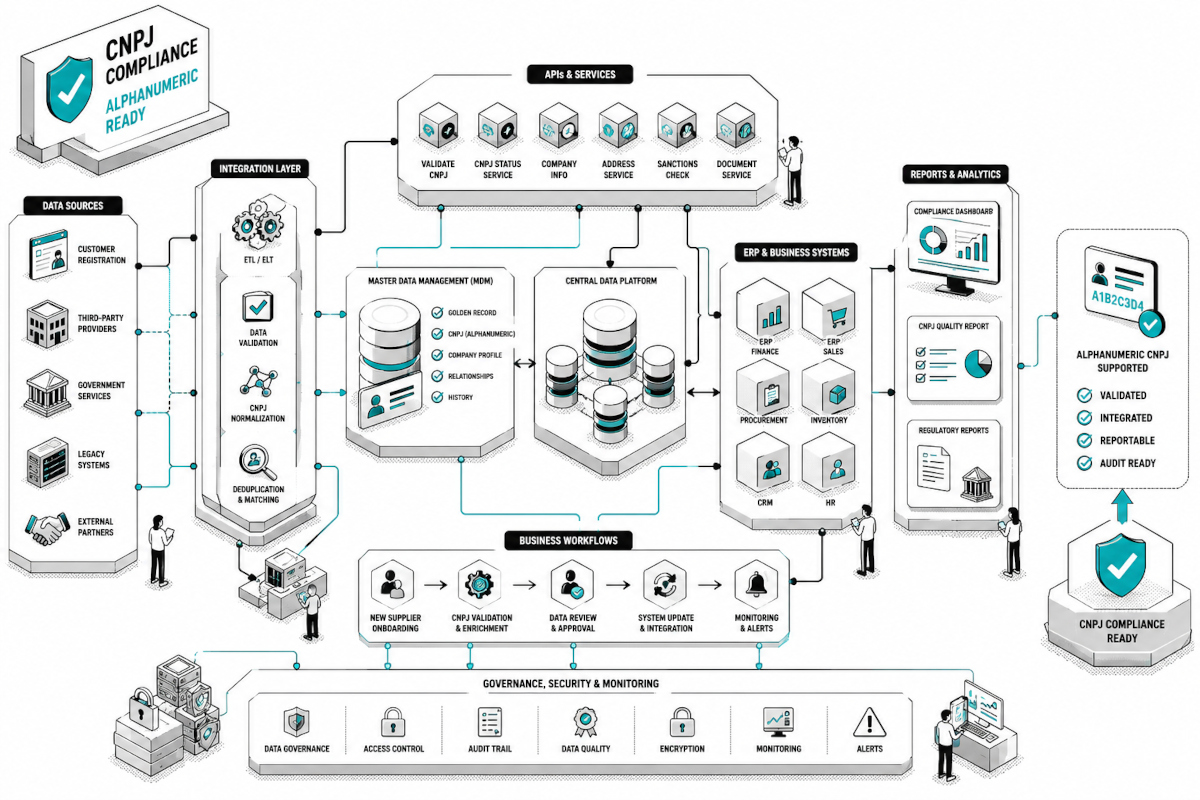
In many companies, CNPJ appears far beyond the obvious registration screen. It may exist in ERP modules, CRM records, supplier portals, customer onboarding workflows, billing systems, tax integrations, payment processes, reports, APIs, data warehouses, ETL jobs, configuration files, test suites, and legacy batch jobs. It may also be embedded in validation routines, database constraints, input masks, search logic, matching rules, reconciliation processes, and vendor file layouts.
Without a roadmap, organizations risk solving only the visible part of the problem. A team may update a frontend field but miss a backend validation rule. An ERP owner may update a configuration but leave an integration mapping unchanged. A database column may accept the new value, while a report, API, fiscal connector, or downstream data pipeline still expects numbers only.
That is why readiness should be treated as a coordinated system and business initiative, not an isolated technical patch. The goal is to move from uncertainty to control: identify where CNPJ exists, understand what each reference does, prioritize the highest-risk systems, remediate the right components, and validate complete business workflows before production.
For regulated and operationally complex enterprises, this approach is especially important. A CNPJ issue can affect invoicing, supplier onboarding, customer records, tax reporting, procurement, accounts payable, accounts receivable, and external integrations. The earlier the organization creates a structured roadmap, the easier it becomes to plan resources, involve vendors, protect business continuity, and avoid last-minute remediation.
Phase one: establish ownership and discover where CNPJ exists
The first step in CNPJ readiness is ownership. Before teams begin changing fields, validation rules, or API schemas, the organization should decide who is accountable for the readiness effort and which systems, processes, and vendors are in scope.
For many enterprises, this should not sit with one developer or one application team. CNPJ touches business identity, tax workflows, customer and supplier records, invoicing, procurement, finance operations, reporting, and integrations. A practical working group may include IT leadership, application owners, ERP owners, tax technology teams, finance operations, procurement, customer operations, QA, data teams, compliance stakeholders, and external vendors.
The group should answer several questions early:
Who owns CNPJ readiness? Which systems are in scope? Which business processes are most exposed? Which vendors need to confirm support for the new format? What internal readiness date should the company target before July 2026?
Once ownership is clear, discovery can begin. This is where many organizations underestimate the work. CNPJ may appear in source code, databases, APIs, ERP modules, CRM systems, supplier portals, customer onboarding platforms, billing systems, fiscal integrations, reports, ETL jobs, data warehouses, batch jobs, legacy systems, configuration files, documentation, and test suites.
The goal of discovery is not only to find fields named “CNPJ.” Teams also need to identify where CNPJ is stored, validated, formatted, transformed, exchanged externally, used in reports, or used as a matching key. A value that looks like a simple business identifier in one application may become a technical dependency in another.
This is where CodeAura’s Discovery package fits naturally. CodeAura helps teams identify where CNPJ appears across systems, codebases, databases, APIs, integrations, reports, and workflows. For organizations with legacy systems or limited documentation, that discovery work creates the visibility needed before remediation begins.
Skipping this phase creates avoidable risk. Teams that jump directly to code changes may fix the most visible application while leaving hidden dependencies untouched. A stronger approach starts with a full map of where CNPJ exists, then uses that map to guide analysis, prioritization, and implementation.
Phase two: analyze impact and prioritize risk
After discovery, the next step is to determine which CNPJ references actually matter and what kind of change each one requires. Not every occurrence has the same level of risk. A reference in outdated documentation is different from a validation function used by every customer onboarding workflow. A report label is different from an API schema that rejects alphanumeric values.
Impact analysis should separate simple references from functional dependencies. Teams should look closely for numeric-only fields, hard-coded masks, old regex patterns, check-digit validation functions, API schemas, database constraints, ETL transformations, ERP customizations, fiscal integrations, legacy batch jobs, BI dependencies, and manual processes that assume CNPJ is numeric-only.
This analysis should also consider how CNPJ moves across the enterprise. A value may be accepted correctly in one system, then fail when passed to another. It may be stored correctly in a database, then lose formatting in a data pipeline. It may appear valid in an application, then be rejected by an ERP integration, tax engine, or third-party provider.
Prioritization should be based on business and technical risk. High-priority systems are usually those with high transaction volume, tax or fiscal relevance, customer or supplier impact, external exposure, integration complexity, legacy complexity, vendor dependency, or difficult testing requirements. These are the systems that should move first in the remediation plan.
This is where CodeAura’s Analysis package becomes important. CodeAura helps teams assess impact, identify technical risk, prioritize affected systems, define testing requirements, and create a remediation plan. For complex environments, especially those with undocumented systems or legacy code, this analysis helps teams move from a long list of CNPJ references to a practical, risk-based action plan.
The goal is not to treat every system equally. The goal is to understand which systems could break critical workflows, which changes are straightforward, which require deeper investigation, and which depend on vendors or external partners. A strong analysis phase turns discovery data into a clear remediation strategy.
Phase three: define and implement the remediation backlog
Once the organization understands where CNPJ appears and which systems carry the highest risk, the next step is to turn analysis into a concrete remediation backlog. This is where readiness becomes execution.
The backlog should be specific enough for engineering, ERP, data, QA, and vendor teams to act on. Common remediation items may include changing CNPJ fields from numeric to text where needed, updating regex rules, revising input masks, modifying check-digit validation logic, normalizing uppercase and lowercase handling, updating API schemas, changing database constraints, adjusting ERP customizations, updating fiscal integrations, revising data pipelines, refreshing reports, updating test data, and correcting documentation.
The sequencing matters. High-risk systems should move first, especially those connected to tax reporting, invoicing, supplier onboarding, customer registration, payment flows, external APIs, ERP integrations, and high-volume operational workflows. Lower-risk reports, internal screens, or archival references may follow after the critical transaction paths are under control.
Implementation should also be controlled. CNPJ changes should go through version control, code review, regression testing, deployment planning, and documentation updates. A change to one validation function or shared library may affect many applications, so teams need to understand dependencies before promoting updates across environments.
This is where CodeAura’s Code Changes package fits into the roadmap. CodeAura helps support updates to validation logic, masks, schemas, field handling, APIs, tests, and affected code paths. In complex enterprise environments, this work may involve frontend form updates, backend services, shared libraries, database migration scripts, ERP configuration, integration mappings, legacy code, batch jobs, and monitoring logic.
The purpose of the remediation backlog is not just to list tasks. It is to create a controlled path from impact analysis to production readiness. By linking each remediation item to a system, workflow, owner, risk level, test case, and deployment plan, organizations can move toward July 2026 with clarity instead of scattered last-minute fixes.
Phase four: test end-to-end workflows and coordinate vendors
Testing should not stop at a single form, field, or validation function. A system may accept an alphanumeric CNPJ correctly at the point of entry but fail later in an invoice workflow, ERP integration, API payload, data warehouse load, report, or vendor platform. Readiness depends on proving that the full business process works from beginning to end.
Test scenarios should cover workflows such as customer onboarding, supplier registration, branch registration, invoicing, accounts payable, accounts receivable, tax reporting, payment processing, ERP integrations, CRM synchronization, CSV imports and exports, data warehouse loads, BI dashboards, legacy batch jobs, and third-party fiscal integrations.
The test data should include both existing numeric CNPJs and valid alphanumeric CNPJs. It should also include invalid check digits, formatted and unformatted values, lowercase input, special characters, leading zeros, API request and response payloads, reporting outputs, and reconciliation scenarios. The goal is to confirm that the new format works without breaking support for the numeric CNPJs already in use.
Vendor coordination should run in parallel with internal testing. Many enterprises depend on ERP vendors, fiscal software providers, tax engines, payment providers, supplier portals, customer data providers, API partners, outsourced IT providers, BPO providers, and compliance platforms. A company may modernize its own systems and still face production issues if an external provider is not ready.
Teams should ask vendors direct questions: When will your system support alphanumeric CNPJ? Do your APIs and file layouts support both numeric and alphanumeric values? Is your validation logic aligned with Receita Federal guidance? Do you support formatted and unformatted values? Is there a homologation or test environment? What version, configuration, or contract update is required? What is your support timeline?
This phase turns technical remediation into business confidence. The organization is not only checking whether code changes compile or unit tests pass. It is verifying that customers, suppliers, invoices, reports, integrations, and operational teams can continue to function correctly when the new format enters real workflows.
Phase five: operationalize readiness before and after rollout
Technical readiness means the system can process the new CNPJ. Operational readiness means the business can use it correctly.
Before July 2026, companies should prepare the teams and processes that will handle CNPJ in daily operations. Finance, tax, procurement, customer support, supplier management, sales operations, compliance, and shared services may all need updated procedures. That includes data-entry guidance, onboarding instructions, exception handling, internal FAQs, validation documentation, audit procedures, and support paths for rejected records or integration failures.
A readiness review should happen before production rollout. The review should confirm that affected systems have been identified, high-risk components have been updated, validation logic supports the new format, databases can store alphanumeric values, APIs accept and return correct values, reports preserve the identifier correctly, business workflows have been tested, vendors have confirmed readiness, users have been trained, and rollback or exception processes are in place.
After rollout, monitoring becomes essential. Even strong test coverage may miss edge cases in production, especially across vendor integrations, legacy batch jobs, fiscal workflows, and manual exception paths. Teams should monitor validation failures, API errors, rejected customer or supplier registrations, invoice issues, failed batch jobs, data pipeline errors, reporting mismatches, manual corrections, support tickets, and vendor integration problems.
This is also where CodeAura’s broader modernization role becomes relevant. In complex environments involving legacy applications, ERP customizations, mainframes, fiscal integrations, vendor dependencies, and enterprise-specific workflows, readiness may require more than a standard remediation path. CodeAura’s Custom support can help organizations address the parts of the environment that do not fit neatly into a simple checklist.
The strategic takeaway is straightforward: alphanumeric CNPJ readiness is a roadmap, not a one-off patch. Enterprises should discover where CNPJ exists, analyze the impact, update the right systems, test end-to-end workflows, coordinate vendors, and prepare the business before July 2026. CodeAura helps teams move through that roadmap with the visibility, analysis, and implementation support needed to make the change with greater control.